

SEO Article Automation for Agencies
Build an agency article workflow with separate client context, clear approvals, reliable publishing, and reporting that connects content quality to business goals.
This guide sits in the AI SEO Automation topic cluster as a supporting resource.
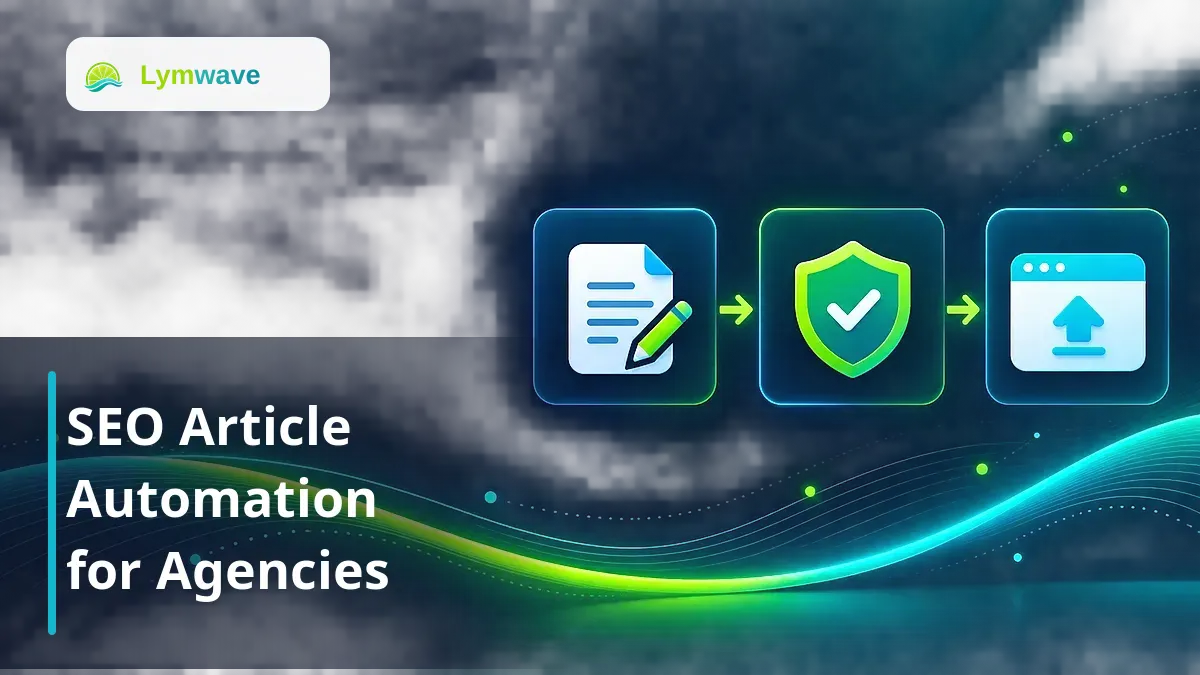
SEO article automation for agencies connects client research, briefs, drafting, review, publishing, and reporting in a repeatable workflow. Automate preparation and delivery while keeping named people responsible for client facts, editorial decisions, and publication approval. The useful outcome is a dependable service your team can supervise across accounts.
For agency owners and content marketers serving SaaS founders or small businesses, the difficult part is often the handoff. A draft waits for feedback, a client changes an offer, or an editor discovers that an article uses another account's terminology. This guide shows how to design around those problems before increasing production.
Define the service before choosing automation
Start with what the client is buying: useful articles supporting a particular audience, offer, and business objective. Specify the deliverables, review responsibilities, publishing destination, and reporting cadence. A monthly article allowance alone leaves too much room for disagreement about research depth and revisions.
Separate the repeatable process from the information unique to each account. Your agency can reuse a brief template and publishing checklist. Each client still needs its own source material, positioning, examples, and approval rules.
| Stage | Repeatable agency process | Client-specific decision |
|---|---|---|
| Planning | Collect questions and inspect existing pages | Which audience and offer deserve attention |
| Briefing | Record intent, evidence, and proposed links | Which facts and examples are approved |
| Drafting | Produce a first draft and metadata | What experience makes the answer useful |
| Review | Check claims, readability, and preview | Who approves the final version |
| Delivery | Publish approved content and verify the URL | Which account, site, and date apply |
If your production problem is slow approval, generating more drafts adds work to the queue. Fix the handoff first. The agency blog strategy guide can help connect these stages to your service offering.
Keep each client's context separate
Maintain a compact reference for every client. Include the audience, actual services, preferred terminology, approved product documentation, brand examples, relevant website pages, and claims that require explicit confirmation. Name an owner and record when the reference was last checked.
Keep source notes attached to the correct account and article. A generic agency folder is easy to search but makes it harder to see whether a price, capability, or customer example belongs to the current client. Remove unnecessary personal information from interview notes before using them in a drafting workflow.
For example, imagine an agency working with two hypothetical scheduling software companies. One serves individual consultants; the other serves teams coordinating shared equipment. Both might discuss appointment scheduling, but their buyers, constraints, and examples differ. Replacing the company name in a shared article would erase the reason a reader should trust either page.
When the client changes a feature or policy, update its reference and identify affected briefs and published pages. Treat that change as maintenance work with an owner. Leaving an old brief in the queue can reintroduce a claim that an editor already corrected elsewhere.
Build a workflow with explicit approval gates
1. Choose an article's job
Before drafting, define the reader's question and the page's purpose. Check whether an existing article or service page already answers that question. Decide whether to create something new, improve an existing page, or decline the idea.
Use the client's sales questions, support themes, site inventory, and available search data as inputs. Give priority to topics the client can answer credibly and connect to a relevant next step. A keyword list becomes useful only after these decisions.
2. Prepare a brief the reviewer can approve
A brief should contain one audience, one primary question, the proposed answer, supporting sources, internal links, and a clear boundary around unknown information. Record who will supply missing evidence before a draft is scheduled.
Ask the client to approve business facts and positioning at this stage. Editors can then focus on clarity and evidence without reopening the strategy in every paragraph. Use the agency content brief guide to make this handoff consistent.
3. Generate a draft from approved inputs
Have the drafting workflow use the agreed brief and current client reference. Where evidence is missing, request a question for the reviewer or remove the claim. Plausible wording is insufficient support for a feature, customer result, guarantee, or comparison.
Add something the client can substantiate: an explanation of its process, an original example, a product screenshot, or an expert's practical observation. Label hypothetical examples clearly so readers do not mistake them for customer evidence.
4. Review the exact publishable version
Assign an agency editor to check the answer, sources, tone, internal links, metadata, and image. Assign a client approver where the service agreement requires one. Make approval apply to a specific version, including its title and commercial claims.
If a substantive revision changes that version, send it through review again. An earlier approval should not silently authorize a rewritten comparison or new product promise. When approval misses the planned date, hold the article and resolve the delay with the account owner.
5. Publish and verify delivery
Before delivery, confirm the client account, destination site, article version, and scheduled time zone. Preview the page for headings, images, links, and mobile readability. After publishing, open the resulting URL and confirm that the intended article is accessible.
Plan how failed deliveries are handled. Record the destination URL or identifier before retrying so a timeout does not become a duplicate post. Name the person who can correct or unpublish an article when the wrong version reaches the site.
Evaluate tools with a real client handoff
Compare automation systems using one representative article from brief to published preview. Include the account manager and editor in the evaluation. A polished generated draft reveals little about how the service handles feedback, permissions, or a failed delivery.
Ask the vendor to demonstrate account separation, where source material is stored, how approvals are recorded, and what happens when an approved draft changes. Confirm which publishing destinations and export formats are supported in the plan you are considering.
Then test an exception: withhold a required fact, request a revision, or simulate a disconnected publishing destination in a safe test environment. Check whether the system stops clearly, preserves the work, and gives someone an actionable next step.
Calculate cost per approved article using research, editing, client communication, publishing, and rework time alongside software charges. A lower draft-generation cost can be outweighed by extensive corrections. Set your own acceptance criteria before the pilot so the decision is based on the workflow your agency needs.
If Lymwave is on your shortlist, bring the same client brief and destination requirements to your evaluation. Use the checklist above to verify fit for your service rather than assuming every agency process works the same way.
Run a small pilot before expanding
Choose one willing client, one topic group, and a small batch your editor can inspect closely. Agree on who supplies facts, who approves content, and how missing feedback affects the schedule. The following four-week sequence is a suggested pilot, not a promised time to SEO results.
During week one, assemble the client reference, inspect existing pages, and approve the first briefs. Record current production effort so you have a baseline for comparison.
During week two, draft and review the first articles. Track the reasons for revisions: missing evidence, unclear positioning, tone, or incorrect links. Fix the recurring input problem before generating the next batch.
During week three, publish approved articles and inspect the live pages. Test how the team handles a correction and confirm that published URLs flow into the reporting process.
During week four, review production effort and quality with the client. Decide whether to expand, adjust the brief, or keep the batch small. The 30-day content planning guide can help organize the calendar around actual review capacity.
Support SEO, AEO, and GEO with clear answers
Search engine optimization helps people discover relevant pages through search. Answer engine optimization emphasizes direct, understandable answers. Generative engine optimization concerns visibility in generated answers. For an agency, these goals share useful editorial habits: specific questions, supported explanations, clear entities, and pages that readers can navigate.
Google says generative AI can help with research and structure, while generating many pages without user value may violate its scaled content abuse policy. Its guidance also calls for accuracy in titles, descriptions, structured data, and image descriptions. Apply the same review standard to those fields as to the article body. Google's generative AI content guidance.
Open with a concise answer, explain important terms, and add examples that clarify the client's expertise. Keep structured data consistent with visible content. Google says its AI search features do not require special schema or additional optimizations beyond the relevant search foundations; inclusion is not guaranteed. Google's guidance on AI features.
Use the SEO, AEO, and GEO article checklist during review. Avoid selling markup or article volume as a guarantee of rankings or AI citations.
Measure quality, delivery, and business contribution
Keep reporting specific to each client. Track approved and published articles, review time, revision reasons, and delivery failures. These operational signals show whether automation is creating a sustainable service.
For search performance, review page and query trends over comparable periods and record publication or revision dates. For business contribution, agree on meaningful actions such as qualified inquiries or relevant demo requests. Explain attribution limits when several channels or website changes could affect the result.
Use findings to make a decision. Repeated factual corrections call for better source material. A growing approval queue calls for a smaller batch or clearer responsibility. Visits from unrelated questions call for an intent review. Record the next action and owner in the report so measurement changes the next cycle.
Frequently asked questions
Can an agency reuse the same article across clients?
Reuse the workflow and brief structure. Each article should answer that client's audience with relevant evidence, examples, and positioning. Changing company names in otherwise identical copy offers little reason for readers to choose either page.
Should clients approve every AI-assisted article?
Agree on approval requirements before production. Keep a named agency editor responsible for every article, and involve the client for business facts or claims that require its judgment. Hold publication whenever required approval is missing.
How many articles should an agency automate first?
Start with a batch small enough to review completely. Expand when source material is reliable, revisions are manageable, and publishing checks work consistently. Let review capacity and reader value determine volume.
What is the best sign that the pilot is working?
Your team can deliver useful, approved articles with understandable effort and fewer recurring handoff problems. Search and business results require continued observation. Use the pilot to establish a reliable process before committing clients to a larger schedule.
Useful next reads
AI SEO Automation Guide: How to Build a Content Engine That Publishes Consistently explains practical SEO, AEO, and GEO workflows for planning, publishing, measuring, and improving useful content consistently.
How to Create a 30-Day SEO Content Plan with AI explains practical SEO, AEO, and GEO workflows for planning, publishing, measuring, and improving useful content consistently.
How to Optimize Blog Posts for SEO, AEO, and GEO explains practical SEO, AEO, and GEO workflows for planning, publishing, measuring, and improving useful content consistently.
Turn this into a working content system
Audit your content, find AI visibility gaps, and build a publishing workflow that compounds.