

AI SEO Automation Guide: How to Build a Content Engine That Publishes Consistently
AI SEO Automation Guide: How to Build a Content Engine That Publishes Consistently explains practical SEO, AEO, and GEO workflows for planning, publishing, measuring, and improving useful content consistently.
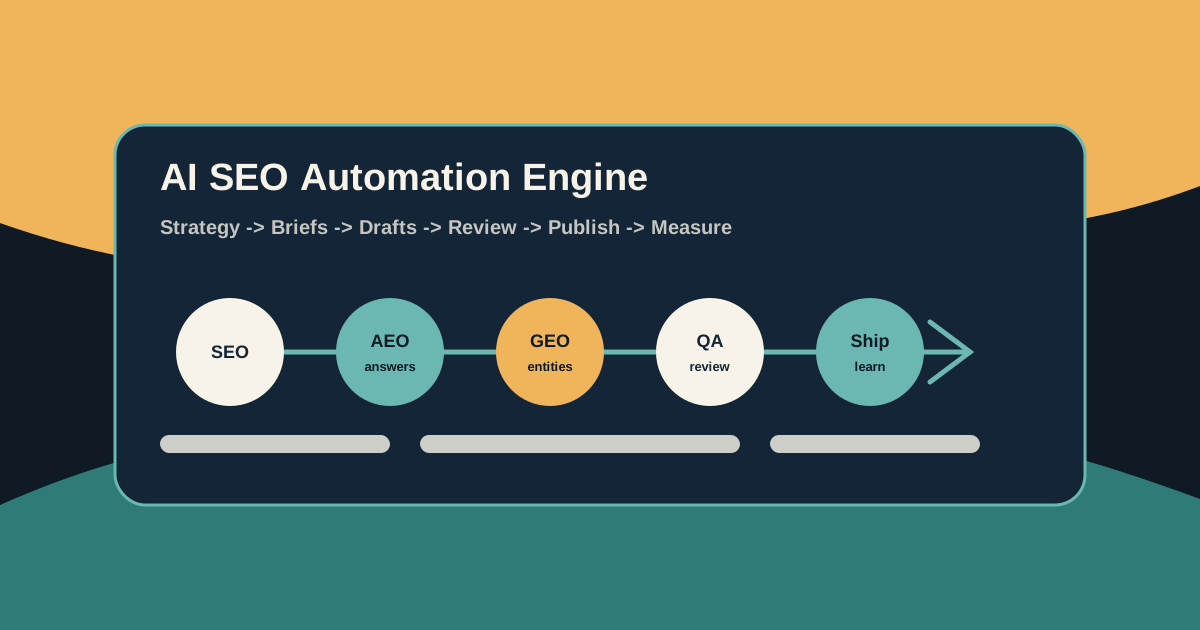
This guide sits in the AI SEO Automation topic cluster as a pillar resource.
The complete guide to ai seo automation guide how to build a content engine that publishes consistently
Consistent publishing is not a volume problem first. It is an operating system problem. Most teams already have ideas, customer questions, product expertise, and a backlog of pages they would like to ship. What they lack is a repeatable way to turn those inputs into useful articles that answer search intent, support answer engines, build entity coverage, and move through review without getting stuck.
This AI SEO automation guide how to build a content engine that publishes consistently explains how to design that operating system. The goal is not to let software spray generic posts across a blog. The goal is to combine AI SEO automation, editorial judgment, structured data, and measurement so every post has a clear job.
Quick answer: build a consistent content engine by separating strategy, briefs, drafting, SEO review, AEO review, GEO review, human editing, publishing, and measurement into repeatable stages. Use automation for research organization, draft assembly, link checks, schema preparation, and quality scoring. Keep humans responsible for positioning, claims, examples, product accuracy, and final approval.
For SaaS founders, small business owners, and content marketers, the practical value is reliability. A good AI content workflow makes it easier to publish without forgetting metadata, skipping internal links, repeating thin explanations, or losing track of what each post should accomplish. A good workflow also creates audit trails: which keyword the post targets, which audience it serves, which entities it covers, which questions it answers, and which signals indicate that it should be improved.
The strongest automated SEO content programs share a few traits:
| Capability | What it prevents | What it improves |
|---|---|---|
| Structured briefs | Random topic selection | Search intent and topical focus |
| Entity mapping | Thin or generic copy | GEO and topical authority |
| Answer blocks | Slow introductions | AEO and featured-snippet readiness |
| Human review | False claims and brand drift | Trust and conversion quality |
| Measurement loops | Publishing without learning | Refresh priorities and compounding gains |
This guide focuses on building the engine behind the content, not chasing a single prompt. Prompts help, but the durable advantage is a system that can repeatedly produce useful work.
What is ai seo automation guide how to build a content engine that publishes consistently?
AI SEO automation is the use of AI-assisted workflows to plan, create, optimize, publish, and improve content for organic discovery. It connects traditional SEO work, such as keyword mapping and metadata, with answer engine optimization and generative engine optimization. In plain terms, it helps a team create content that can be found, understood, quoted, and trusted by both search engines and AI systems.
An AI SEO automation guide how to build a content engine that publishes consistently should cover more than drafting. Drafting is only one stage. A real content engine includes:
- a topic strategy that defines which clusters matter
- a brief template that captures intent, audience, entities, and conversion role
- a drafting workflow that uses the brief instead of inventing a direction
- an editorial checklist for accuracy, tone, differentiation, and examples
- SEO checks for titles, descriptions, headings, canonical paths, and links
- AEO checks for short answers, FAQs, definitions, and direct explanations
- GEO checks for entity clarity, citation-friendly summaries, and consistent brand context
- publishing steps for Markdown, CMS, GitHub, WordPress, or another destination
- measurement steps for traffic, impressions, rankings, citations, assisted conversions, and refresh needs
The difference between "using AI for content" and "running AI SEO automation" is governance. A casual AI workflow asks for an article and then edits whatever comes back. A production workflow starts with a content plan, uses automation to reduce repeated labor, and validates the output against known standards.
That distinction matters because modern content has to satisfy multiple discovery surfaces. SEO asks whether a page can rank and earn clicks. AEO asks whether the page gives clear answers that answer engines can extract. GEO asks whether the page gives AI systems enough entity-rich, trustworthy context to understand what the brand, category, workflow, and claims mean.
Here is a simple definition suitable for a team wiki:
AI SEO automation is a governed content workflow that uses AI to accelerate planning, drafting, optimization, publishing, and improvement while preserving human control over accuracy, positioning, and quality.
The phrase "content engine" is important. An engine has inputs, stages, quality gates, outputs, and feedback loops. Without those pieces, AI can make isolated drafts faster, but it cannot make publishing more dependable. The engine is what turns one good draft into a repeatable content program.
Strategy and planning
Start with the topics that deserve repeatable coverage. A content engine should not generate posts from a disconnected keyword list. It should build clusters that match product strategy, audience questions, and business outcomes. For this topic, the cluster is AI SEO Automation, and the role is pillar content. That means the post should explain the whole operating model and create a foundation for more tactical supporting posts later.
A useful planning model has five layers.
First, define the audience. SaaS founders often care about leverage, speed, and market education. Small business owners often care about whether the workflow is affordable and practical without a large team. Content marketers often care about editorial control, organic performance, and how the workflow fits existing review processes. The same topic needs different examples for each group.
Second, define the search intent. This post is informational and awareness-stage. A reader is likely trying to understand how AI SEO automation works, what the workflow includes, and what to avoid before they commit to tools or a service. That means the article should explain concepts clearly before pushing a sales action.
Third, define the cluster architecture. A pillar guide should map the main concepts and leave room for narrower posts. Example supporting topics include creating a 30-day SEO content plan with AI, optimizing blog posts for SEO, AEO, and GEO, and explaining what an AI content agent does. Those target posts do not exist yet in this blog directory, so they should remain as plain referenced ideas in the planning layer, not visible broken links.
Fourth, define the content standard. Before generating anything, decide what "good" means. For AI SEO automation, a good post should include direct answers, workflow steps, examples, definitions, measurement guidance, internal-link readiness, and realistic cautions. It should not imply that AI can replace strategy, expertise, or review.
Fifth, define the feedback loop. A publishing engine is only as useful as its learning cycle. Every post should create data: impressions, clicks, engagement, assisted conversions, indexed status, AI citation visibility when available, and editorial notes. That data determines whether the next action is an update, a supporting article, a stronger CTA, or a better internal link.
Use this planning checklist before generating a post:
- What topic cluster does this article strengthen?
- Is the article a pillar, supporting guide, comparison, FAQ, or glossary asset?
- Which primary keyword and secondary keywords are natural fits?
- Which entities should appear because they define the subject?
- Which questions should be answered directly?
- What examples would make the article less generic?
- What claims need human verification?
- Which existing posts can be linked without creating broken paths?
- What schema types match the visible content?
The best planning output is a brief, not a prompt. A brief gives AI the guardrails it needs and gives editors a concrete standard to evaluate against.
Step-by-step workflow
A reliable AI content workflow should move through clear stages. Each stage should produce a small artifact that the next stage can use. This keeps the process inspectable and prevents one giant prompt from hiding weak assumptions.
1. Build the topic brief
Start with the topic, cluster, primary keyword, secondary keywords, audience, search intent, funnel stage, entities, and questions. For this post, the primary keyword is awkward because it combines the title and intent: ai seo automation guide how to build a content engine that publishes consistently. Use it where it fits, but do not force it into every paragraph. A natural article can still include AI SEO automation, SEO content automation, AI content workflow, and automated SEO content as semantic support.
The brief should also define what the post is not. This article is not a tool roundup, not a prompt library, and not a promise that AI replaces editorial judgment. That boundary keeps the content focused.
2. Map the article structure
Use the configured H1 and sections as the skeleton. A pillar post should include a hook, definition, strategy, workflow, measurement, and FAQ. This ensures the reader gets both conceptual clarity and operational steps.
For each section, write a one-line intent:
| Section | Intent | Useful proof |
|---|---|---|
| Intro | Show why consistency is a system problem | Direct answer and operating model |
| Definition | Clarify AI SEO automation | Definition, scope, and governance |
| Strategy | Show planning decisions | Cluster, audience, and brief checklist |
| Workflow | Explain execution | Step-by-step process |
| Measurement | Close the loop | Metrics and refresh triggers |
| FAQ | Answer objections | Short, specific answers |
This structure helps SEO because headings are predictable. It helps AEO because the article answers the topic in clean units. It helps GEO because entities and relationships are repeated in meaningful contexts.
3. Generate section drafts from the brief
Draft one section at a time. Ask the AI to use the brief, target audience, and section intent. This reduces repetition because each section has a different job. It also makes review easier: an editor can reject a weak measurement section without rewriting the entire article.
Good section prompts ask for:
- practical examples
- concrete workflows
- clear definitions
- risks and tradeoffs
- audience-specific language
- internal-link opportunities without fake URLs
- short answer blocks where appropriate
Weak prompts ask only for "a long SEO article." That almost always creates vague paragraphs, repeated advice, and keyword stuffing.
4. Run SEO, AEO, and GEO checks
After drafting, evaluate the post against three lenses.
SEO checks confirm that the page has a unique title, meta description, canonical path, clean slug, logical headings, relevant keywords, and useful internal links. SEO content automation should speed up these checks, but it should not hide them.
AEO checks confirm that the article answers the main question quickly, includes concise explanations, uses FAQ-style answers where useful, and avoids burying definitions. In this article, the quick answer near the top gives answer engines and human readers a clean summary.
GEO checks confirm that the article uses entity-rich language. Terms like AI SEO Automation, AI content automation, SEO, AEO, GEO, AI content workflow, and SEO content automation help define the topic. The goal is not to repeat them mechanically. The goal is to explain how they relate.
5. Add human editorial review
Human review is not just proofreading. It should check whether the article is true, specific, differentiated, and aligned with the brand. Reviewers should ask:
- Does this reflect how our product or service actually works?
- Are there unsupported claims or invented numbers?
- Are examples specific enough to be useful?
- Does the article repeat itself?
- Does the CTA match the funnel stage?
- Are all visible links real?
- Does the article have one clear H1 and a logical heading hierarchy?
For automated SEO content, this is the quality gate that prevents scale from becoming noise.
6. Publish with metadata and schema
Publishing should include frontmatter, featured image, canonical URL, Open Graph image, BlogPosting schema, BreadcrumbList schema, and FAQPage schema when the FAQ is visible. The post should not rely on client-side rendering for its core content. Server-rendered Markdown is easier for crawlers and AI systems to parse.
For this post, the generated image helper could not download a source image in the current environment, so a slug-specific fallback SVG is used. That is acceptable because generation should not block on image search, and the asset is still unique to the article. The important rule is consistency: featuredImage and seo.ogImage must match.
7. Feed results back into the plan
After publishing, do not immediately forget the article. Add it to the content inventory and watch how it performs. If impressions grow but clicks lag, revisit the title and description. If rankings stall, improve specificity, examples, and internal links. If AI citations are weak, strengthen entity coverage and concise answer blocks. If conversions are weak, adjust the CTA and next-step content.
A content engine that publishes consistently should also improve consistently.
How to measure results
Measurement should answer two questions: did the post become discoverable, and did it help the business? Vanity metrics alone are not enough. A blog post can earn traffic and still fail if it attracts the wrong audience or gives no useful next step.
Use a layered measurement model.
| Layer | Metrics | What it tells you |
|---|---|---|
| Indexing | indexed status, crawl errors, sitemap inclusion | Whether the page can appear |
| SEO visibility | impressions, clicks, average position, queries | Whether search demand is finding the post |
| Engagement | scroll depth, time on page, CTA clicks | Whether readers find it useful |
| AEO readiness | direct answers, FAQ coverage, concise definitions | Whether answers are easy to extract |
| GEO readiness | entity coverage, clear claims, brand/category context | Whether AI systems can understand and cite the page |
| Business impact | signups, demo assists, report downloads, pipeline notes | Whether the post supports revenue or learning |
For a new awareness-stage pillar article, early results may be modest. That is normal. The first goal is crawlability, clarity, and topical foundation. The second goal is to publish supporting posts that link into the pillar. The third goal is to improve the page based on real query data.
Here is a practical 30-day review cadence:
Week 1: verify the post renders correctly, metadata is present, schema matches visible content, and the URL appears in the sitemap. Check that there are no broken internal links.
Week 2: review early impressions and queries. Look for mismatches between what the post targets and what search engines think it covers. If the queries are too broad, improve headings and entity coverage.
Week 3: review engagement. If readers leave early, tighten the introduction, improve the quick answer, or add a clearer table, checklist, or workflow.
Week 4: decide the next content action. You might create a supporting post, add examples, strengthen FAQs, update metadata, or add a more relevant CTA.
The most useful measurement habit is annotating why changes were made. If a post is refreshed because AEO coverage was weak, record that. If a post gets a new section because Search Console queries reveal a missing subtopic, record that too. Over time, those notes make the content engine smarter.
Avoid three common measurement mistakes.
First, do not judge a pillar post only by immediate conversions. Awareness content often helps readers understand the category before they are ready to buy. Use assisted metrics and internal journey data where possible.
Second, do not treat word count as quality. This guide targets about 3,200 words because the topic needs depth. A narrower FAQ or glossary article should be shorter. The right length is the length needed to satisfy intent without filler.
Third, do not refresh blindly. AI SEO automation can make updates fast, but updates should be tied to evidence: outdated information, weak rankings, missing entities, poor engagement, new product positioning, or new supporting pages.
When the measurement loop works, the content engine becomes cumulative. Each post creates data, each data point improves the plan, and each planned update strengthens the library.
Frequently asked questions
What should you know about ai seo automation guide how to build a content engine that publishes consistently?
You should know that consistency comes from workflow design, not from asking AI to write faster. A useful AI SEO automation guide how to build a content engine that publishes consistently should explain how strategy, briefs, drafting, review, metadata, schema, publishing, and measurement work together. The durable advantage is the system: clear inputs, controlled stages, validation gates, and feedback loops.
How does ai seo automation guide how to build a content engine that publishes consistently support SEO, AEO, and GEO?
It supports SEO by enforcing clean metadata, keyword mapping, headings, canonical paths, and internal-link checks. It supports AEO by requiring direct answers, concise definitions, FAQ-style explanations, and clear section structure. It supports GEO by making entity relationships explicit, using consistent category language, and writing summaries that AI systems can understand without guessing the context.
What mistakes should you avoid with ai seo automation guide how to build a content engine that publishes consistently?
Avoid treating AI as a replacement for strategy, publishing posts without human review, using exact-match keywords unnaturally, inventing statistics, linking to pages that do not exist, and measuring only output volume. Also avoid one-prompt workflows that produce long drafts without clear section intent. They look efficient, but they usually create thin, repetitive content.
How many posts should an AI content engine publish?
Publish only as many posts as the team can brief, review, and improve. A small team may get better results from one or two strong posts per week than from daily generic output. The right cadence depends on topic complexity, editorial capacity, review needs, and how quickly the team can learn from performance data.
What should humans keep control over?
Humans should own positioning, customer insight, examples, product accuracy, claims, source quality, tone, and final approval. Automation can prepare drafts, check structure, suggest metadata, identify missing entities, and flag weak sections. It should support judgment, not hide the need for it.
What is the best first step for a small team?
Start with one pillar topic and a simple brief template. Define the audience, primary keyword, secondary keywords, entities, questions, structure, CTA, and review checklist. Generate one post, validate it, publish it, and measure what happens. Once the loop works, increase cadence carefully.
How do you keep automated SEO content from sounding generic?
Use specific briefs, section-level drafting, original examples, product context, audience constraints, and human editing. Require each section to do a different job. Add tables, workflows, checklists, and decision criteria where they genuinely help. Most generic content comes from vague inputs and no review standard.
What should the CTA be for an awareness-stage post?
Use a soft CTA that helps the reader take the next step without forcing a sales conversation too early. For example, invite them to audit their current content workflow, map their topic clusters, or use a free tool to find SEO, AEO, and GEO gaps. The CTA should match the reader's stage of understanding.
AI SEO automation works best when it makes the content process calmer, clearer, and more accountable. The point is not to publish endlessly. The point is to build a content engine that can choose better topics, answer real questions, explain entities clearly, ship consistently, and improve every time new evidence arrives.
Useful next reads
How to Create a 30-Day SEO Content Plan with AI explains practical SEO, AEO, and GEO workflows for planning, publishing, measuring, and improving useful content consistently.
How to Optimize Blog Posts for SEO, AEO, and GEO explains practical SEO, AEO, and GEO workflows for planning, publishing, measuring, and improving useful content consistently.
What Is an AI Content Agent? explains practical SEO, AEO, and GEO workflows for planning, publishing, measuring, and improving useful content consistently.
Turn this into a working content system
Audit your content, find AI visibility gaps, and build a publishing workflow that compounds.