

AI Blog Strategy for Agencies: A Scalable Client Workflow
Build a scalable AI-assisted blog strategy for agency clients with shared standards, client-specific evidence, review gates, and measurable workflows.
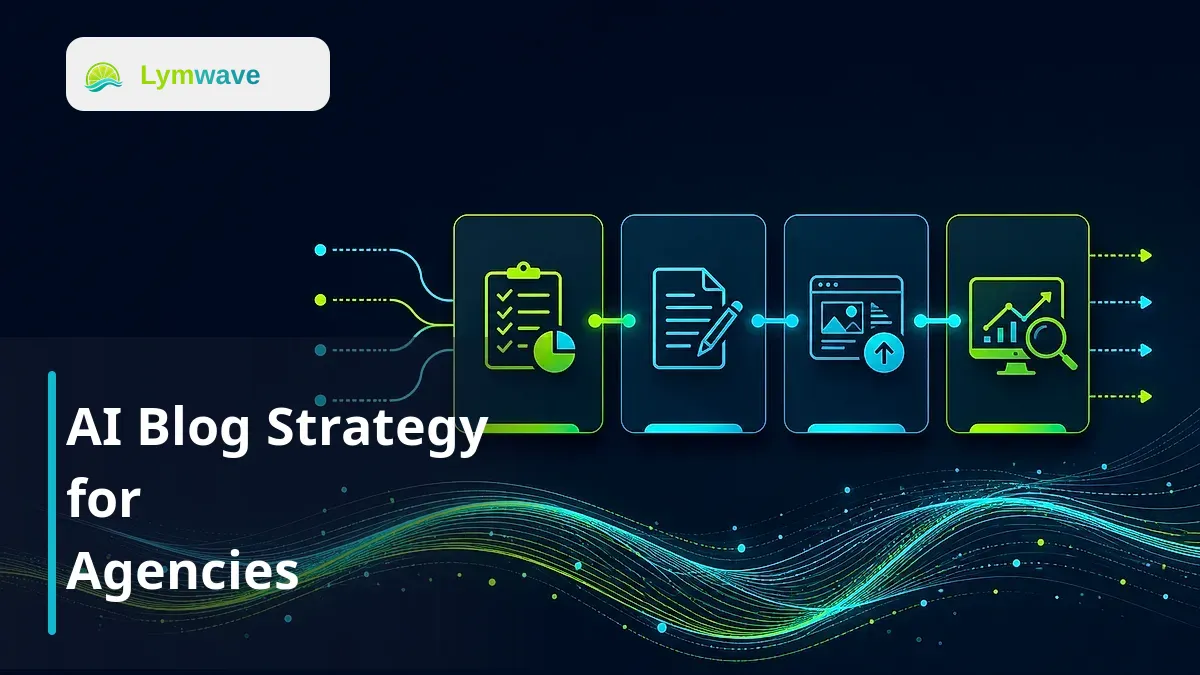
This guide sits in the AI SEO Automation topic cluster as a supporting resource.
Agencies do not need a system that merely produces more drafts. They need a controlled way to turn each client's expertise, audience evidence, priorities, and approval rules into useful content without rebuilding the production process for every account.
Quick answer: standardize the workflow, not the client's voice or point of view. Use AI to organize evidence, compare opportunities, prepare briefs and drafts, check page requirements, and coordinate delivery. Keep separate context, permissions, sources, review gates, and performance decisions for every client. A client expert should approve claims, positioning, examples, and publication.
Why agencies need a different AI blog strategy
An in-house team can design one content process around one brand. An agency must operate the same process across different markets, products, risk profiles, approval chains, publishing systems, and commercial goals.
That makes scale a governance problem before it becomes a writing problem. If an agency shares too little, every account becomes a custom production line. If it shares too much, clients begin to sound alike and information can leak across accounts.
AI increases both possibilities. It can reduce repetitive preparation and make quality checks more consistent. It can also reproduce a weak template, stale product detail, or unsupported claim across dozens of pages before anyone notices.
A sound strategy separates two layers:
- Agency standards define the repeatable workflow, quality criteria, status model, escalation rules, and delivery checks.
- Client context defines the audience, terminology, evidence, positioning, constraints, examples, permissions, and desired outcomes for one account.
The first layer should become more reusable over time. The second must remain deliberately specific. That boundary lets an agency improve efficiency without turning client expertise into generic copy.
What an agency AI blog strategy means
An agency AI blog strategy is a repeatable operating model for selecting, creating, reviewing, publishing, and improving client content with AI assistance. It connects portfolio-wide standards to account-level evidence and accountability.
It is broader than an AI writer or prompt library. A prompt can shape a draft, but it does not decide whether the client needs a new URL, who may approve a legal claim, which CMS is authoritative, or what should happen after a page underperforms.
| Layer | Shared across the agency | Kept specific to each client |
|---|---|---|
| Intake | Required fields and handoff rules | Goals, audience, offer, market, and constraints |
| Evidence | Source-quality criteria | Interviews, product facts, query data, and examples |
| Planning | Opportunity scoring method | Priorities, capacity, seasonality, and page roles |
| Production | Brief and validation standards | Voice, entities, claims, proof, and internal links |
| Approval | Statuses and audit trail | Named reviewers and risk thresholds |
| Delivery | Publishing and verification checklist | Destination, credentials, schedule, and canonical URL |
| Learning | Reporting cadence and decision labels | Relevant outcomes and next actions |
This model gives the agency a stable production system while protecting what makes each client credible. The goal is not to eliminate judgment. It is to spend human judgment on the decisions where it matters most.
How to build a scalable client workflow
1. Define the service boundary before choosing tools
Decide what the agency owns and what the client must supply or approve. A useful agreement covers research inputs, strategy, briefs, drafting, specialist review, images, publishing, distribution, measurement, and refreshes.
Make exceptions explicit. A financial, medical, legal, or security-sensitive client may require specialist approval for every factual section. Another client may let the agency publish low-risk educational content after one editorial review. Automation should follow those boundaries rather than silently redefine them.
2. Create one isolated source of truth per client
Store approved context separately for each account. Include:
- company, product, category, and audience definitions;
- approved terminology, capabilities, and limitations;
- customer questions and objections;
- evidence that may be cited or paraphrased;
- claims that require review;
- examples that are safe to publish;
- voice guidance and prohibited language; and
- owners and review dates for time-sensitive information.
Do not rely on one large agency prompt containing fragments from many clients. Isolation reduces accidental context mixing and makes outdated information easier to locate. Access should follow the same principle: team members and automated jobs receive only the client data required for their work.
3. Collect evidence before generating topics
Start with signals that belong to the client: sales questions, support themes, interviews, product documentation, site audits, existing page performance, relevant search queries, and content gaps.
AI can group those inputs by audience, intent, funnel stage, entity, and relationship to an existing page. It should not treat a generated keyword or competitor headline as proof that an article deserves to exist.
For each opportunity, choose one action:
- Create when an important intent has no strong page.
- Refresh when a relevant page exists but its answer, evidence, metadata, or examples are weak.
- Consolidate when several URLs compete for substantially the same need.
- Wait when the client lacks evidence, expertise, approval capacity, or a useful next step.
This gate protects client budgets from unnecessary output and gives strategists a defensible reason for every assignment.
4. Plan around client capacity and page roles
A calendar should reflect the client's ability to review, publish, and maintain content. Ten approved briefs are not useful if the subject expert can review only two drafts per month.
Assign every item a page role, intended reader, primary question, connected product or service page, owner, and review deadline. A 30-day SEO content plan can provide visibility without forcing every proposed title into production.
Mix new articles with refreshes, consolidation, and internal-link work. This prevents the agency's output metric from rewarding URL growth while the existing library becomes stale.
5. Approve the brief before producing the draft
The brief is the cheapest place to catch a strategic error. It should define the audience, intent, direct answer, required entities, approved evidence, internal links, prohibited claims, conversion path, and reviewer.
Require client approval when the direction affects positioning or relies on specialist knowledge. Once the brief is approved, AI can help produce a structured first draft. If a required fact is missing, the workflow should flag the gap instead of filling it with a plausible number, quotation, or customer result.
This is where a broader AI SEO automation content engine becomes useful: context and approvals travel with the article instead of being reconstructed in disconnected tools.
6. Separate mechanical validation from editorial review
Automate checks that have predictable answers: metadata completeness, one H1, logical headings, canonical paths, image fields, working internal links, repeated phrases, answer targets, and structured data that matches visible content.
Human reviewers should judge usefulness, accuracy, differentiation, tone, and commercial fit. They should ask whether the client would confidently say the same thing to a prospect, whether advice reflects actual practice, and whether the next step fits the reader's situation.
Use a consistent SEO, AEO, and GEO review while allowing stricter gates for sensitive accounts. Passing automated checks makes a draft ready for judgment; it does not make the draft true.
7. Publish through controlled account connections
Keep each client's destination, credentials, canonical domain, authorship rules, and schedule separate. Use the minimum access required and make failed deliveries visible.
After publication, verify the live body, title, image, metadata, canonical URL, links, indexability, and publication status. Record the final URL, approver, publish time, and any deviation from the approved brief.
Automatic publishing should come after the agency can reliably detect and recover from failures. A draft that disappears into the wrong CMS or publishes with incomplete metadata creates more work than it saves.
8. Report decisions, not just production volume
Portfolio reporting should make delivery health visible without flattening every client into one performance benchmark. Report output and workflow status consistently, then interpret outcomes against each page's role and the client's available data.
Useful operational measures include approval time, revision causes, publish success, overdue reviews, refresh backlog, and unresolved evidence gaps. Page-level review can examine relevant discovery, qualified reader paths, assisted conversions, or customer education outcomes where those can be measured responsibly.
End each review with a decision: keep, improve, expand, consolidate, redistribute, or retire. That decision should feed the next plan. AI content automation becomes strategically useful when published evidence changes what the agency does next.
How the workflow supports SEO, AEO, and GEO
SEO, answer engine optimization, and generative engine optimization share practical foundations: clear intent, accessible pages, direct answers, consistent entities, supported claims, and useful connections between related information.
| Area | Agency contribution | Account-level review question |
|---|---|---|
| SEO | Distinct page roles, crawlable delivery, metadata, links, and maintenance | Is this the best client URL for this search need? |
| AEO | Concise answers, definitions, steps, tables, and matching FAQs | Can the answer stand alone without losing necessary context? |
| GEO | Consistent relationships among brand, category, audience, product, and workflow | Are the entities and claims specific, stable, and supportable? |
Agencies can standardize these review questions without standardizing the answers. One client's approved category language should never become another client's terminology by convenience.
No agency or automation platform can guarantee rankings, traffic, backlinks, or inclusion in generated answers. A controlled workflow can improve the clarity, credibility, accessibility, and consistency of the material available to search and answer systems.
Common agency mistakes to avoid
The first mistake is using one generic template as the strategy. A reusable structure can help, but the evidence, angle, terminology, examples, and next step must come from the client.
The second is mixing account context. Shared prompts, folders, dashboards, or credentials can expose the wrong information to people or jobs. Make isolation part of the workflow design.
The third is optimizing for approved article count. Volume can hide duplicate intent, weak differentiation, delayed reviews, and a growing refresh backlog.
The fourth is allowing AI to resolve missing evidence. A confident sentence is not a source. Escalate gaps to the strategist or client expert.
The fifth is adding automatic publishing before permissions, verification, and recovery are dependable. Start with reviewable drafts, then expand automation as the controls prove reliable.
Finally, avoid comparing clients with one simplistic performance target. Different markets, sites, offers, page roles, and measurement systems require account-specific interpretation.
Frequently asked questions
What should agencies know about AI blog strategy?
Standardize the production system while keeping client context separate. AI can support evidence organization, planning, briefs, drafts, validation, and delivery, but client experts should approve positioning, factual claims, examples, and publication.
How can an agency prevent AI content from sounding generic?
Use client-specific customer questions, approved terminology, product details, examples, and evidence before drafting. Approve a focused brief, require editorial review, and reject pages that could plausibly belong to any competitor.
What should be shared across client accounts?
Share workflow stages, quality criteria, status labels, validation rules, escalation patterns, and delivery checks. Do not share private evidence, credentials, product claims, voice instructions, examples, or unpublished strategy between clients.
Which agency blog tasks should be automated first?
Start with reversible, observable tasks such as organizing evidence, checking existing URLs, preparing briefs, generating first drafts, validating metadata and links, and tracking approval status. Add publishing automation after account permissions and recovery controls are reliable.
How does an agency content workflow support SEO, AEO, and GEO?
It helps every page maintain a distinct intent, direct answer, consistent entities, useful links, complete metadata, and matching structured data. These practices improve search and answer readiness without guaranteeing rankings or citations.
How should agencies measure AI-assisted blog work?
Track operational quality, including approval time, revision causes, publish success, overdue reviews, and evidence gaps. Evaluate page outcomes according to each client's goals and data, then record a clear next decision such as improve, expand, consolidate, or retire.
Useful next reads
AI SEO Automation Guide: How to Build a Content Engine That Publishes Consistently explains practical SEO, AEO, and GEO workflows for planning, publishing, measuring, and improving useful content consistently.
How to Create a 30-Day SEO Content Plan with AI explains practical SEO, AEO, and GEO workflows for planning, publishing, measuring, and improving useful content consistently.
How to Optimize Blog Posts for SEO, AEO, and GEO explains practical SEO, AEO, and GEO workflows for planning, publishing, measuring, and improving useful content consistently.
Turn this into a working content system
Audit your content, find AI visibility gaps, and build a publishing workflow that compounds.