

Automated SEO Workflows: Common Mistakes and How to Avoid Them
Learn the most common automated SEO workflow mistakes and how to prevent weak topics, generic drafts, publishing errors, and missed improvement opportunities.
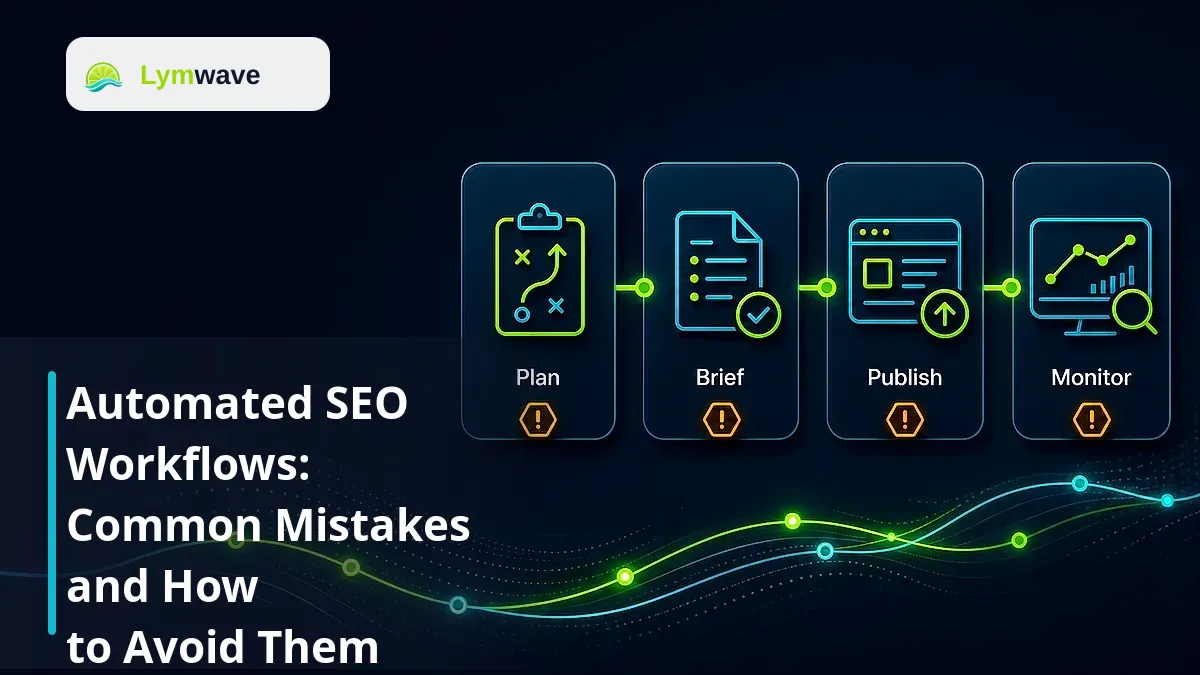
This guide sits in the AI SEO Automation topic cluster as a supporting resource.
Why automated SEO workflows fail
Automated SEO workflows fail when speed replaces judgment. A system can produce topics, briefs, drafts, metadata, images, and scheduled posts quickly, but each automated step can also multiply a weak decision. If the topic does not serve a real reader, faster drafting only creates low-value content sooner.
Quick answer: the most common automated SEO workflow mistakes are choosing topics without evidence, starting from shallow briefs, accepting generic drafts, skipping fact and brand review, publishing without technical checks, and never using performance data to improve the next article. Prevent them with clear gates between planning, drafting, review, publishing, and measurement.
This is not an argument against AI SEO automation. It is an argument for designing automation as a controlled content system. The best workflow reduces repetitive work while keeping people responsible for strategy, accuracy, positioning, and final approval.
For SaaS founders, small business owners, and content marketers, that distinction is practical. A reliable system should make good decisions easier to repeat. It should also stop an article when the evidence, brief, draft, or publishing setup is not ready.
Common automated SEO workflow mistakes
Most failures occur at the handoff between stages, not inside one isolated tool. The planner assumes the brief will fix a weak topic. The writer assumes an editor will verify every claim. The publisher assumes metadata and links were already checked. When ownership is unclear, small gaps move all the way to the live page.
| Mistake | What it causes | Better control |
|---|---|---|
| Automating topic selection without evidence | Irrelevant or repetitive pages | Require reader need, business fit, and demand signals |
| Using a thin content brief | Generic drafts with missing context | Define intent, answer target, entities, links, and constraints |
| Treating the first draft as final | Repetition, weak examples, and unsupported claims | Add editorial and factual review gates |
| Optimizing for keywords alone | Awkward copy and shallow coverage | Optimize for the reader question and related entities |
| Publishing without technical validation | Broken links, duplicate metadata, or indexing issues | Validate URL, canonical, metadata, image, schema, and links |
| Measuring output instead of outcomes | More posts without useful learning | Review impressions, clicks, conversions, and content gaps |
Mistake 1: automating weak topic selection
A content engine cannot rescue a topic that has no clear audience or purpose. Keyword volume alone is not enough. A useful topic should connect a reader problem, search intent, business relevance, existing site coverage, and a realistic next step.
Before a topic enters the plan, ask:
- Who needs this answer?
- What decision or task does the article help with?
- Does the site already cover the same intent?
- Can the business add useful context or experience?
- Where should the article link, and what should link to it?
Search Console queries, site audits, customer questions, product knowledge, and content gaps can all provide evidence. A structured 30-day SEO content plan should use those signals instead of filling a calendar with loosely related keywords.
Mistake 2: generating from a shallow brief
“Write an article about this keyword” is not a content brief. It leaves the model to guess the audience, intent, scope, terminology, examples, internal links, and claims. The result may read smoothly while saying very little.
A usable brief should define the primary question, intended reader, search intent, article outcome, relevant entities, section goals, source requirements, internal-link targets, product context, and claims that require caution. It should also say what the article must not do, such as invent statistics, imply guaranteed rankings, or repeat a product pitch in every section.
Mistake 3: confusing a complete draft with a useful article
Length and formatting do not prove usefulness. A draft can have 1,800 words, clean headings, and a conclusion while still failing to answer the question clearly. Automated SEO content often becomes generic when every section explains why something matters but never shows how to make a decision.
Review the opening first. It should answer the central question in plain language. Then check whether each section adds a distinct idea, example, comparison, or action. Remove repeated introductions, vague benefits, and paragraphs that could appear in any article about marketing automation.
Mistake 4: skipping accuracy and brand review
AI-assisted drafts can overstate benefits, blur product capabilities, or present uncertain information confidently. Every factual claim, product statement, statistic, quotation, and external reference needs an appropriate check. Claims should be specific enough to evaluate and cautious enough to remain credible.
Brand review is different from proofreading. It checks whether the article represents the category, audience, product, and workflow consistently. For Lymwave, that means describing an agentic content growth workflow that combines planning, SEO/AEO/GEO articles, images, review, publishing, translations, integrations, visibility signals, and improvement—not presenting the product as a one-click text generator.
Mistake 5: publishing without delivery checks
Good content can still underperform when the published page has a duplicate title, incorrect canonical URL, missing social image, broken internal link, mismatched schema, or an accidental noindex directive.
The publishing stage should verify the rendered URL, H1, title, meta description, canonical, robots directive, featured image, alt text, Open Graph fields, internal links, and structured data. FAQ schema should only describe questions and answers visible on the page.
Mistake 6: ending the workflow at publication
Publishing is a transition, not the finish line. Without measurement, the system cannot learn whether its topic choices, briefs, answers, links, or calls to action were effective.
Track the signals that match the article's job. Informational pages may need impressions, query coverage, engaged visits, and assisted conversions. Commercial pages may need qualified visits and product actions. Search Console can reveal low click-through rate, ranking headroom, new queries, and pages that need stronger internal links or clearer answers.
How to build safeguards into the workflow
Use explicit gates between stages. A gate is a small set of pass conditions that determines whether an item can move forward. It should be strict enough to stop preventable errors and short enough that the team actually uses it.
1. Set a planning gate
The topic passes only when it has a defined reader, intent, business connection, evidence, unique angle, and place in the content cluster. If one of those elements is missing, return it to research rather than drafting it anyway.
2. Set a brief gate
The brief passes when another writer or model could follow it without guessing the article's purpose. Require a direct answer target, section outcomes, entity context, internal links, evidence needs, and editorial constraints.
3. Set a draft gate
The draft passes when it answers the primary question early, covers the brief without padding, uses specific examples, avoids unsupported claims, and gives the reader a useful next step. Run a repetition pass separately; polished repetition is still repetition.
4. Set an approval gate
A named reviewer should own accuracy, brand fit, usefulness, and risk. Approval should be an explicit state, not an assumption created by the absence of comments. Teams that want a repeatable process can use a practical automated SEO workflow checklist at this point.
5. Set a publishing gate
Validate the final rendered page, not only the source document. Confirm metadata, canonical URL, image delivery, schema, links, crawlability, mobile presentation, and the connected publishing destination before marking the job complete.
6. Set an improvement gate
Define what will cause the page to be revisited. Useful triggers include a Search Console opportunity, declining clicks, a low click-through rate, new product context, outdated facts, weak conversion behavior, or a newly published page that should be linked internally.
An AI SEO automation guide can help connect these controls into one content engine rather than a collection of unrelated tools.
How quality controls support SEO, AEO, and GEO
SEO quality controls protect crawlability, intent alignment, metadata, internal links, and content depth. They help search engines discover the page and understand why it deserves a distinct place in the site.
AEO controls make the answer easy to extract without stripping away important meaning. The article should answer its primary question near the top, define important terms, use tables or steps where they clarify the response, and keep FAQ answers direct.
GEO controls strengthen entity and relationship context. An article about automated workflows should clearly connect AI SEO automation, search intent, content briefs, editorial review, publishing, Search Console, AEO, GEO, and ongoing improvement. Clear relationships are more useful than repeating one exact keyword.
| Quality area | Pass condition |
|---|---|
| SEO | The page is unique, crawlable, internally linked, and technically complete |
| AEO | The main question receives a concise, visible, well-supported answer |
| GEO | Entities, audience, category, and workflow relationships are explicit |
| Trust | Claims are accurate, qualified, and attributable when needed |
| Operations | Every stage has an owner, status, and failure path |
These layers work together. A technically perfect page with a vague answer is weak. A clear answer on a broken or orphaned page is also weak. The workflow needs content quality and delivery quality at the same time.
A compact review framework
Use four statuses for each gate: ready, needs work, blocked, or not applicable. “Ready” means every required condition passes. “Needs work” means the current owner can fix the issue without changing strategy. “Blocked” means the workflow needs missing evidence, product context, approval, or publishing access. “Not applicable” should include a reason so it does not become a shortcut.
Keep the ownership model simple:
- Strategy owns the topic, intent, and cluster role.
- Editorial owns clarity, accuracy, examples, and brand fit.
- SEO owns metadata, links, schema, and indexability.
- Publishing owns destination readiness and rendered-page validation.
- Growth owns measurement signals and improvement triggers.
One person may hold several roles in a small team, but the decisions should remain distinct. That separation makes it easier to diagnose whether a weak result began with the topic, brief, draft, delivery, or measurement plan.
The workflow itself should also record failures. If drafts repeatedly miss product context, improve the brief template. If images regularly arrive without useful alt text, add it to the image handoff. If published pages lack links, validate them before approval. Fix recurring problems at the system level rather than relying on someone to remember a correction every time.
Frequently asked questions
What are the most common automated SEO workflow mistakes?
The most common mistakes are automating topic selection without evidence, using shallow briefs, accepting generic drafts, skipping accuracy and brand review, publishing without technical validation, and failing to learn from performance data.
Should every AI-generated article have human review?
Yes. A person should review the article's accuracy, usefulness, positioning, examples, claims, and brand fit before publication. Automated checks can support that review, but they do not own the final editorial judgment.
How do you prevent generic AI SEO content?
Start with a specific brief that defines the reader, intent, answer target, entities, evidence, internal links, examples, product context, and constraints. Then remove repeated explanations and require every section to contribute a distinct answer or action.
Which checks should happen before publishing?
Check the rendered H1, title, meta description, canonical URL, robots directive, featured image, alt text, Open Graph metadata, internal links, schema, mobile presentation, and publishing destination. The content should also have explicit editorial approval.
How should an automated SEO workflow be measured?
Measure the outcome assigned to each page, not only the number of posts produced. Useful signals include impressions, query coverage, clicks, click-through rate, qualified visits, conversions, internal-link growth, and Search Console opportunities that justify an update.
Can a small team use these safeguards without slowing down?
Yes. Keep each gate short, assign one owner, and automate deterministic checks such as metadata completeness, URL validation, image presence, and broken-link detection. Reserve human attention for strategy, accuracy, usefulness, and approval.
Useful next reads
AI SEO Automation Guide: How to Build a Content Engine That Publishes Consistently explains practical SEO, AEO, and GEO workflows for planning, publishing, measuring, and improving useful content consistently.
How to Create a 30-Day SEO Content Plan with AI explains practical SEO, AEO, and GEO workflows for planning, publishing, measuring, and improving useful content consistently.
How to Optimize Blog Posts for SEO, AEO, and GEO explains practical SEO, AEO, and GEO workflows for planning, publishing, measuring, and improving useful content consistently.
Turn this into a working content system
Audit your content, find AI visibility gaps, and build a publishing workflow that compounds.