

The Practical Checklist for automated SEO workflows
The Practical Checklist for automated SEO workflows explains practical SEO, AEO, and GEO workflows for planning, publishing, measuring, and improving useful content consistently.
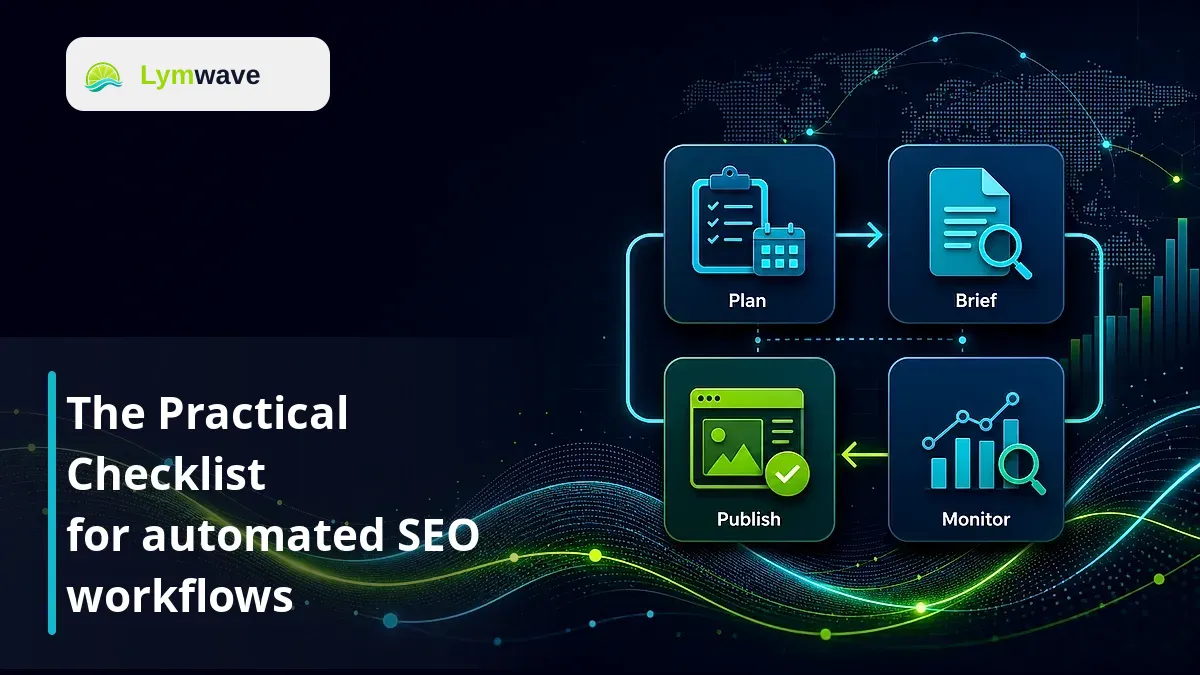
This guide sits in the AI SEO Automation topic cluster as a supporting resource.
Why The Practical Checklist for automated SEO workflows matters
Automated SEO workflows are only useful when they help a team publish better work with less repeated effort. A checklist keeps the system honest. It turns the workflow from "the tool generated something" into a reviewable process for choosing the right topic, creating a useful brief, checking the draft, preparing metadata, publishing cleanly, and learning from performance data.
Quick answer: a practical checklist for automated SEO workflows is a pre-publish and post-publish control layer. It helps teams confirm that each AI-assisted article has a clear intent, strong brief, direct answer, complete SEO/AEO/GEO metadata, relevant internal links, human review, and a measurement plan.
This matters for SaaS founders, small business owners, and content marketers because automation can increase output faster than quality systems can keep up. Without a checklist, teams often publish more pages but miss basic controls: weak intent match, repetitive drafts, missing internal links, thin examples, vague meta descriptions, or no refresh plan after the page goes live.
The goal is not to slow the workflow down. The goal is to make each step easier to trust. A good checklist should be short enough to use every week and specific enough to catch the mistakes that usually damage search visibility.
What The Practical Checklist for automated SEO workflows means
The practical checklist is a set of gates for the full content lifecycle. It starts before an article is drafted and continues after publication. That matters because the biggest SEO problems are rarely isolated to the final draft. They often begin earlier, when the team chooses a topic without business fit, writes a brief without search intent, or lets a draft move forward without a clear answer.
Use the checklist across seven stages:
| Stage | Checklist question | Why it matters |
|---|---|---|
| Topic | Does this topic serve a real reader and business need? | Prevents low-value content volume |
| Brief | Does the brief define intent, audience, entities, and links? | Gives AI content workflow guardrails |
| Draft | Does the draft answer the question clearly? | Keeps content useful, not just formatted |
| Optimization | Are metadata, headings, schema, and internal links ready? | Supports crawlability and search snippets |
| Review | Has a person checked accuracy, claims, and usefulness? | Protects trust and positioning |
| Publish | Is the page ready for the CMS, image, canonical, and URL? | Avoids operational mistakes |
| Improve | Is there a plan to measure and refresh it later? | Turns publishing into a learning loop |
This checklist is especially useful when paired with a broader AI SEO automation guide, because the guide explains the engine while the checklist helps you run it consistently.
How to approach The Practical Checklist for automated SEO workflows
Start with a topic-readiness pass before generating the article. The topic should have a visible reason to exist in your content library. Check the reader's likely question, the buying stage, the product or service connection, and whether the page can add something more useful than another generic explanation.
Before drafting, confirm the brief includes:
- the intended reader and search intent
- the primary answer the article must give
- supporting questions that belong in the page
- relevant entities, terms, and category language
- internal links to existing useful pages
- claims to avoid or qualify
- required metadata, image direction, and schema needs
The draft-review checklist should be stricter than the generation prompt. Read the opening section first. If the article does not answer the main question quickly, fix that before polishing headings. Then scan for generic paragraphs, repeated exact-match keywords, unsupported claims, overconfident predictions, missing examples, and sections that do not help the reader make a decision.
For optimization, use a compact publishing checklist:
- one clear H1 that matches the page intent
- logical H2 and H3 structure
- unique meta title and meta description
- canonical URL that matches the final slug
- featured image and Open Graph image
- internal links to related live pages
- FAQ content only when the visible article answers those questions
- crawlable page output with no broken links
If you are building a month of planned content, connect this checklist to your planning workflow. A 30-day SEO content plan with AI works better when every scheduled article has the same readiness gates before it reaches publishing.
After publication, the checklist should shift from production quality to performance learning. Note the target query group, the page's role in the content cluster, the intended internal-link path, and the signals you will review later. Those signals can include impressions, clicks, click-through rate, ranking movement, conversions, engagement quality, and whether the page earns more internal links over time.
Keep the checklist visible inside the workflow instead of storing it as a separate document nobody opens. Add the topic-readiness checks to the planning view, the brief checks to the brief template, the review checks to the editorial handoff, and the publishing checks to the CMS or deployment step. The closer each check is to the moment of work, the more likely the team is to use it.
You can also score each article with a simple pass, needs work, or blocked status. Pass means the item is ready to move forward. Needs work means the owner can fix it without changing strategy. Blocked means the topic, offer, source material, or publishing setup is not ready yet. That small distinction keeps automation moving without letting weak articles slip through because the next step is waiting.
How this supports SEO, AEO, and GEO
For SEO, the checklist protects the fundamentals. It makes sure each page has a clean slug, unique metadata, consistent headings, relevant internal links, optimized images, schema that matches visible content, and a clear reason to be indexed. These checks are basic, but they are also easy to miss when content production speeds up.
For AEO, the checklist forces direct answers into the workflow. The article should define the topic, answer the primary question near the top, include useful tables or steps when they clarify the answer, and keep FAQs specific. AEO quality improves when the page can be quoted or summarized without losing the meaning.
For GEO, the checklist helps the article explain entities and relationships. A page about AI SEO automation should connect SEO, AEO, GEO, content briefs, search intent, internal links, publishing workflows, and measurement in clear prose. That entity context makes the article easier for AI systems to understand and cite.
Use this review pass before publishing:
| Area | Pass condition |
|---|---|
| SEO | The page is crawlable, unique, internally linked, and metadata-complete |
| AEO | The main answer is concise, visible, and supported by useful details |
| GEO | Entities, categories, audience, and workflow context are clearly connected |
| Trust | Claims are specific, cautious, and reviewable |
| Maintenance | The team knows what to measure after publication |
If the page is already live, run the same controls during a refresh. A dedicated process for optimizing blog posts for SEO, AEO, and GEO can turn checklist misses into concrete updates.
Common mistakes to avoid
The first mistake is making the checklist too long. If the checklist has dozens of vague items, nobody will use it. Keep the core controls focused on topic fit, brief quality, draft usefulness, metadata, links, review, publishing, and measurement.
The second mistake is checking only the final draft. Automated SEO content can go wrong before drafting begins. A weak topic or shallow brief usually produces a weak article, even when the final text is polished.
The third mistake is treating SEO as metadata only. Metadata matters, but the page also needs intent alignment, clear answers, entity coverage, internal links, and a reason to exist in the cluster.
The fourth mistake is skipping human review. Automation can speed up research, planning, drafting, formatting, and publishing, but a person still needs to review accuracy, positioning, examples, claims, and brand fit.
The fifth mistake is publishing without a measurement plan. If nobody checks how the article performs, the team cannot learn which briefs, topics, and internal links worked.
The final mistake is using the same checklist for every content type. A product-led tutorial, comparison page, local-service article, and educational blog post may share basic quality controls, but each needs different proof, examples, calls to action, and review rules.
Frequently asked questions
What should you know about The Practical Checklist for automated SEO workflows?
You should know that the checklist is a quality-control layer for AI-assisted content. It helps teams confirm that each article has the right topic, brief, draft, metadata, links, review, publishing setup, and measurement plan.
How does The Practical Checklist for automated SEO workflows support SEO, AEO, and GEO?
It supports SEO by checking crawlability, metadata, headings, links, and schema. It supports AEO by requiring direct answers and useful FAQ content. It supports GEO by making entity relationships, audience context, and workflow language explicit.
What mistakes should you avoid with The Practical Checklist for automated SEO workflows?
Avoid creating an overlong checklist, checking only the final draft, treating metadata as the whole SEO process, skipping human review, publishing without measurement, and using one generic checklist for every content type.
When should the checklist be used?
Use it before drafting, before publishing, and during refresh reviews. The checklist is most valuable when it catches weak topics or briefs early instead of waiting until the article is almost ready to go live.
Who should own the checklist?
One person should own the final decision, but different roles can own different checks. Strategy owns topic fit, editorial owns usefulness and claims, and publishing owns metadata, links, images, schema, and delivery.
Useful next reads
AI SEO Automation Guide: How to Build a Content Engine That Publishes Consistently explains practical SEO, AEO, and GEO workflows for planning, publishing, measuring, and improving useful content consistently.
How to Create a 30-Day SEO Content Plan with AI explains practical SEO, AEO, and GEO workflows for planning, publishing, measuring, and improving useful content consistently.
How to Optimize Blog Posts for SEO, AEO, and GEO explains practical SEO, AEO, and GEO workflows for planning, publishing, measuring, and improving useful content consistently.
Turn this into a working content system
Audit your content, find AI visibility gaps, and build a publishing workflow that compounds.