

Why AI SEO Automation Matters for AI Search
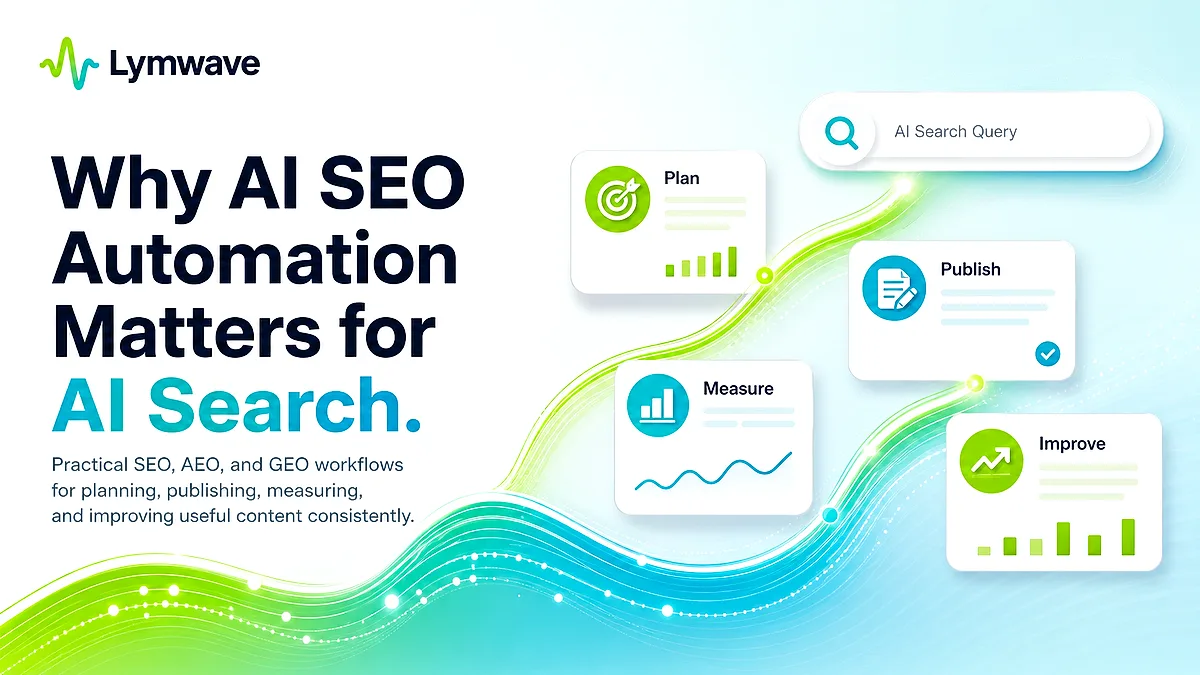
Why AI SEO automation matters for AI search explains practical SEO, AEO, and GEO workflows for planning, publishing, measuring, and improving useful content consistently.
This guide sits in the AI SEO Automation topic cluster as a supporting resource.
Why AI search changes the content workflow
AI search changes content work because the page is no longer judged only by whether it can rank for a query. It also needs to be easy to summarize, cite, compare, and connect to a wider topic. That makes structure, factual clarity, entity coverage, and consistent publishing discipline more important than raw drafting speed.
Quick answer: AI SEO automation matters for AI search because it helps teams turn search intent, answer structure, entity language, metadata, internal links, publishing checks, and refresh triggers into one repeatable workflow. The goal is not to publish unchecked AI drafts. The goal is to make useful content easier to plan, review, ship, measure, and improve.
For SaaS founders, small business owners, and content marketers, the practical challenge is consistency. One strong article is helpful. A library of articles that answer related questions clearly, link to each other well, and stay updated is much more valuable. AI-assisted workflows can reduce the manual coordination required to keep that library coherent.
This matters even more as search behavior spreads across classic search results, answer engines, AI assistants, and brand-discovery prompts. A page that explains a topic clearly has a better chance of being understood across those surfaces. A page that repeats vague claims, skips definitions, or hides the actual answer behind filler is harder for both humans and machines to use.
What automation needs to mean now
Automation should mean governed assistance across the content lifecycle. It should not mean handing every decision to a model. In AI search, the most useful automation is the kind that makes the editorial process more complete and less forgetful.
That includes planning the topic, deciding what question the page should answer, creating a brief, drafting from approved context, checking claims, adding metadata, recommending internal links, preparing schema, publishing to the right destination, and tracking whether the page still does its job later.
A simple writing tool can create paragraphs. A content workflow has to preserve intent. It needs to know the audience, the product context, the topic cluster, the related articles, and the difference between a safe educational claim and an unsupported promise.
That difference is important for AI search visibility. AI systems often need concise explanations, repeated entity clarity, and a clean relationship between topics. If every page in a cluster uses different terms, skips definitions, or buries the key answer, the site becomes harder to interpret.
For the broader operating model, treat the pillar article in this cluster as the system map. It should explain how planning, drafting, optimization, publishing, and measurement fit into one content engine, while supporting posts like this one answer narrower questions.
How to build the workflow
A reliable workflow starts with the reason for the article. The team should know who the page is for, what question it answers, what business goal it supports, and which existing pages it should connect to before any draft is generated.
The planning step should group the topic with related questions, entities, and internal links. For this topic, that means connecting AI content automation, SEO, AEO, GEO, and SEO content automation to a real publishing process rather than treating those terms as isolated keywords.
Next comes the brief. A useful brief should include the reader, search intent, angle, required sections, answer target, internal links, claim constraints, and publishing destination. The brief is the guardrail that keeps the draft from becoming generic.
The brief should also define what the page should not do. That can include avoiding claims about guaranteed rankings, avoiding third-party logos, skipping unsupported performance numbers, or leaving product-specific promises to pages where the feature actually exists. These negative constraints are easy to forget in a manual workflow, but they are exactly the kind of editorial rule automation can carry forward.
Drafting should create working material, not final copy. The editor should review whether the article answers the main question quickly, whether each section adds something new, whether examples are specific, and whether the page avoids unsupported claims.
Optimization should happen before publication. That means checking the title, meta description, canonical URL, Open Graph image, visible headings, FAQ content, structured data, image path, and internal links. The goal is to make the page useful and machine-readable without turning it into a keyword-stuffed checklist.
Publishing should preserve those decisions in the CMS, static site, or hosted blog. If a team publishes to WordPress, Webflow, GitHub, or another destination, automation can reduce formatting drift by carrying metadata, links, and image assets through the process.
Finally, the workflow should continue after launch. AI search and classic search both reward content that stays useful. Teams should watch query fit, impressions, internal-link clicks, AI visibility patterns, content age, and editorial notes so pages can be refreshed before they become stale.
If planning is the bottleneck, a focused calendar can help. The guide to creating a 30-day SEO content plan with AI shows how to give each article a clear role before automation enters the draft stage.
How this supports SEO, AEO, and GEO
AI search does not remove the need for SEO. It adds more pressure for content to be structured, explainable, and trustworthy. A page still needs crawlable metadata, a clean canonical URL, useful headings, and internal links. Without those basics, the content library is harder to discover and maintain.
AEO, or answer engine optimization, depends on direct answers and clear question coverage. Automation can help teams include a useful summary, concise definitions, and FAQ sections when they match the search intent. The point is to answer quickly, then give the reader enough detail to make the answer credible.
GEO, or generative engine optimization, depends on entity clarity and citable explanations. A page should make the relationship between the brand, category, workflow, audience, and problem easy to understand. That is why consistent product naming and topic language matter across the whole content library.
Here is the practical difference:
| Layer | What the page needs | How automation helps |
|---|---|---|
| SEO | Search intent, metadata, headings, links, crawlable structure | Keeps the publishing checklist consistent before launch |
| AEO | Direct answers, definitions, useful FAQ coverage | Prompts editors to answer the main question clearly |
| GEO | Entity coverage, brand context, citable explanations | Keeps related topics and product language aligned across posts |
The best content workflow supports all three layers at once. It helps a reader understand the topic, helps search engines classify the page, and helps AI systems summarize the page without losing the point.
This is where the workflow becomes more useful than a one-off prompt. A prompt might remind the writer to add a summary. A workflow can require the summary, check whether the configured FAQ appears visibly on the page, make sure the Open Graph image matches the featured image, and prevent unresolved related links from shipping. Those small checks compound across a large content library.
For a deeper optimization process, see how to optimize blog posts for SEO, AEO, and GEO.
Common mistakes to avoid
The first mistake is treating automation as a volume tool only. Publishing more pages does not automatically create more visibility. If the pages are thin, repetitive, or poorly linked, volume can create a maintenance problem instead of a growth channel.
The second mistake is skipping editorial review. AI can write confident sentences that still need proof, context, or correction. Human review should own strategy, positioning, sensitive claims, examples, and final approval.
The third mistake is optimizing only for classic keywords. AI search depends heavily on clear entities and answer structure. A page can include the target phrase and still fail if it never explains the workflow in plain terms.
The fourth mistake is ignoring internal links. AI-assisted content works best when every page has a role in a topic cluster. Related articles should help the reader move from a definition to a plan, from a plan to an optimization process, and from an optimization process to measurement.
The fifth mistake is using schema that does not match visible content. FAQPage schema should reflect questions that readers can actually see. BlogPosting and BreadcrumbList schema should match the page being rendered. Structured data is a support layer, not a place to hide content.
The final mistake is stopping at publication. AI search visibility is not a one-time event. Pages should be refreshed when queries shift, examples age, product workflows change, or related pages create better linking opportunities.
Teams should also avoid measuring the workflow by publication count alone. Better indicators include how many approved briefs become useful pages, how often older posts are refreshed before traffic drops, whether related articles form clear paths through a topic, and whether search queries match the audience the page was meant to serve.
Frequently asked questions
Why does AI SEO automation matter for AI search?
It matters because AI search rewards clear, structured, useful information. Automation helps teams keep briefs, answers, metadata, internal links, schema, publishing checks, and refresh decisions consistent across a content library.
Is automation enough to improve AI search visibility?
No. Automation is only useful when it is governed by human strategy and review. Teams still need accurate claims, real examples, audience fit, strong positioning, and a clear reason for each page to exist.
How does this workflow support SEO, AEO, and GEO?
It supports SEO with crawlable structure and metadata, AEO with concise answer-ready sections, and GEO with consistent entity language and citable explanations. The same article can support all three when the workflow is planned before drafting.
What should stay human-led?
Humans should own topic strategy, brand positioning, proof, sensitive claims, competitive claims, product accuracy, and final publishing approval. AI can assist the workflow, but judgment should stay with the team.
What is the safest way to start?
Start with one topic cluster. Build a short content plan, define review gates, generate one article at a time, validate frontmatter and links, publish with approval, then use performance signals to decide what to refresh next.
Useful next reads
AI SEO Automation Guide: How to Build a Content Engine That Publishes Consistently explains practical SEO, AEO, and GEO workflows for planning, publishing, measuring, and improving useful content consistently.
How to Create a 30-Day SEO Content Plan with AI explains practical SEO, AEO, and GEO workflows for planning, publishing, measuring, and improving useful content consistently.
How to Optimize Blog Posts for SEO, AEO, and GEO explains practical SEO, AEO, and GEO workflows for planning, publishing, measuring, and improving useful content consistently.
Turn this into a working content system
Audit your content, find AI visibility gaps, and build a publishing workflow that compounds.