

What Is SEO Content Automation?
What Is SEO content automation? explains practical SEO, AEO, and GEO workflows for planning, publishing, measuring, and improving useful content consistently.
This guide sits in the AI SEO Automation topic cluster as a faq resource.
Why SEO content automation matters
Quick answer: SEO content automation is the use of structured workflows and AI-assisted tools to plan, draft, optimize, publish, measure, and refresh search content while keeping humans responsible for strategy, accuracy, and final approval.
For SaaS founders, small business owners, and content marketers, the pressure is simple: search still needs useful pages, answer engines need clear explanations, and generative search systems need consistent entity signals. The hard part is keeping that work moving every week without reducing the blog to generic AI output.
Automation helps when it makes the content system more reliable. It can turn customer questions, Search Console signals, topic clusters, briefs, drafts, metadata, internal links, images, publishing status, and refresh tasks into one operating flow. That is different from asking a writing tool for ten posts and hoping they fit the site.
The goal is not to remove editors. The goal is to give editors a better pipeline: fewer blank pages, clearer briefs, more consistent optimization, and less manual handoff between planning and publishing.
What content automation means for search
For search, content automation means coordinating the repeatable parts of organic content production. It usually includes topic selection, brief creation, draft generation, optimization checks, publishing preparation, and performance review.
The useful version has guardrails:
| Workflow layer | What automation handles | What humans still decide |
|---|---|---|
| Planning | Cluster ideas, spot gaps, suggest article angles | Business priority and audience fit |
| Briefing | Outline questions, entities, headings, and link targets | Point of view, examples, and claims |
| Drafting | Produce a complete first version | Accuracy, usefulness, and tone |
| Optimization | Check metadata, FAQs, structure, and internal links | Whether the page truly satisfies intent |
| Publishing | Prepare CMS-ready content and images | Approval, timing, and distribution |
| Refreshing | Flag stale pages or weak performance signals | Whether to update, merge, or create new content |
This matters because SEO is no longer only about matching keywords. A strong article also needs a direct answer, a clear heading structure, useful entities, internal links, and content that a reader can trust. Automated SEO content should support those requirements instead of hiding them behind a fast draft.
It also gives the team a shared checklist. Instead of remembering every optimization step from scratch, the workflow can surface what is missing before an article reaches approval.
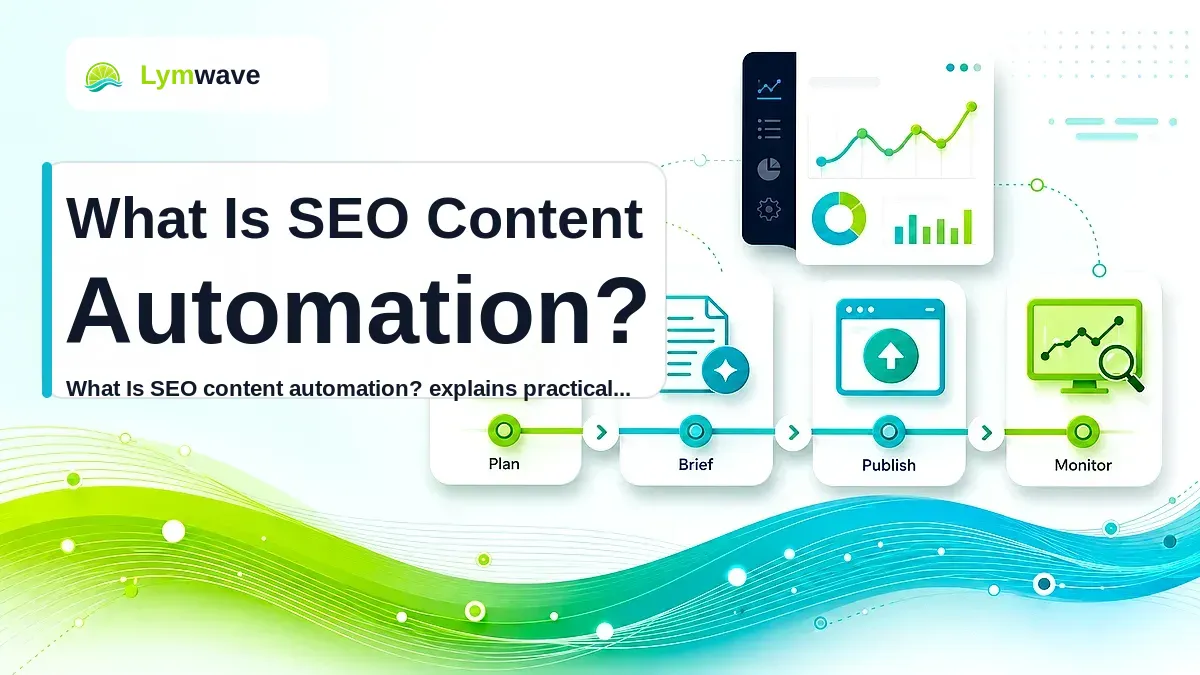
Lymwave treats this as an AI SEO automation workflow: plan the cluster, create the brief, generate the article, add a featured image, prepare metadata, suggest internal links, publish through the chosen destination, and monitor what should be improved later.
That broader workflow is most useful when every article has a clear role in the cluster, not just a standalone keyword target.
How to approach an automated SEO content workflow
Start with a narrow system. Pick one topic cluster, one audience, and one review rhythm. Automation works best when the inputs are specific enough to shape the draft before it is written.
A practical workflow looks like this:
- Choose the topic cluster.
Group article ideas around a core business topic. For example, a content automation cluster might include a pillar guide, beginner explainers, workflow posts, comparison pages, and refresh checklists.
- Build the brief before generating.
The brief should name the primary question, search intent, target reader, entities to include, sections to cover, internal links, and claims to avoid. A keyword alone is not enough context.
- Generate a complete draft from approved context.
Use the brief as the source of truth. The draft should answer the main question early, follow a clean H2/H3 structure, include examples, and avoid unsupported claims about rankings, traffic, backlinks, or AI citations.
- Review for SEO, AEO, and GEO.
Check the title, meta description, canonical URL, FAQ coverage, internal links, entity language, and whether the page has a concise answer that can be summarized without losing meaning. A related checklist is covered in how to optimize blog posts for SEO, AEO, and GEO.
- Publish with assets and metadata.
The article should move with its featured image, Open Graph image, canonical URL, internal links, and publishing status. This reduces the gap between a draft that exists and a page that is ready to be indexed.
- Measure and refresh.
Use impressions, clicks, CTR, ranking headroom, assisted conversions, and qualitative feedback to decide what to update next. Automation should keep published content in the workflow instead of treating publication as the finish line.
For planning the first batch, use a focused calendar rather than a giant idea list. The process in how to create a 30-day SEO content plan with AI is a useful starting point.
How this supports SEO, AEO, and GEO
SEO, AEO, and GEO overlap, but they reward slightly different habits.
SEO benefits from consistent planning, clear intent matching, useful internal links, metadata, and refreshes. Automation can help keep those details from being skipped when the team is busy.
AEO, or answer engine optimization, benefits from direct answers and structured explanations. A post should answer the main question near the top, then expand with definitions, steps, examples, and FAQs.
GEO, or generative engine optimization, benefits from clear entity and workflow context. The article should make the product category, audience, use case, and related concepts easy to identify. That does not guarantee AI citations, but it makes the content easier to understand and reuse accurately.
The shared principle is clarity. Automated content should help a reader understand the topic faster, not bury the answer under filler.
Common mistakes to avoid
The first mistake is treating automation as bulk publishing. More articles do not help if they repeat the same angle, miss the audience, or create thin pages that nobody wants to maintain.
The second mistake is skipping the brief. Without a brief, AI tends to produce smooth general advice. For a business site, the article needs product context, reader context, link context, and editorial constraints.
The third mistake is over-optimizing for exact-match keywords. Repeating the same phrase can make a post sound mechanical. Use natural language, related terms, examples, and entity coverage instead.
The fourth mistake is publishing without review. Automation can accelerate drafting, but it cannot own factual accuracy, claims, product positioning, or final editorial judgment.
The fifth mistake is ignoring old content. A healthy workflow looks at existing pages before creating new ones. Sometimes the best action is a refresh, internal-link update, stronger FAQ, or title rewrite.
Frequently asked questions
What is SEO content automation?
SEO content automation is the use of structured workflows and AI-assisted tools to plan, draft, optimize, publish, measure, and refresh search content while keeping humans in control of strategy, accuracy, and approval.
Is SEO content automation the same as AI writing?
No. AI writing is usually one step in the workflow. Content automation includes planning, briefs, metadata, internal links, images, publishing preparation, performance review, and refresh decisions.
How does this support answer engines?
It supports answer engines by making articles easier to parse: clear questions, concise answers, logical headings, visible definitions, relevant entities, and FAQs that match the page content.
Can automated SEO content still be high quality?
Yes, if the workflow starts with strong context and includes human review. Quality drops when teams generate from keywords alone, skip fact checks, or publish pages that do not solve a real reader problem.
What should teams automate first?
Start with briefs, metadata checks, internal-link suggestions, and refresh monitoring. Those steps improve consistency without removing editorial judgment from the article itself.
Useful next reads
AI SEO Automation Guide: How to Build a Content Engine That Publishes Consistently explains practical SEO, AEO, and GEO workflows for planning, publishing, measuring, and improving useful content consistently.
How to Create a 30-Day SEO Content Plan with AI explains practical SEO, AEO, and GEO workflows for planning, publishing, measuring, and improving useful content consistently.
How to Optimize Blog Posts for SEO, AEO, and GEO explains practical SEO, AEO, and GEO workflows for planning, publishing, measuring, and improving useful content consistently.
Turn this into a working content system
Audit your content, find AI visibility gaps, and build a publishing workflow that compounds.