

The Practical Checklist for SEO content automation
The Practical Checklist for SEO content automation explains practical SEO, AEO, and GEO workflows for planning, publishing, measuring, and improving useful content consistently.
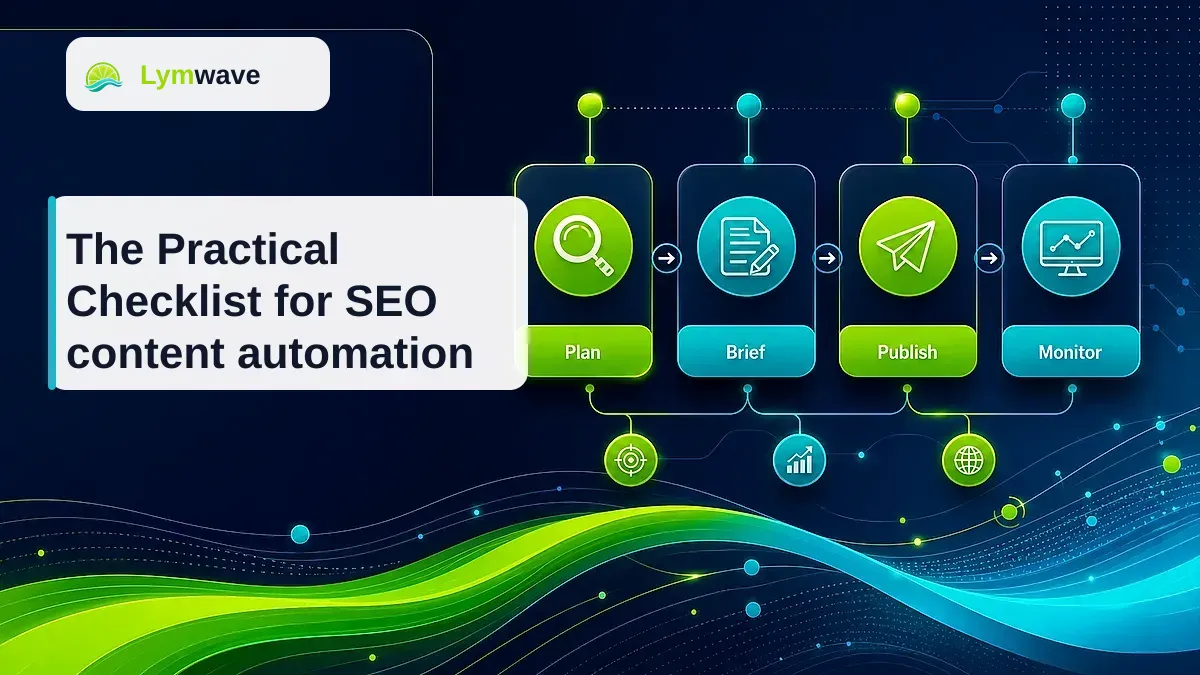
This guide sits in the AI SEO Automation topic cluster as a supporting resource.
Why The Practical Checklist for SEO content automation matters
Quick answer: a practical checklist for automated SEO content should confirm the article's search intent, audience, brief, source inputs, answer quality, metadata, internal links, schema, publishing status, and refresh plan before the post goes live.
Automation can help a small team move faster, but speed only helps when every post still has a reason to exist. A checklist gives the content team a shared standard for turning ideas into useful pages instead of loose drafts, thin summaries, or disconnected posts.
This is especially important for SaaS founders, small business owners, and content marketers who need consistent publishing without building a large editorial department. The risk is not only low-quality writing. The bigger risk is workflow drift: topics get approved without a clear angle, drafts ship without useful answers, and published pages never get measured.
The checklist below is designed for day-to-day use. It helps a team plan, review, publish, and improve content without turning the workflow into a giant audit. Use it as the final operating layer around a broader AI SEO automation content engine.
What The Practical Checklist for SEO content automation means
SEO content automation means using structured workflows and AI-assisted tools to repeat parts of the content lifecycle: opportunity discovery, content planning, briefs, drafts, metadata, internal linking, schema preparation, publishing, and performance review.
The checklist is the quality control layer. It keeps the system focused on useful content rather than raw output volume. A good automated workflow does not ask, "Can we publish this quickly?" It asks, "Does this page solve the intended problem clearly enough to deserve publishing?"
Use four layers to keep the process simple:
| Layer | What to check | Why it matters |
|---|---|---|
| Strategy | Audience, search intent, cluster role, and topic overlap | Prevents duplicate or disconnected posts |
| Editorial | Direct answer, examples, accuracy, and section usefulness | Keeps the article reader-first |
| Technical | Metadata, canonical URL, image, schema, and crawlability | Helps search and answer systems understand the page |
| Operations | Approval, publishing, measurement, and refresh ownership | Makes improvement repeatable |
The goal is not to make every article longer. The goal is to make each article more deliberate. A short workflow post can pass if it answers a specific question, links to relevant live resources, and has complete metadata. A long article can fail if it repeats the same point, hides the answer, or includes unsupported claims.
How to approach The Practical Checklist for SEO content automation
Start before drafting. The first check is whether the article belongs in the content library. Confirm the audience, intent, primary question, and role in the topic cluster. If the idea overlaps an existing article, refine the angle or update the older page instead of publishing a near-duplicate.
Use this pre-draft checklist:
- Topic source is clear. The idea comes from a content plan, customer question, search opportunity, product education need, or cluster gap.
- Reader is specific. The brief names who the article helps and what decision, task, or question they bring.
- Intent is defined. The post is a guide, checklist, comparison, workflow, glossary answer, use case, or troubleshooting article.
- Main answer is written. The brief includes the concise answer that should appear near the top of the post.
- Cluster fit is known. The post supports a pillar page, topic cluster, or planned content path.
- Links are real. Internal links point to live pages that add context, not imagined future posts.
Once the topic passes, check the brief. A useful brief should include the H1, expected H2s, target audience, primary keyword, related entities, questions answered, examples to include, internal links, metadata draft, and review notes. For planning depth, pair this step with a 30-day SEO content plan.
During drafting, review for usefulness before polishing tone. The introduction should answer the main question quickly. Each section should add something new. Tables and checklists should clarify decisions, not decorate the page. If a paragraph could appear in any article about marketing automation, it probably needs to be replaced with a more specific explanation.
Before publishing, run the page-level checks:
| Check | Pass condition |
|---|---|
| H1 | One clear H1 that matches the page intent |
| Introduction | Direct answer appears near the top |
| Headings | H2s move from problem to definition, workflow, trust, and FAQ |
| Metadata | Title, description, canonical, Open Graph, and Twitter fields are complete |
| Featured image | Image path exists, alt text is useful, and social preview is appropriate |
| Internal links | Links are relevant, live, and helpful to the reader |
| Schema | BlogPosting, FAQPage, and BreadcrumbList match visible content when used |
| Review | Claims, examples, and recommendations have been checked |
After publication, measure the page instead of treating it as finished. Track whether impressions, clicks, query fit, and engagement match the article's intent. If the post earns impressions for a different question, update the page or plan a more specific supporting article.
How this supports SEO, AEO, and GEO
The checklist supports SEO by making the page technically complete and easier to crawl. Metadata, canonical URLs, internal links, schema, and clear headings help search systems understand where the page belongs and how it relates to the rest of the site.
It supports AEO by making the answer easy to extract. A direct answer near the top, clear FAQ questions, concise definitions, and practical tables all help answer engines summarize the page without losing the point. The page should make its best answer visible instead of burying it after several generic paragraphs.
It supports GEO by strengthening entity and workflow context. AI systems need to understand the brand, category, audience, process, and related concepts. That means using consistent product and topic language, explaining the workflow plainly, and linking to relevant cluster content such as how to optimize blog posts for SEO, AEO, and GEO.
The best checklist is not a keyword-stuffing exercise. It is a way to make automated content more understandable. Search engines, answer engines, and AI summaries all benefit when a page has clear structure, visible evidence of editorial intent, and useful connections to related pages.
Common mistakes to avoid
The most common mistake is treating automation as permission to skip judgment. AI can draft sections, suggest links, and create metadata, but it cannot decide whether a page is strategically necessary without good inputs and review.
Avoid these failure points:
| Mistake | Why it hurts | Better approach |
|---|---|---|
| Publishing every generated draft | Creates thin or repetitive pages | Review each draft against intent and usefulness |
| Using vague briefs | Produces generic sections | Define audience, answer, examples, and links upfront |
| Linking to irrelevant pages | Weakens user experience and topical clarity | Link only when the destination helps the reader |
| Ignoring schema-content alignment | Creates structured data that does not match the page | Match FAQ and BlogPosting data to visible content |
| Measuring only publication volume | Rewards output instead of outcomes | Track query fit, clicks, engagement, and refresh needs |
Also avoid over-optimizing the page for one exact phrase. The article should use natural language around the topic, including AI content workflow, automated publishing, search visibility, content planning, and performance review. Entity coverage matters, but the page still has to read like a useful article for a real person.
Finally, do not let the checklist become a blocker. If it is too long, people stop using it. Keep the required checks lean, make them visible in the publishing workflow, and improve the checklist only when a real quality issue repeats.
Frequently asked questions
What should you know about The Practical Checklist for SEO content automation?
You should know that the checklist is a practical quality-control layer for automated content workflows. It helps teams confirm intent, brief quality, draft usefulness, metadata, internal links, schema, publishing readiness, and performance review before and after a post goes live.
How does The Practical Checklist for SEO content automation support SEO, AEO, and GEO?
It supports SEO with complete metadata, crawlable structure, internal links, and schema. It supports AEO with direct answers, clear definitions, and visible FAQ content. It supports GEO with consistent entity language, brand context, workflow clarity, and useful connections to related topic-cluster pages.
What mistakes should you avoid with The Practical Checklist for SEO content automation?
Avoid using the checklist as a box-ticking exercise. The biggest mistakes are publishing raw AI drafts, approving vague briefs, stuffing exact-match phrases, linking to irrelevant pages, adding schema that does not match visible content, and measuring success only by the number of posts published.
Useful next reads
AI SEO Automation Guide: How to Build a Content Engine That Publishes Consistently explains practical SEO, AEO, and GEO workflows for planning, publishing, measuring, and improving useful content consistently.
How to Create a 30-Day SEO Content Plan with AI explains practical SEO, AEO, and GEO workflows for planning, publishing, measuring, and improving useful content consistently.
How to Optimize Blog Posts for SEO, AEO, and GEO explains practical SEO, AEO, and GEO workflows for planning, publishing, measuring, and improving useful content consistently.
Turn this into a working content system
Audit your content, find AI visibility gaps, and build a publishing workflow that compounds.