

SEO Article Automation: A Practical Publishing Checklist
Use this SEO article automation checklist to review briefs, verify claims, approve drafts, check metadata, and monitor published articles.
This guide sits in the AI SEO Automation topic cluster as a supporting resource.
SEO article automation works best when each article passes a defined set of checks before publication: a distinct reader need, a complete brief, verified claims, useful examples, accurate metadata, working links, and an assigned reviewer. After publication, confirm the page renders correctly and review its search and business performance before expanding the workflow.
This checklist is for SaaS founders, small business owners, and content marketers who already use AI to draft articles but need a repeatable way to decide which drafts are ready. Use it as an editorial handoff: every unchecked item should have an owner and a next action.
What a publication checklist should control
Automation can move information between research, drafting, review, and publishing. A checklist defines the evidence required to move an article forward. Generating a draft is one milestone; accepting it for publication is another decision.
Give each article one record containing its proposed URL, reader question, source notes, reviewer, and publication status. Keep the approved version easy to identify. If a later generation replaces that version, require review again so approval cannot accidentally apply to text nobody checked.
For example, an invoicing software team might draft a guide to handling overdue invoices. The brief should specify the reader's situation, include a clearly labeled sample reminder, and identify which product capabilities can be described accurately. An attractive draft that invents automatic reminder features fails review even if its headings and metadata are complete.
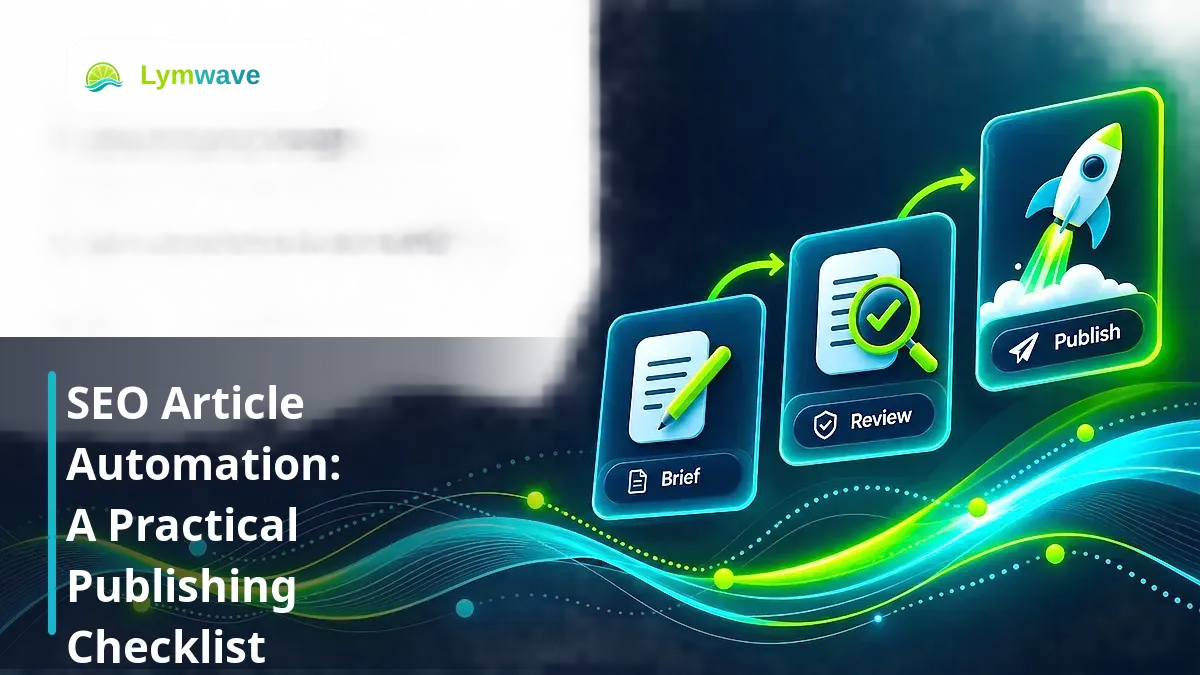
The practical outcome is a small set of states: brief ready, draft ready, changes needed, approved, and published. Choose labels your team understands and make responsibility clear at each handoff.
Before drafting: check the brief
Confirm the article has a distinct purpose
- Write the main reader question in one sentence.
- Describe what the reader should be able to do after reading.
- Compare the topic with existing articles and decide whether to create, update, or consolidate.
- Select one relevant next step, such as a related tutorial or product explanation.
Different keywords do not always justify different pages. If two proposed articles would use the same examples and answer the same question, consider improving the existing page. Record the decision before generating another draft.
A useful brief says, “Help a freelancer write a first overdue invoice reminder.” A vague brief says, “Write about invoice automation.” The specific version gives both the writer and reviewer an observable outcome.
Supply evidence and boundaries
- Attach primary sources for factual claims that require verification.
- Supply approved product facts, terminology, and relevant limitations.
- Identify an example, procedure, or comparison that adds practical value.
- State which claims the writer must omit when evidence is unavailable.
Avoid treating a model-generated source list as research. Open the sources and check whether they support the proposed statement. Record dates when facts may change, such as documentation for a software feature.
For a broader planning process, use the 30-day SEO content plan guide. A checklist becomes easier to apply when the content calendar already distinguishes each article's purpose.
During review: check the article itself
Verify claims against their sources
- Check numbers, quotations, names, dates, and product capabilities.
- Keep citations close to the claims they support.
- Label invented scenarios as examples rather than customer results.
- Remove unsupported claims instead of polishing their wording.
Google's guidance on generative AI content emphasizes accuracy, quality, and relevance, including metadata. It also warns that producing many pages without adding user value may violate its scaled content abuse policy. An automated process therefore needs a value check as well as a formatting check.
For the overdue invoice example, the reviewer could approve a sample email while removing an unsupported claim that reminders reduce late payments by a specific percentage. The example remains useful without invented proof.
Test whether a reader can use the answer
- Answer the main question near the beginning.
- Put steps in an order a reader can follow.
- Define unfamiliar terms where they first matter.
- Include relevant constraints, exceptions, or decision criteria.
- Remove repeated paragraphs and headings that restate the title.
Ask someone to follow one procedure using only the draft. If they cannot identify the input, action, or expected result, revise that section. This small usability check often reveals missing instructions that a grammar review misses.
Do not use word count as the final quality decision. A longer article can still leave the main question unanswered. Length targets help plan scope, but examples, explanations, and reader needs should determine what stays.
Assign a publication decision
Use a short decision table to keep review consistent:
| Finding | Decision | Next action |
|---|---|---|
| Unsupported factual claim | Return for changes | Verify, qualify, or remove the claim |
| Same purpose as an existing page | Revisit the brief | Update or consolidate the existing article |
| Helpful answer with minor presentation issues | Edit | Fix formatting and inspect the preview |
| Complete evidence and publication checks | Approve | Record the approved version and publisher |
An approval should identify the person responsible and the version reviewed. Avoid a blanket approval that automatically covers later rewrites.
Before publishing: check the page
Inspect metadata, links, and presentation
- Use a unique, descriptive page title and an accurate meta description.
- Confirm the intended public URL and canonical URL.
- Preview headings, tables, lists, and images on narrow and wide screens.
- Open internal links and verify they reach relevant, available pages.
- Check that the featured image loads and has useful alternative text.
- Confirm the page is discoverable through a relevant internal link.
A generated link can look convincing while pointing to a planned article that does not exist. Keep unavailable references in planning notes until their destination is ready. Do the same for a product call to action: its wording must match what the destination actually offers.
Check the rendered page rather than approving the source document alone. A publishing integration can drop formatting, duplicate a heading, or use an outdated image even when the draft looks correct.
Check SEO, AEO, and GEO together
Search engine optimization concerns search visibility. Answer engine optimization emphasizes clear answers, while generative engine optimization considers how content may be represented in generated responses. Treat these as editorial perspectives on the same useful page.
- Keep essential explanations visible in the page text.
- Use consistent names for products, organizations, and concepts.
- Make short answers understandable without the surrounding sales copy.
- Ensure structured data describes content readers can actually see.
Google says its AI search features use the same foundational SEO practices and require no special optimization for inclusion. These checks help maintain clear content; they do not guarantee rankings or AI citations. Review the SEO, AEO, and GEO optimization guide for the wider editorial workflow.
After publishing: verify and learn
- Open the public URL and confirm the approved text, image, and links appear.
- Check that indexing settings match the page's intended visibility.
- Record the publication date and any meaningful later edits.
- Review relevant search queries and page-level engagement when data is available.
- Assign a follow-up action rather than merely collecting metrics.
Keep operational and audience outcomes separate. Operational measures include review time, drafts returned for corrections, and publishing failures. Audience measures might include relevant visits and completion of the article's intended next step.
Choose a review cadence appropriate to your publishing volume and available data. A newly published page with little information should not trigger an immediate rewrite solely because it has no conversions. First confirm the page works and that measurement is configured correctly.
When evidence accumulates, diagnose the problem before changing the process. Irrelevant queries may suggest an unclear brief. Reader confusion may suggest missing examples. Repeated factual corrections may indicate weak source inputs. Adjust the responsible stage and test that change on a small batch.
For teams organizing this process around Lymwave, keep this checklist as the acceptance criteria for each individual article. Use the related guides below when you need broader context for building a consistent content workflow.
Frequently asked questions
What should an SEO article automation checklist include?
Include a distinct reader need, a sourced brief, factual review, useful examples, publication approval, metadata, working links, image checks, and a post-publication review owner. Each item should describe evidence a reviewer can inspect.
Which checks can be automated?
Automate repeatable checks such as required fields, missing images, malformed URLs, and duplicate slugs. Use those results to assist review. A passing technical check does not establish that a claim is true or an explanation is useful.
How does the checklist support SEO, AEO, and GEO?
It encourages accessible page content, clear answers, consistent entity names, and supported claims. Those practices make an article easier to understand and evaluate. No checklist can promise a particular search placement or citation in a generated answer.
What mistakes should teams avoid?
Avoid approving drafts without checking sources, publishing overlapping pages, linking to unfinished articles, and leaving nobody responsible after publication. Start with a manageable batch, record the reasons drafts fail, and improve the brief or review process before increasing output.
Useful next reads
AI SEO Automation Guide: How to Build a Content Engine That Publishes Consistently explains practical SEO, AEO, and GEO workflows for planning, publishing, measuring, and improving useful content consistently.
How to Create a 30-Day SEO Content Plan with AI explains practical SEO, AEO, and GEO workflows for planning, publishing, measuring, and improving useful content consistently.
How to Optimize Blog Posts for SEO, AEO, and GEO explains practical SEO, AEO, and GEO workflows for planning, publishing, measuring, and improving useful content consistently.
Turn this into a working content system
Audit your content, find AI visibility gaps, and build a publishing workflow that compounds.