

The Practical Checklist for AI keyword research
The Practical Checklist for AI keyword research explains practical SEO, AEO, and GEO workflows for planning, publishing, measuring, and improving useful content consistently.
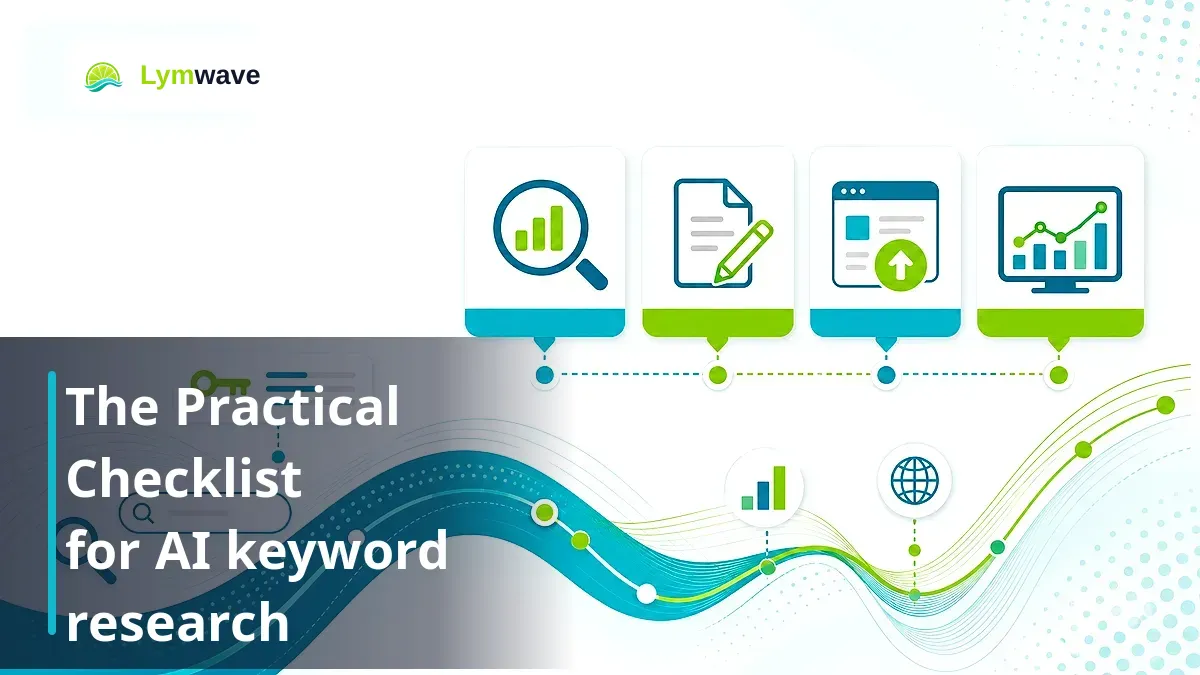
This guide sits in the AI SEO Automation topic cluster as a supporting resource.
Why The Practical Checklist for AI keyword research matters
AI keyword research is useful only when it turns search demand into a clear publishing decision. A long list of phrases is not a strategy. The work is to understand what people are trying to solve, decide which topics belong in the content plan, and give each article enough context to rank, answer questions, and support AI search visibility.
Quick answer: a practical AI keyword research checklist should cover audience, search intent, topic clusters, entity coverage, question coverage, internal links, publishing priority, and post-publication measurement. AI can speed up discovery and grouping, but a human should still approve the topic, angle, and claims before the article moves into production.
This matters for SaaS founders, small business owners, and content marketers because AI SEO automation can make content planning faster, but it can also make weak planning easier to scale. If the keyword process only collects terms, the article pipeline will publish scattered posts. If the process connects keywords to audience problems and topic clusters, automation becomes much more useful.
The goal is not to find every possible keyword. The goal is to choose the few opportunities that deserve a page, understand the answer the page must provide, and prepare enough structure for a strong article brief.
What The Practical Checklist for AI keyword research means
AI keyword research means using AI assistance to collect, classify, expand, and organize search opportunities. It can help summarize query patterns, group similar phrases, identify likely intent, suggest questions to answer, and connect a topic to existing content. It should not be treated as automatic approval to publish every suggested topic.
The practical checklist has three layers:
| Layer | What to decide | Why it matters |
|---|---|---|
| Demand | Which queries, questions, and problems show interest? | Keeps the plan connected to real reader needs |
| Fit | Which topics match the audience, product, and content cluster? | Prevents generic articles that do not support the business |
| Execution | What should the article answer, link to, and measure? | Turns research into a usable brief and workflow |
For SEO, the checklist helps choose a primary keyword, supporting phrases, a clean URL, and a search-intent match. For AEO, it highlights the direct answer and FAQ questions the post should address. For GEO, it makes entities and category language explicit so AI systems can understand how the topic connects to the broader content library.
AI is especially helpful when the team already has boundaries. It can sort a messy keyword export into clusters, flag duplicate ideas, and propose briefing notes. Without boundaries, it may produce a polished list that looks useful but does not match the business, the audience, or the existing content plan.
How to approach The Practical Checklist for AI keyword research
Start with the audience, not the tool. A keyword list for a SaaS founder should not look exactly like a keyword list for an agency, ecommerce brand, or local service business. The same phrase can imply different content depending on who is searching and what they need next.
Use this checklist before adding a topic to the plan:
- Define the reader. Name the audience segment, their problem, and the decision they are trying to make.
- Identify the intent. Decide whether the searcher wants a definition, checklist, tutorial, comparison, template, troubleshooting guide, or strategic explanation.
- Choose one primary keyword. Use it as the organizing phrase, not as a phrase to repeat in every heading.
- Group secondary keywords. Keep close variants and related workflow terms together so the article has depth without becoming unfocused.
- List the answer questions. Add the questions the article must answer directly near the top, in the workflow, and in the FAQ.
- Map entity coverage. Note the people, tools, platforms, categories, and processes that explain the topic clearly.
- Check existing content. Avoid creating a duplicate article when an older post should be refreshed instead.
- Choose internal links. Connect the topic to relevant existing posts, such as a broader AI SEO automation guide or a planning workflow like how to create a 30-day SEO content plan with AI.
- Set a publishing priority. Prioritize topics that support a cluster, answer a sales or support question, or fill a visible content gap.
- Define measurement. Decide which signals will show whether the topic worked: impressions, clicks, query fit, internal-link movement, assisted conversions, or refresh opportunities.
This process keeps AI content workflow practical. AI can draft the clustering notes, summarize the intent, and suggest the brief. The editorial owner still decides whether the opportunity is worth publishing and whether the article needs product context, examples, or additional proof.
For teams that publish frequently, the checklist should become a repeatable handoff. A keyword opportunity should not move into article generation until the primary intent, target audience, internal links, and answer target are clear. That one rule prevents many generic drafts.
How this supports SEO, AEO, and GEO
The same keyword research process can support search engines, answer engines, and generative AI systems when the output is structured around intent and context.
SEO benefits from focus. A clear primary keyword, related terms, and internal links help the article match a specific demand pattern. The page becomes easier to title, describe, crawl, and connect to the rest of the site.
AEO benefits from direct answers. If the research process captures the questions readers ask, the article can answer them in visible copy instead of hiding the useful point deep in the page. A good brief should include the answer target before drafting begins.
GEO benefits from entity clarity. AI systems need more than isolated keywords. They need to understand that AI keyword research connects to AI SEO Automation, SEO content automation, AI content automation, search intent, topic clusters, content briefs, internal linking, and refresh decisions. The article should explain those relationships in normal language.
Use this final review before publishing a keyword-led article:
| Review area | Question to ask |
|---|---|
| Intent | Does the article answer the reason someone searched this topic? |
| Differentiation | Does the page have a specific angle, example, or workflow? |
| Links | Does it connect to relevant existing posts without forcing links? |
| Metadata | Do title, description, canonical, and social image match the page? |
| Schema | Do BlogPosting, FAQPage, and breadcrumbs reflect visible content? |
| Measurement | Do we know how this topic will be evaluated after publication? |
For a deeper optimization pass after the draft is written, use the companion guide on how to optimize blog posts for SEO, AEO, and GEO.
Common mistakes to avoid
The first mistake is letting AI choose topics without business context. A tool can suggest search opportunities, but it does not know which customers matter most, which product workflows should be explained, or which topics already exist in the site architecture unless that context is supplied.
The second mistake is treating every keyword as a new article. Many opportunities should become sections inside existing pages, FAQ additions, refresh tasks, or internal-link improvements. Publishing a new URL is only the right move when the topic has a distinct intent and enough value to stand alone.
The third mistake is confusing volume with priority. High-volume keywords are not automatically better. A lower-volume phrase with stronger fit, clearer intent, and better conversion relevance can be more useful for a smaller team.
The fourth mistake is overusing exact-match phrases. The primary keyword should guide the page, but the article should read naturally. Repeated exact-match headings make content feel mechanical and less trustworthy.
The fifth mistake is skipping measurement. Keyword research should not end when the post is published. Search Console data, query fit, CTR, rankings, internal-link clicks, and refresh signals should feed the next planning cycle.
Finally, avoid unsupported claims. AI keyword research can improve consistency and speed, but it does not guarantee rankings, citations, traffic, or revenue. The safest promise is operational: better inputs make the content workflow easier to review and improve.
Frequently asked questions
What should you know about AI keyword research?
You should know that AI keyword research is a planning workflow, not just a keyword-list generator. It works best when AI helps organize demand, intent, questions, and entities while a human approves the topic, angle, and publishing priority.
How does AI keyword research support SEO, AEO, and GEO?
It supports SEO by matching articles to search intent, AEO by capturing direct questions and answers, and GEO by clarifying entities, categories, and workflow context that AI systems can understand and summarize.
What mistakes should you avoid with AI keyword research?
Avoid publishing every suggested keyword, ignoring existing content, chasing volume without fit, repeating exact-match phrases too often, skipping internal links, and treating AI output as approved strategy.
Can AI keyword research replace a content strategist?
No. AI can accelerate discovery, clustering, and brief preparation, but the strategist still owns audience fit, product context, prioritization, and the decision to publish, refresh, merge, or ignore an opportunity.
What should happen after keyword research is complete?
The selected opportunity should become a brief with a primary keyword, search intent, answer target, entity notes, internal links, metadata direction, and measurement plan. Then it can move into drafting, review, optimization, and publishing.
Useful next reads
AI SEO Automation Guide: How to Build a Content Engine That Publishes Consistently explains practical SEO, AEO, and GEO workflows for planning, publishing, measuring, and improving useful content consistently.
How to Create a 30-Day SEO Content Plan with AI explains practical SEO, AEO, and GEO workflows for planning, publishing, measuring, and improving useful content consistently.
How to Optimize Blog Posts for SEO, AEO, and GEO explains practical SEO, AEO, and GEO workflows for planning, publishing, measuring, and improving useful content consistently.
Turn this into a working content system
Audit your content, find AI visibility gaps, and build a publishing workflow that compounds.