

The Practical AI Blog Strategy Checklist
Use this practical AI blog strategy checklist to plan, review, publish, and improve useful content without automating away editorial judgment.
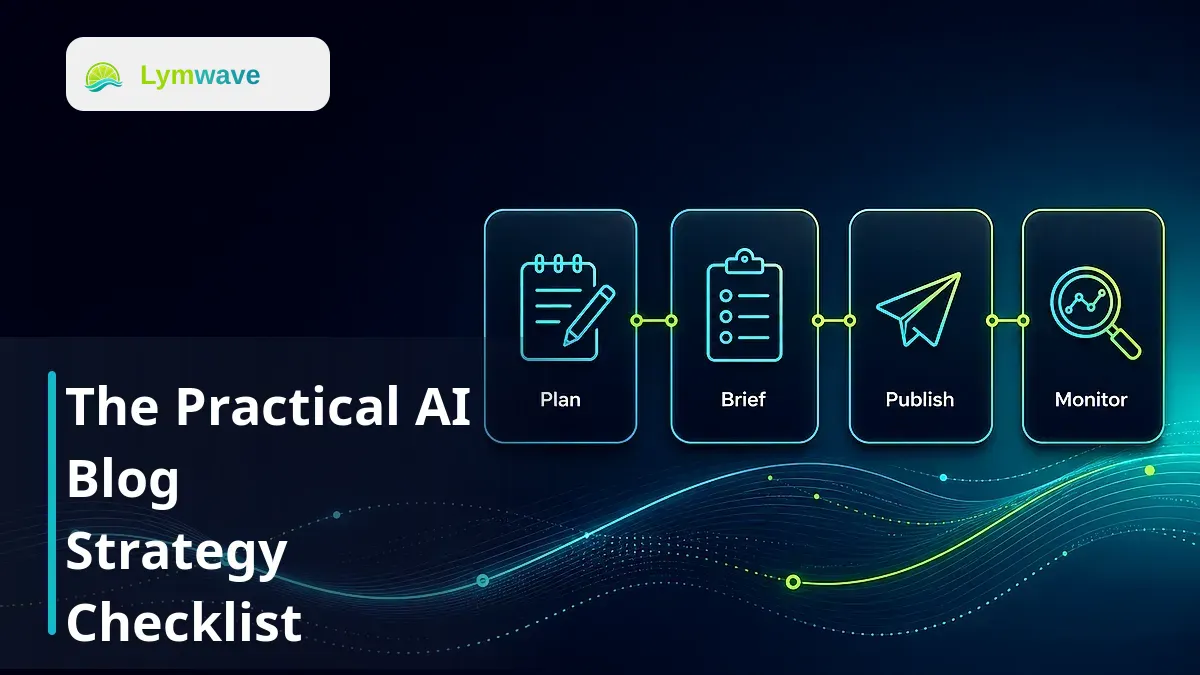
This guide sits in the AI SEO Automation topic cluster as a supporting resource.
An AI-assisted blog needs a repeatable way to decide what deserves coverage, what a useful article must contain, and what happens after publication.
Quick answer: an AI blog strategy checklist should cover audience, goals, evidence, topic selection, briefs, editorial review, metadata, internal links, publishing, and measurement. AI can accelerate research and production, but people should still approve the strategy, verify claims, shape the point of view, and decide what gets published.
This checklist is for SaaS founders, small business owners, and content marketers who want a practical AI content workflow without producing interchangeable drafts. Complete each relevant section before moving an article forward.
Why an AI blog strategy checklist matters
AI SEO automation can increase output quickly. That is useful only when the system is producing pages that serve a defined audience and strengthen the site rather than overlap with it.
A checklist makes the operating standard visible. It catches weak ideas before drafting, unsupported claims before approval, and broken details before launch. It also shifts attention from article volume to worthwhile answers.
Keep it short enough to use. Each item should help the team:
- proceed;
- revise the plan;
- merge or refresh existing content; or
- stop an idea that lacks value or evidence.
If every idea always passes, the checklist is probably too vague.
Checklist 1: Set the strategy before choosing topics
Start with the reader and the business context. Topic generation comes later.
- Name one priority audience. Record what they already understand, what problem they are trying to solve, and what would count as a useful outcome.
- Define the blog's role. Decide whether it educates prospects, supports adoption, answers questions, or builds category understanding.
- Choose a focused subject area. State the category and adjacent topics the blog will cover—and what sits outside its scope.
- Choose a credible next step. It may be another guide, a tool, a product workflow, or a conversation.
- Assign decision ownership. Name who approves topics, claims, final drafts, and publication.
- Set realistic capacity. Plan around the number of articles the team can review well, not the number an AI system can generate.
A useful one-sentence strategy looks like this:
Our blog helps [audience] solve [problem] with [types of content]. We prioritize topics using [evidence], use AI for [repeatable tasks], and require human approval for [important decisions].
If any subject could fit that sentence, narrow the audience, problem, or content role.
Checklist 2: Turn evidence into a focused plan
An AI model can suggest hundreds of plausible titles. A strategy needs a reason to choose one title over another.
- Collect real inputs. Use customer questions, site audits, Search Console queries, existing-page performance, and subject expertise.
- Inventory existing content. Record each live URL's audience, intent, main answer, topic cluster, and status.
- Check for overlap. Compare a proposed article with existing pages before creating a new URL.
- Identify the article's job. Label it as a definition, tutorial, checklist, comparison, pillar, supporting article, or refresh.
- State the search intent. Explain what the reader wants to understand, accomplish, compare, or fix.
- Score business and reader fit. High search volume should not outweigh weak relevance.
- Confirm available expertise. Make sure the team can review the subject credibly.
- Sequence dependencies. Publish or update foundational pages before supporting articles that depend on them.
- Choose create, refresh, consolidate, or wait. A new draft is only one possible outcome.
For a manageable queue, use a 30-day SEO content plan. Keep a rationale beside each priority.
Before drafting, summarize the decision in one line:
| Decision | Evidence | Intended reader outcome |
|---|---|---|
| Create, refresh, consolidate, or wait | The signals behind the choice | What the reader should know or do |
If the evidence or intended outcome cannot be stated clearly, return the topic to planning.
Checklist 3: Control drafting and editorial review
The approved brief connects strategy to production. It should provide enough context for a useful first draft without treating that draft as finished.
- Define the direct answer. Write a concise answer to the main question before expanding the article.
- Set scope and exclusions. Clarify what the article covers and what belongs elsewhere.
- List questions and entities. Include only concepts needed for an accurate explanation.
- Choose useful internal links. Link to live pages that deepen the reader's next step.
- Set source rules. Identify claims that need primary sources, documentation, or expert review.
- Add brand and product context. Prevent generic advice and inaccurate product descriptions.
- Record claims to avoid. Exclude guarantees, invented statistics, fake proof, and unsupported comparisons.
- Specify the page package. Include the title, H1, description, canonical, image direction, and schema.
- Generate in reviewable stages. Review the outline and direct answer before spending time on the full draft.
- Run a human editorial pass. Check usefulness, accuracy, clarity, examples, repetition, tone, and fit with the approved intent.
Review the draft against the brief, not “Does this sound polished?” Polished copy can still answer the wrong intent or repeat an existing page.
A practical editorial gate asks:
- Does the opening answer the main question quickly?
- Does every section help the intended reader?
- Are distinctions, examples, and recommendations specific?
- Can every factual or product claim be supported?
- Does the article add something distinct to the content library?
Checklist 4: Complete the publishing checks
Run publishing checks after editorial review so metadata and links match the final article.
- Use one clear H1. It should accurately describe the page without stuffing variants of the target phrase.
- Check heading order. H2 and H3 sections should form a logical, scannable outline.
- Confirm unique metadata. The title and description should distinguish this page from related articles.
- Verify the canonical URL. It should use the intended clean slug.
- Match social metadata. Open Graph and X/Twitter data should represent the page.
- Optimize the featured image. Use compressed media, descriptive alt text, and no invented proof.
- Test every internal link. Remove links to planned pages that are not live.
- Match structured data to visible content. BlogPosting, BreadcrumbList, and FAQPage data should describe content that readers can actually see.
- Check crawlability. Confirm index settings, sitemap coverage, robots directives, and server-rendered content.
- Preview mobile reading. Look for dense copy, wide tables, and broken media.
- Approve the final version. Record who reviewed it and when.
The SEO, AEO, and GEO optimization guide provides a deeper review. Optimization should confirm that the page supports the reader's intent.
Checklist 5: Learn after publication
An AI blog strategy becomes useful when publication creates feedback for the next decision.
- Confirm the page is accessible and indexable. Check the live URL, canonical, metadata, links, and rendering.
- Record the baseline. Note the date, intent, related pages, and available signals.
- Allow time for meaningful evidence. Avoid rewriting a new page in response to a few days of noise.
- Review query fit. Check whether impressions and clicks come from searches that match the intended answer.
- Inspect engagement in context. Do not treat one metric as proof of quality.
- Review internal-link support. Confirm that useful related pages link to the article and that the article links onward.
- Watch for overlap. New query data may reveal that two pages are competing for the same intent.
- Choose the next action. Refresh, consolidate, improve links, wait, or plan supporting content.
- Document the decision. Feed the reason—not just the metric—back into the content plan.
Publishing frequency, word count, and draft volume describe activity. They do not establish rankings, conversions, backlinks, or AI citations.
Lymwave connects business context, audits, Search Console insights, planning, SEO/AEO/GEO article and image generation, publishing, translations, Buffer distribution, reports, visibility monitoring, and MCP tools. Human review remains important for evidence, claims, and approval.
How the checklist supports SEO, AEO, and GEO
The same reader-first workflow can support multiple discovery surfaces:
| Discipline | Checklist emphasis | Useful outcome |
|---|---|---|
| SEO | Search intent, crawlability, metadata, internal links, and query feedback | A page that search engines can understand and connect to the site |
| AEO | A visible direct answer, clear questions, concise sections, and matched FAQ content | An answer that can be extracted without losing its meaning |
| GEO | Explicit entities, category context, supported claims, and consistent brand language | Content that gives generative systems clearer relationships and context |
These disciplines overlap, but they are not guarantees. A checklist can improve clarity and readiness; it cannot promise rankings, traffic, backlinks, or citations. Strong GEO context comes from explaining the audience, problem, category, workflow, and product clearly—not repeating a brand or keyword.
Common mistakes to avoid
The first mistake is starting with a quota. Cadence should follow editorial capacity and worthwhile opportunities.
The second is treating generated keyword lists as evidence. Validate those hypotheses against customers, the site, search data, and business relevance.
The third is automating approval. AI can flag risks, but people should approve sensitive claims, comparisons, and recommendations.
The fourth is creating a new page for every phrase variation. Consolidate overlapping intent and use internal links to build a coherent topic cluster.
The fifth is forgetting to recheck metadata and schema after revision. The sixth is refreshing too quickly—or never. Wait for useful signals and change the page for a documented reason.
Finally, do not report output as guaranteed growth. Results still depend on the audience, competition, website, distribution, authority, and time.
Frequently asked questions
What should an AI blog strategy checklist include?
Include audience, goals, evidence, content inventory, topic selection, intent, briefs, editorial review, metadata, links, schema, publishing checks, and measurement.
When should a team use this checklist?
Use the relevant section before topic approval, drafting, publication, and performance reviews. Do not save the checklist for the end.
Can AI complete the checklist automatically?
AI can collect inputs, suggest answers, detect overlap, and run checks. A person should approve priorities, verify claims, judge usefulness, and authorize publication.
How does the checklist support SEO, AEO, and GEO?
It supports SEO through intent, metadata, crawlability, and links; AEO through direct answers and clear questions; and GEO through explicit entities, supported claims, and consistent category context.
How often should an AI blog strategy be reviewed?
Review signals regularly and revisit the strategy when the audience, product, capacity, or evidence changes. Ignore isolated short-term noise.
Does following the checklist guarantee organic growth?
No. It improves planning, editorial control, publishing completeness, and learning, but it cannot guarantee rankings, traffic, backlinks, conversions, or AI citations.
Useful next reads
AI SEO Automation Guide: How to Build a Content Engine That Publishes Consistently explains practical SEO, AEO, and GEO workflows for planning, publishing, measuring, and improving useful content consistently.
How to Create a 30-Day SEO Content Plan with AI explains practical SEO, AEO, and GEO workflows for planning, publishing, measuring, and improving useful content consistently.
How to Optimize Blog Posts for SEO, AEO, and GEO explains practical SEO, AEO, and GEO workflows for planning, publishing, measuring, and improving useful content consistently.
Turn this into a working content system
Audit your content, find AI visibility gaps, and build a publishing workflow that compounds.