

SEO content automation for Agencies
SEO content automation for Agencies explains practical SEO, AEO, and GEO workflows for planning, publishing, measuring, and improving useful content consistently.
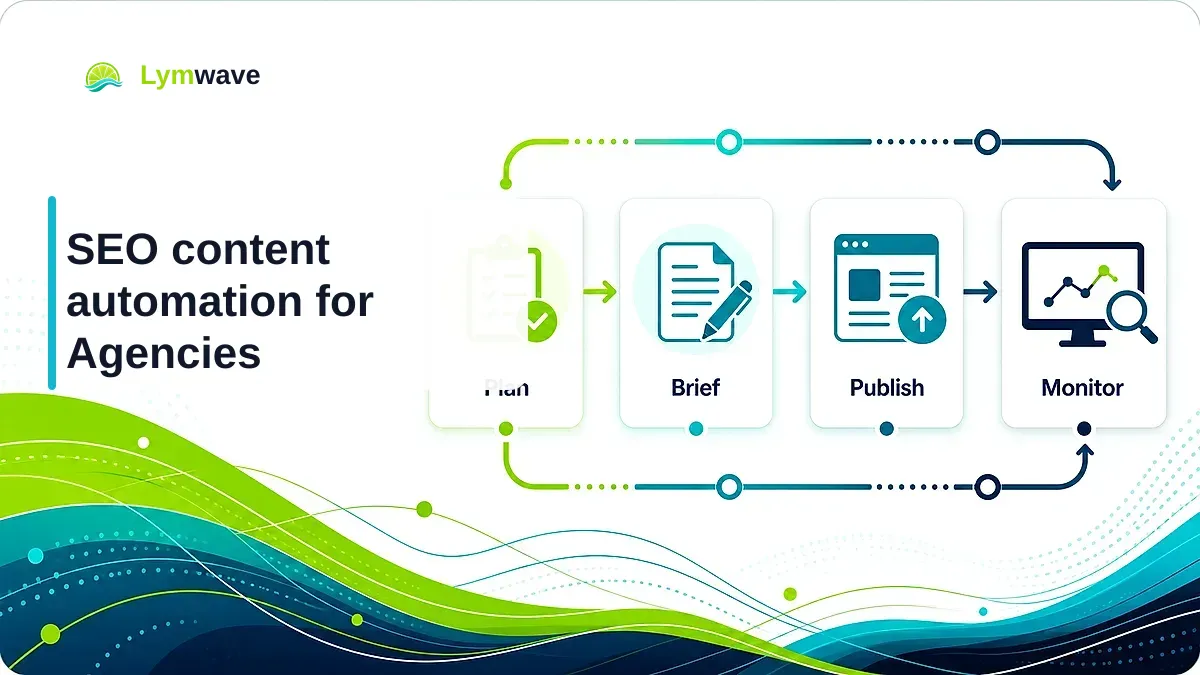
This guide sits in the AI SEO Automation topic cluster as a supporting resource.
Why SEO content automation for Agencies matters
Quick answer: SEO content automation for agencies works when it turns research, briefs, drafting, review, publishing, reporting, and refreshes into a repeatable client workflow. It should improve consistency without removing expert judgment.
Agencies are asked to publish more content across more channels while still proving that the work is strategic. A client may need educational blog posts, comparison content, local pages, refreshes, internal links, featured images, and monthly reporting. The pressure is not only volume. The pressure is doing that work without letting quality, brand context, or search intent drift.
That is where automation can help. A disciplined AI content workflow gives the agency a shared operating system: every article starts from a brief, uses the right client context, passes through human review, ships with metadata, and gets measured after publication. The result is not a hands-off article machine. It is a cleaner production line for work the agency already knows how to do.
For agency teams, the most valuable automation is usually in the handoffs. Strategy becomes approved briefs. Briefs become first drafts. Drafts become SEO, AEO, and GEO checks. Approved content becomes CMS-ready articles. Performance data becomes refresh priorities. When those steps are visible, account managers, strategists, writers, editors, and clients can move faster without guessing what changed.
The business case is simple: agencies need predictable content operations. Automated SEO content can protect margins, reduce missed details, and keep client work moving, but only if the system includes guardrails for claims, tone, links, and approvals.
What SEO content automation for Agencies means
SEO content automation for agencies means using structured tools and AI-assisted workflows to produce, optimize, publish, and improve client content at a consistent standard. It is different from asking an AI writing tool to generate a batch of posts from keywords.
The agency version has extra complexity because each client has a different audience, offer, approval process, CMS, and risk tolerance. A workflow that works for one SaaS client may not work for a local service business or ecommerce brand. Good automation stores those differences before drafting begins.
At minimum, each client workflow should define:
| Input | Why it matters |
|---|---|
| Audience and funnel stage | Keeps the article aligned with the reader's decision process |
| Search intent | Prevents a commercial page from sounding like a glossary entry |
| Product or service context | Reduces unsupported claims and generic examples |
| Required entities | Helps SEO, AEO, and GEO systems understand the topic clearly |
| Internal link targets | Connects the article to live supporting content |
| Review owner | Keeps accuracy and approval responsibility explicit |
This is why agencies should treat AI SEO automation as operations, not only generation. The draft is one output. The stronger asset is the repeatable process around it.
For example, a strategist can build the content plan, an editor can approve the brief, automation can create a complete draft, and the account team can review the article against client positioning. The final post can then ship with a canonical URL, Open Graph image, FAQ structure, and reporting notes already prepared.
If your team is still shaping that operating model, start by defining how planning, drafting, optimization, publishing, and measurement fit together. The agency-specific goal is to make that engine repeatable across accounts without making every client sound the same.
How to approach SEO content automation for Agencies
Start with one service line. Agencies often try to automate everything at once: net-new posts, refreshes, briefs, keyword clustering, CMS publishing, reporting, and social distribution. That creates confusion quickly. Pick one workflow, define the standard, and expand after the team trusts the process.
A practical agency workflow looks like this:
- Create the client content profile. Capture audience, positioning, services, excluded claims, tone, competitors, publishing destination, and approval rules.
- Build a focused topic queue. Group ideas by client goals, search intent, topic cluster, and funnel stage.
- Approve briefs before drafting. Each brief should include the main question, outline, entities, examples, internal links, and review notes.
- Generate complete first drafts. Use the approved brief and client profile, not only the keyword.
- Run quality checks. Review search intent, factual accuracy, heading structure, metadata, FAQs, internal links, and brand fit.
- Publish or export cleanly. Prepare the article for the client's CMS with image, slug, canonical, and social metadata.
- Report and refresh. Connect impressions, clicks, rankings, engagement, and client feedback to the next action.
This flow gives every team member a clear job. Strategists own direction. Editors own usefulness. Account managers own client fit. Automation handles repetitive assembly and checks.
The topic queue should be smaller than most agencies expect. A 30-day plan is usually enough to prove the workflow, keep the client involved, and avoid a backlog of stale ideas. The process in how to create a 30-day SEO content plan with AI works well as a starting point for client approvals because it turns broad strategy into a concrete publishing queue.
Briefs should be compact but strict. A good brief names the primary question, reader stage, search intent, required entities, internal links, examples to include, and claims to avoid. That gives automation enough context to create a useful draft while preserving room for expert editing.
Quality control should be part of the system, not a heroic final pass. Before publication, check whether the article answers the main question quickly, whether the sections match the intent, whether the FAQ repeats or adds value, whether internal links are live, and whether the article makes any claim the client has not approved.
For agencies, the best metric is not articles generated. It is articles approved, published, indexed, refreshed, and connected to business goals. A workflow that creates fewer drafts but ships more usable content is usually the better system.
How this supports SEO, AEO, and GEO
SEO content automation supports classic search by making planning and optimization more consistent across clients. Articles can be mapped to clusters, written for a specific intent, linked to relevant live pages, and shipped with clean metadata instead of relying on memory at the end of production.
It supports AEO by making direct answers part of the article structure. An agency can require every post to include a concise opening answer, clear definitions where useful, comparison tables when they clarify choices, and FAQ answers that are specific enough to stand alone.
It supports GEO by keeping entity language consistent across a client's content library. Search and generative systems need stable signals about the brand, category, audience, workflow, and problem being solved. Terms such as SEO, AEO, GEO, AI content automation, automated SEO content, and AI content workflow should appear naturally where they help the reader.
Use this review grid before client approval:
| Review area | Question | Good sign |
|---|---|---|
| SEO | Does the article target one clear intent? | The title, H1, intro, and sections all point at the same need |
| AEO | Can the main answer be quoted cleanly? | The opening answer is concise and specific |
| GEO | Are key entities explained in context? | Category terms support the workflow instead of feeling inserted |
| Client fit | Are examples and claims approved? | The article reflects real positioning and avoids invented proof |
| Operations | Is the post ready to publish? | Slug, metadata, image, links, and review status are complete |
This layer matters because agency content often crosses multiple reviewers. A strategist may think in terms of clusters, an editor may think in terms of clarity, and a client may think in terms of brand risk. A shared SEO, AEO, and GEO checklist gives everyone the same inspection frame.
For a deeper article-level review process, pair the workflow with how to optimize blog posts for SEO, AEO, and GEO. It gives agencies a practical way to inspect headings, direct answers, structured data, internal links, and entity coverage before content goes live.
Common mistakes to avoid
The first mistake is selling automation as unlimited content. Clients do not need unlimited drafts. They need useful, accurate, approved content that supports their market position. If automation increases volume while lowering trust, the agency inherits the cleanup work later.
The second mistake is using the same prompt or template for every client. A law firm, B2B SaaS company, clinic, and local contractor do not need the same structure, examples, proof standards, or tone. Client context has to sit inside the workflow.
Another mistake is skipping brief approval. If the brief is wrong, the draft will be polished in the wrong direction. Agencies save more time by approving the angle early than by rewriting a complete article after the fact.
Do not let generation outpace review capacity. Automated drafting can create a queue faster than editors or clients can inspect it. Set the publishing cadence from approval capacity, not model speed.
Avoid linking to pages that are not live. Internal links should help readers and crawlers move through the existing content library. Keep planned future pages in the roadmap until they are published.
Do not invent proof. AI-assisted content should never create customer outcomes, named logos, rankings, pricing details, integration claims, or performance numbers unless those details are supplied and approved by the client.
Finally, do not ignore refresh work. Agency retainers often focus on new content because it is easier to show output. But old content can lose accuracy, rankings, and conversion value. Add refresh checks to the same automation workflow so published assets keep earning their place.
Frequently asked questions
What should you know about SEO content automation for Agencies?
You should know that it is a repeatable production workflow, not only AI writing. The strongest agency systems combine client context, topic planning, brief approval, draft generation, human review, metadata, publishing steps, reporting, and refreshes.
How does SEO content automation for Agencies support SEO, AEO, and GEO?
It supports SEO through consistent topic mapping, metadata, and internal links. It supports AEO through direct answers, definitions, comparison structures, and FAQs. It supports GEO through stable entity language that helps generative systems understand the client, category, audience, and workflow.
What mistakes should you avoid with SEO content automation for Agencies?
Avoid generating from keywords alone, reusing one workflow for every client, skipping brief approval, publishing faster than reviewers can keep up, linking to missing pages, inventing proof, and forgetting to refresh older articles.
How can agencies keep automated SEO content from sounding generic?
Use client-specific inputs before drafting: audience, positioning, services, examples, excluded claims, tone, internal links, and approval notes. Then review the draft for real usefulness, not just grammar or keyword coverage.
What is the best first workflow to automate?
Start with one repeatable workflow such as monthly blog planning, article briefs, or first-draft generation for a single client segment. Once the team trusts that workflow, connect it to publishing, reporting, and refresh decisions.
Useful next reads
AI SEO Automation Guide: How to Build a Content Engine That Publishes Consistently explains practical SEO, AEO, and GEO workflows for planning, publishing, measuring, and improving useful content consistently.
How to Create a 30-Day SEO Content Plan with AI explains practical SEO, AEO, and GEO workflows for planning, publishing, measuring, and improving useful content consistently.
How to Optimize Blog Posts for SEO, AEO, and GEO explains practical SEO, AEO, and GEO workflows for planning, publishing, measuring, and improving useful content consistently.
Turn this into a working content system
Audit your content, find AI visibility gaps, and build a publishing workflow that compounds.