

SEO content automation: Common Mistakes and How to Avoid Them
SEO content automation: Common Mistakes and How to Avoid Them explains practical SEO, AEO, and GEO workflows for planning, publishing, measuring, and improving useful content consistently.
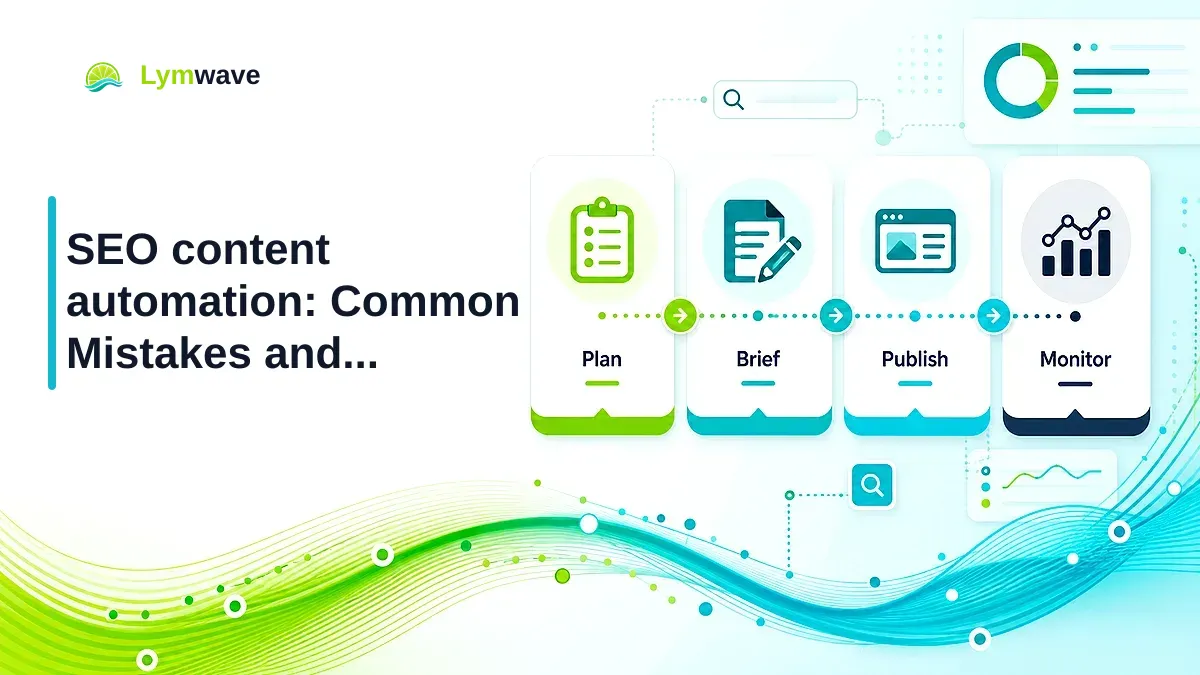
This guide sits in the AI SEO Automation topic cluster as a supporting resource.
Why SEO content automation matters
Quick answer: SEO content automation works when it turns strategy, briefs, writing, metadata, internal links, publishing, and measurement into one reviewed workflow. It fails when teams use it only to produce more drafts without intent, quality checks, or a feedback loop.
Automation is useful because content operations have many repeatable parts. A team can standardize search intent checks, article briefs, metadata, schema, internal links, publishing handoffs, and performance reviews. That helps SaaS founders, small business owners, and content marketers publish more consistently without rebuilding the process for every article.
The risk is that the same speed can amplify weak decisions. If the topic is vague, the brief is thin, or the article is not connected to a cluster, automation simply makes the mistake faster. A reliable workflow has to preserve editorial judgment while removing repetitive coordination.
The goal is not to remove human review. The goal is to make review easier by giving every article a clear intent, target audience, topic role, internal-link plan, metadata set, and measurement path before it goes live.
What SEO content automation means
SEO content automation means using software and AI to coordinate the content workflow from planning to publishing and improvement. It can include topic discovery, 30-day plans, briefs, article drafts, metadata, internal links, featured images, CMS export, translation, reporting, and refresh recommendations.
It is not the same as asking an AI writer for a blog post and publishing whatever comes back. A real automated SEO content workflow has structure around the AI step.
| Workflow layer | What automation should help with | What still needs judgment |
|---|---|---|
| Planning | Grouping topics, search intent, and cluster roles | Choosing the topics that matter to the business |
| Briefing | Turning intent and entities into article requirements | Deciding the angle, examples, and promise |
| Drafting | Producing a complete first version | Checking usefulness, accuracy, and tone |
| Optimization | Metadata, FAQs, schema, links, and image prompts | Avoiding keyword stuffing and weak claims |
| Publishing | Scheduling, exporting, and status tracking | Approving what is ready to go live |
| Improvement | Monitoring and refresh prompts | Choosing what to update, merge, or stop |
This definition matters because many content problems are process problems. The draft may be the most visible output, but it is rarely the only place where quality is won or lost.
How to approach SEO content automation
Start with the operating model, not the tool. Decide how a topic becomes a brief, how a brief becomes a draft, who reviews the article, what must be true before publishing, and how results are checked after publication.
A simple workflow is enough:
- Choose a topic cluster and business goal.
- Identify the search intent and likely reader.
- Create a short brief with entities, questions, internal links, and article role.
- Generate the draft from the brief.
- Review the article for usefulness, accuracy, structure, links, and claims.
- Add metadata, schema, featured image, and publishing details.
- Publish or schedule the article.
- Review performance and create refresh tasks.
For planning, connect this process to a calendar. A guide like how to create a 30-day SEO content plan with AI helps keep article ideas tied to a publishing rhythm instead of a loose backlog.
For cluster structure, anchor supporting articles to a pillar or a strong hub article. That kind of page can collect supporting posts, explain the broader system, and reduce orphaned content. The important point is that every supporting article should know what it supports before the draft is generated.
The most practical approach is to treat every automated article as a small product shipment. It needs a purpose, constraints, acceptance checks, and a follow-up loop.
This also helps reviewers. Instead of asking "is this article good?" in the abstract, the reviewer can ask sharper questions: does this page answer the intended question, does it fit the cluster, does it link to the right existing pages, and does it create a clear next action for the reader?
When a workflow reaches that level of clarity, automation becomes less risky. The system is not trying to make all editorial decisions. It is carrying structured inputs through repeatable steps so the team can spend more attention on accuracy, usefulness, and fit.
How this supports SEO, AEO, and GEO
Automation supports SEO when it produces crawlable, internally linked, intent-matched pages. It should help the site build topical coverage and keep metadata consistent without turning every page into the same template.
It supports AEO when content gives direct answers near the top, uses clear definitions, and includes concise FAQ answers that match visible content. Answer engines need well-structured explanations, not long articles that bury the point.
It supports GEO when entity relationships are explicit. The article should make the category, audience, workflow, and brand context easy for generative systems to summarize. That means using terms such as AI SEO Automation, AI content automation, SEO, AEO, GEO, and automated SEO content in useful context rather than repeating them mechanically.
Use a basic review checklist before publishing:
| Area | Check |
|---|---|
| SEO | Does the article match one clear intent and link to related existing pages? |
| AEO | Does the intro answer the main question directly? |
| GEO | Are the entities, audience, and workflow easy to understand? |
| Editorial | Are claims specific, restrained, and reviewable? |
| Operations | Is there a measurement or refresh path after publication? |
For page-level optimization, use a workflow like how to optimize blog posts for SEO, AEO, and GEO. It keeps the final review focused on what readers and search systems can actually evaluate.
The strongest workflows also separate reusable rules from article-specific judgment. Reusable rules include frontmatter requirements, canonical paths, image conventions, schema types, and internal-link validation. Article-specific judgment includes whether the explanation is genuinely helpful, whether the examples match the reader, and whether the recommendation is honest.
That split is useful for GEO as well. Generative systems often summarize pages by extracting entities, relationships, and short answer patterns. If every article follows a clear structure while still using specific examples, the library becomes easier to interpret without becoming repetitive.
Common mistakes to avoid
The first mistake is automating before the strategy is clear. If the audience, product category, and topic clusters are vague, the articles will feel vague too. Automation cannot fix unclear positioning.
The second mistake is using volume as the main success metric. Publishing more often can help, but only if the articles answer real questions, connect to the content architecture, and improve over time.
The third mistake is skipping briefs. A weak prompt usually creates a generic article. A useful brief includes search intent, reader context, related posts, required questions, entities, examples, and the job the page should do.
A fourth mistake is creating one universal template for every topic. Templates are helpful for metadata and quality checks, but the article angle still needs to change based on intent. A comparison page, a how-to guide, a troubleshooting post, and a strategic explainer should not all have the same section pattern.
Another mistake is allowing exact-match keyword repetition to drive headings and paragraphs. The article should sound natural. Keywords should clarify the topic, not make every section feel like it was written for a scanner instead of a person.
Teams also forget internal links. Automated posts should not become isolated URLs. Each article needs relevant links to existing content and should be eligible to receive links from future posts.
Publishing without measurement is another common failure. If nobody checks whether the article was indexed, received impressions, supported a cluster, or needs a refresh, the workflow cannot learn. A practical measurement habit is covered in how to measure AI SEO automation results.
Image and metadata shortcuts can create problems too. Reusing the same generic visual, leaving mismatched Open Graph images, or publishing vague descriptions makes the page feel unfinished. The same quality bar should apply to the supporting assets as to the article body.
Finally, watch for invisible workflow failures. A draft may be complete, but the article can still fail if it is not scheduled, exported, reviewed, linked, or monitored. These handoff points should be explicit in the system.
Do not overpromise what automation can deliver. It can improve consistency, planning, review, and publishing speed. It cannot guarantee rankings, traffic, backlinks, revenue, or AI citations.
Finally, avoid treating the AI draft as the final artifact. The final artifact is the reviewed, linked, metadata-complete, publishable page. That distinction keeps the workflow honest.
Frequently asked questions
What should you know about SEO content automation?
You should know that it is a workflow system, not just a writing shortcut. The best results come from combining topic strategy, clear briefs, AI-assisted drafting, editorial review, metadata, internal links, publishing controls, and measurement.
How does SEO content automation support SEO, AEO, and GEO?
It supports SEO by creating structured, internally linked pages; AEO by adding direct answers and FAQs; and GEO by making entities, audience, category, and workflow context easier for generative systems to understand.
What mistakes should you avoid with SEO content automation?
Avoid automating unclear strategy, measuring only volume, skipping briefs, overusing exact-match keywords, publishing without internal links, ignoring refresh signals, and making unsupported performance promises.
Should automated SEO articles be reviewed by a person?
Yes. Human review should confirm the article is useful, accurate, aligned with the business, restrained in its claims, and ready for the audience before it is published.
How many automated articles should a small team publish?
Start with a pace the team can review and improve. Consistency matters, but a smaller number of reviewed, internally linked, useful articles is better than a larger set of thin pages.
What is the safest first workflow to automate?
Start with briefs and metadata before full drafting. Automating topic briefs, search intent notes, related links, FAQs, and SEO fields gives the team structure while keeping editorial control close to the final article.
Useful next reads
AI SEO Automation Guide: How to Build a Content Engine That Publishes Consistently explains practical SEO, AEO, and GEO workflows for planning, publishing, measuring, and improving useful content consistently.
How to Create a 30-Day SEO Content Plan with AI explains practical SEO, AEO, and GEO workflows for planning, publishing, measuring, and improving useful content consistently.
How to Optimize Blog Posts for SEO, AEO, and GEO explains practical SEO, AEO, and GEO workflows for planning, publishing, measuring, and improving useful content consistently.
Turn this into a working content system
Audit your content, find AI visibility gaps, and build a publishing workflow that compounds.