

SEO article automation: Common Mistakes and How to Avoid Them
Avoid common SEO article automation mistakes with better briefs, source checks, editorial review, publishing validation, and measurement.
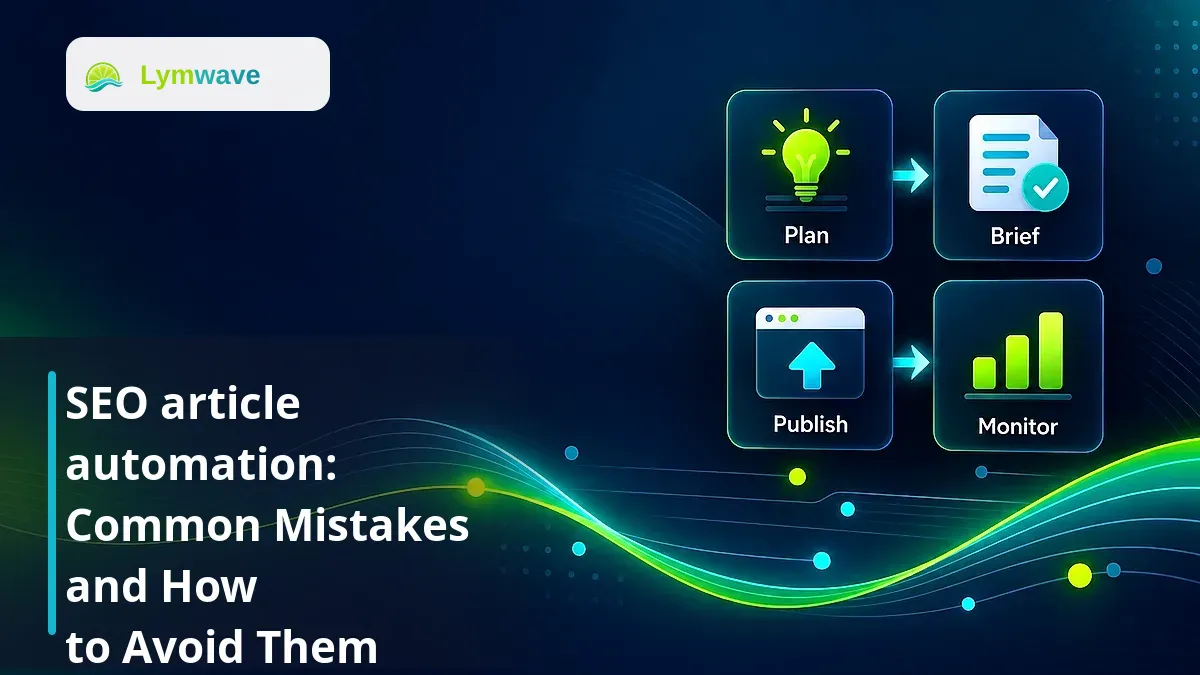
This guide sits in the AI SEO Automation topic cluster as a supporting resource.
SEO article automation works best when each draft has a distinct reader need, verified sources, an accountable reviewer, and a checked publishing destination. The common mistakes are scaling overlapping topics, trusting generated claims, approving unfinished pages, and measuring article volume without checking usefulness. Prevent them with explicit acceptance criteria at each handoff.
This guide is for SaaS founders, small business owners, and content marketers who already produce articles with AI and want fewer corrections after publication. The goal is a repeatable process that catches errors while they are still inexpensive to fix.
Why SEO article automation matters
Automation repeats decisions as well as tasks. A useful brief can make a series of drafts more consistent; an incorrect product description can spread the same mistake across that series. Faster generation therefore makes upstream checks more valuable.
Imagine a small software company creating articles about project handoffs. Its queue contains “handoff checklist,” “project handover checklist,” and “team handoff template.” Those phrases may belong on one practical resource. Automatically producing three similar articles creates three pages to review, link, and maintain before the team has established whether readers need separate answers.
The same problem appears after drafting. A broken image path or unsupported integration claim can survive across every scheduled article if nobody checks the output. Start by finding where errors repeat, then place a review step immediately before the next expensive action.
What SEO article automation means
SEO article automation connects repeatable work such as topic selection, briefing, drafting, metadata preparation, internal linking, publishing, and measurement. AI may perform some of these tasks, while deterministic checks handle requirements such as missing fields and invalid links.
A generated draft, an approved article, a published page, and an indexed URL are different states. Treating them as interchangeable makes reporting misleading and troubleshooting harder. A publishing integration can report success while the page still needs a visual check.
Google's guidance on generative AI content emphasizes accuracy, quality, and relevance, including metadata. It also warns that producing many pages without adding value may violate its scaled content abuse policy. The practical implication is to define the reader benefit before setting a production target.
A complete content process connects these states and records who is responsible for the next action.
How to approach SEO article automation
Use a small set of handoffs with a clear owner and a visible pass condition. A spreadsheet or existing content queue is enough; adding another dashboard is optional.
| Handoff | Pass condition | Hold the article when |
|---|---|---|
| Idea to brief | Audience, question, and intended URL are clear | An existing page already answers the same question |
| Brief to draft | Sources and product facts are available | The proposed angle depends on unverified claims |
| Draft to approval | The answer is useful and claims are checked | The reviewer cannot trace a material statement |
| Approval to publishing | Links, metadata, images, and destination are checked | Required fields or assets are missing |
| Publishing to maintenance | Live URL and review owner are recorded | The published page differs from the approved version |
Begin with a small batch and record why drafts are returned. If most revisions concern product accuracy, improve the business context supplied to the writer. If editors repeatedly merge topics, fix planning. If approved articles lose formatting, inspect the publishing handoff.
Choose the batch size according to review capacity. A team with time to check two articles should not schedule ten merely because drafts are available. Use a 30-day content plan to sequence work around the people and evidence required to finish it.
How this supports SEO, AEO, and GEO
SEO benefits from clear page intent, useful internal links, accurate metadata, and accessible content. Answer engine optimization (AEO) focuses editorial attention on direct answers and self-contained explanations. Generative engine optimization (GEO) adds attention to explicit entities, context, and statements that remain accurate when summarized.
These are useful editing perspectives, not guarantees of search placement or AI citations. Google states that its AI search features require no special additional optimization beyond established SEO practices. Do not let an automation workflow sell a special schema field or repeated keyword pattern as a requirement for inclusion.
For example, name the publishing destination and explain what happens there. “The editor approves the draft before it is sent to the CMS” is more useful than “AI transforms your content ecosystem.” Apply the same specificity to limitations, examples, and next steps.
Use the SEO, AEO, and GEO article checklist during review, while keeping every structured-data statement consistent with the visible page.
Common mistakes to avoid
1. Turning every keyword into a separate article
A list of keywords is not yet a content plan. Different phrases can express the same task, while a broad phrase can hide several distinct needs.
Before approving an idea, write one sentence describing what the reader will accomplish. Compare it with existing articles and other queued briefs. If the promised outcome and required answer are substantially the same, consider updating or combining the coverage. Create a separate URL when it serves a distinct question with enough substance to stand alone.
In the handoff example, a downloadable checklist and instructions for using it could share one page. A guide to troubleshooting failed client handoffs might justify another.
2. Supplying keywords without business context
A model cannot reliably infer your actual product capabilities, audience constraints, or editorial boundaries from a keyword. Generic input often produces advice that sounds plausible but does not fit the business.
Give the brief a named audience, a concrete problem, approved product facts, relevant source material, and claims to avoid. Include what the reader should do next. If a feature is planned but unavailable, explicitly exclude it from descriptions of current functionality.
Refresh this context when the product changes. Assign someone to maintain it so an old capability list does not become a permanent source of errors.
3. Treating confident prose as verified evidence
A fluent explanation can contain invented statistics, inaccurate comparisons, or outdated instructions. Adding a source link does not establish that the linked page supports the sentence.
Check material claims against the source itself. For a statistic, verify the population, period, and measurement. For a product instruction, verify the applicable version or current documentation. Remove claims that cannot be supported, or describe uncertainty clearly when it matters to the reader's decision.
Keep illustrative examples visibly hypothetical. A sample workflow is useful without pretending that a real customer achieved a specific traffic or revenue result.
4. Using a word target as the quality standard
Length requirements can encourage repeated advice, long introductions, and FAQ answers that restate the same point. These additions consume review time without helping the reader complete the task.
Review the draft against its promised outcome. Require enough detail to explain the decision, show an example, and identify relevant limitations. Cut paragraphs that add no new instruction or context. If the outline cannot support a full article without repetition, narrow the deliverable or combine it with related coverage.
Use a word target for planning effort, then judge the finished piece by its completeness and clarity.
5. Making approval a quick tone check
An article can sound on-brand while containing a wrong recommendation or a nonworking link. Approval needs a small, explicit definition.
Ask the reviewer to check the main answer, material claims, product references, internal links, and next step. Record the version approved. If later edits change a recommendation or introduce a new claim, return that part for review before publishing.
Separate automated checks from editorial judgment. A validator can confirm that metadata exists; the editor decides whether the description accurately represents the page. Both are useful, and neither replaces the other.
6. Assuming successful export means successful publication
Publishing systems can change formatting, drop image references, or send content to the wrong destination. Retrying an uncertain request can also create duplicate posts if the integration does not recognize the earlier attempt.
After publishing, open the live URL and compare it with the approved version. Check the title, headings, image, links, canonical destination, and intended indexability. Confirm that the article is discoverable from a relevant site page. Record the remote post identifier when available, and inspect the destination before retrying an ambiguous failure.
For an updated article, check that the existing URL was updated as intended and that the operation did not silently create a second page.
7. Reporting output without investigating results
Article count tells you how much work moved through the system. It does not establish whether the content reached the intended audience or helped the business.
Track operational results separately from search and business outcomes. Useful operational measures include review returns, publishing failures, and correction effort. For search review, inspect relevant impressions, clicks, and query fit. For business contribution, use the conversion events and attribution limits your analytics setup actually supports.
Compare like periods and record major changes. A traffic increase after publication alone does not prove automation caused it. Use observations to choose a specific next action: improve the answer, revise the brief, repair a link, or investigate discovery.
8. Leaving nobody responsible for maintenance
A scheduled article still needs an owner after it goes live. Product details, source material, and recommended workflows can change.
Record a review trigger with each page: a product release, changed source documentation, recurring reader confusion, or a meaningful performance shift. Prioritize pages where stale advice would most affect a reader's decision. Update the substance before changing the modification date, and keep a short note explaining what changed.
For teams evaluating Lymwave, these checks can serve as acceptance criteria for their content workflow. Start with the bottleneck that creates the most rework, then expand automation after the handoff becomes dependable.
Frequently asked questions
What should you know about SEO article automation?
It connects planning, drafting, review, publishing, and maintenance. Define a reader outcome and an owner for each handoff before increasing article volume. A generated draft is not automatically ready for publication.
How does SEO article automation support SEO, AEO, and GEO?
It can make intent checks, direct answers, entity clarity, metadata, and internal linking more consistent. Those practices improve the editorial process; they do not guarantee rankings, inclusion in AI answers, or citations.
What mistakes should you avoid with SEO article automation?
Avoid overlapping topics, missing business context, unsupported claims, repetitive padding, superficial approval, unchecked exports, output-only reporting, and ownerless maintenance. Fix recurring errors at the earliest handoff where they can be detected.
What should a small team fix first?
Review the last few articles that needed corrections. Identify the most frequent material failure and add one clear pass condition before that failure reaches publishing. Recheck the next batch before expanding the queue.
Useful next reads
AI SEO Automation Guide: How to Build a Content Engine That Publishes Consistently explains practical SEO, AEO, and GEO workflows for planning, publishing, measuring, and improving useful content consistently.
How to Create a 30-Day SEO Content Plan with AI explains practical SEO, AEO, and GEO workflows for planning, publishing, measuring, and improving useful content consistently.
How to Optimize Blog Posts for SEO, AEO, and GEO explains practical SEO, AEO, and GEO workflows for planning, publishing, measuring, and improving useful content consistently.
Turn this into a working content system
Audit your content, find AI visibility gaps, and build a publishing workflow that compounds.