

How to Use AI Content Briefs to Improve Organic Traffic
Learn how AI content briefs improve organic traffic by turning search intent, entities, internal links, and SEO/AEO/GEO checks into better drafts.
This guide sits in the AI SEO Automation topic cluster as a supporting resource.
Why AI content briefs matter for organic traffic
AI can turn a title into a draft quickly. That is useful, but it is not the same as creating an article that can earn useful organic traffic. Search traffic comes from matching a real query, answering the right intent, explaining the topic clearly, and connecting the page to the rest of the site. A brief is where those decisions should happen.
Quick answer: use AI content briefs to improve organic traffic by giving each article a clear reader problem, search intent, answer target, entity list, internal-link plan, metadata direction, and human review notes before drafting. AI can create the first version of the brief, but the team should approve the angle and constraints before the article is written.
This matters for SaaS founders, small business owners, and content marketers who want consistent publishing without turning the blog into a pile of disconnected AI drafts. A brief makes the content workflow visible. It tells the AI what to cover, what to avoid, where the page fits, and how the editor should judge the result.
Without a brief, AI SEO automation often produces smooth but generic content. The draft may mention the keyword, but miss the reader's real question. It may include headings, but fail to support the target page. It may be readable, but not specific enough to build authority. A brief reduces those failures before they become editing work.
What an AI content brief should do
An AI content brief is a structured plan for a single article. It translates keyword research, audience context, product positioning, and SEO/AEO/GEO requirements into instructions the writer, editor, or content agent can follow. The output should be more useful than an outline and more focused than a long prompt.
A practical brief should answer seven questions:
| Brief question | What it controls | Traffic value |
|---|---|---|
| Who is the reader? | Audience, knowledge level, pain point | Keeps the article relevant |
| What is the intent? | Informational, comparison, problem-solving, or buying angle | Prevents mismatched content |
| What is the direct answer? | The core response near the top | Supports answer-ready content |
| Which entities matter? | Concepts, categories, workflows, tools, and brand context | Improves topical clarity |
| What should the page link to? | Internal-link targets and next steps | Prevents orphan posts |
| What should the draft avoid? | Duplicate angles, unsupported claims, irrelevant sections | Protects quality |
| How will it be reviewed? | SEO, AEO, GEO, factual, and editorial checks | Makes approval repeatable |
AI is helpful because it can convert messy inputs into a brief quickly. It can group keywords, suggest headings, identify likely questions, propose metadata, and surface overlap with existing content. The team still owns the final decisions.
The brief should not try to solve every organic traffic problem at once. Its job is to define the role of one page. A single article might support a pillar page, answer a specific question, refresh a weak cluster, or capture a long-tail workflow. When that role is clear, the draft has a better chance of becoming useful content rather than generic search copy.
How to use AI content briefs
Start with an approved topic, not an empty prompt. The topic should come from a content plan, Search Console signal, site audit, customer question, sales objection, or topic cluster gap. AI works better when the input already has a reason to exist.
Next, gather the minimum context. For most articles, give the AI:
- The working title.
- The target audience.
- The primary keyword and related terms.
- The search intent.
- Existing pages that should be linked.
- Product or workflow context.
- Claims, examples, or promises to avoid.
- The desired article type, such as how-to, checklist, comparison, or definition.
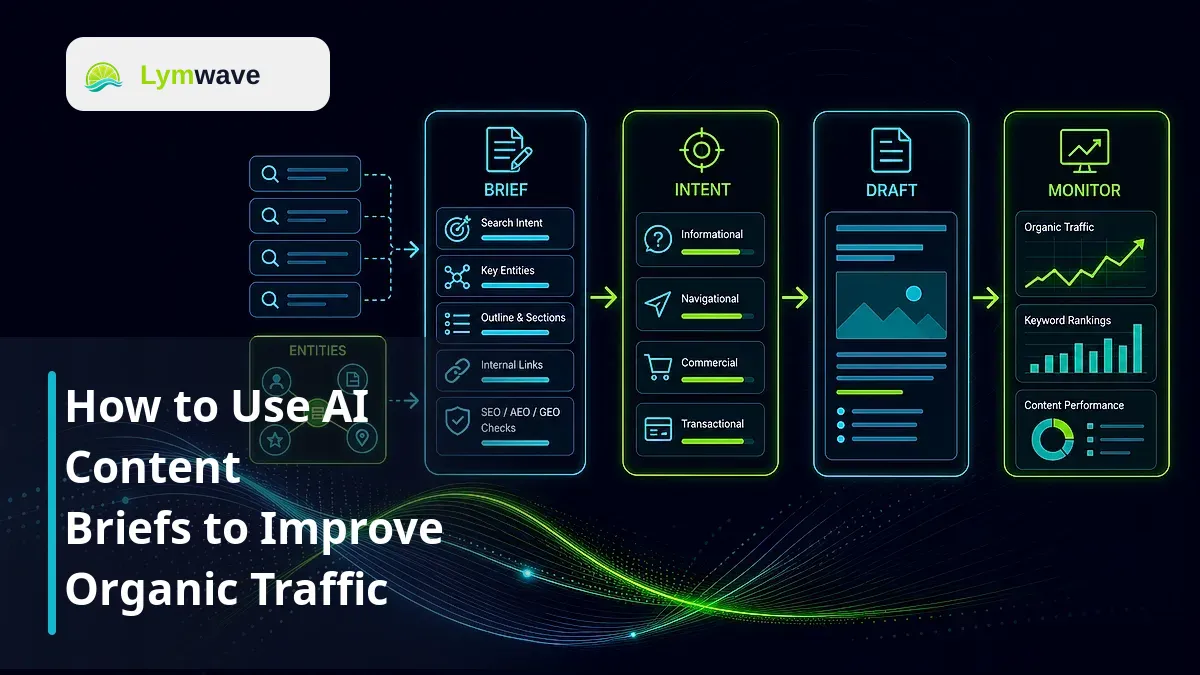
Ask for a brief first, not a draft. The brief should include the H1, section plan, direct answer, target questions, entities, internal links, metadata draft, and review notes. This separation matters because it lets the team reject a weak angle before the article starts to look finished.
A simple workflow looks like this:
- Choose the topic from the approved content plan.
- Ask AI to classify intent and suggest the page role.
- Generate a brief with answer targets, entities, headings, and links.
- Compare the brief against existing content for overlap.
- Add human context the AI cannot know.
- Approve the brief before drafting.
- Use the brief as the editing checklist after the draft exists.
The brief should also explain why the article deserves a place in the calendar. Add a short priority note, such as "supports the AI SEO automation cluster," "answers a recurring sales question," or "fills a gap found in Search Console." That note keeps the article tied to a strategy after the draft moves into review.
For example, a brief for an article about AI content briefs should not drift into a full guide to keyword research, publishing integrations, or weekly reporting. Those topics matter, but they are separate pages. The brief should keep this article focused on how better planning improves the draft and supports organic visibility.
Use AI again during review. Ask it to compare the finished article against the approved brief: did the draft answer the main question, include the required entities, avoid unsupported claims, include useful internal links, and preserve the intended audience? The editor should still make the final call, but the comparison catches obvious misses.
Lymwave is built around this kind of review-first workflow. It can use onboarding context, site audits, Google Search Console signals, AI opportunity detection, content planning, article generation, featured images, publishing workflows, translations where configured, Buffer social distribution, weekly reports, and visibility monitoring. The point is not only to draft faster. The point is to keep the planning, drafting, publishing, and improvement loop connected.
After publication, keep the brief attached to the article record. When impressions, clicks, CTR, ranking headroom, or AI visibility checks suggest a refresh, the team can compare the live page against the original plan. Sometimes the fix is a new section. Sometimes it is a stronger internal link, clearer metadata, or a narrower answer. The brief gives that decision a stable reference point and makes future improvements easier to explain during review with clear original context and measurable follow-up signals.
How this supports SEO, AEO, and GEO
AI content briefs support SEO by defining intent, metadata, structure, and internal links before drafting starts. The article is less likely to become an orphan post because the brief names where it belongs in the content library.
They support AEO by making direct answers explicit. If the brief includes the main answer target and the questions the page should answer, the draft is more likely to include concise, useful sections instead of vague setup paragraphs.
They support GEO by planning entity coverage. A strong brief names the category, workflow, audience, product context, and related concepts in plain language. That helps readers and generative systems understand what the page is about without forcing repeated keywords into every heading.
Use this review map before approving a brief:
| Goal | Brief requirement | Good sign |
|---|---|---|
| SEO | Intent, title, metadata, links | The article has one clear role |
| AEO | Direct answer and FAQ questions | The main answer is visible early |
| GEO | Entities and workflow context | The brand/category relationship is clear |
| Quality | Claims to verify and avoid | The editor knows what needs review |
| Operations | Drafting and publishing notes | The workflow can move without guesswork |
The best briefs make optimization easier because they move important decisions upstream. Instead of fixing a generic article after the fact, the team starts with a plan that already describes what useful content should look like.
Common mistakes to avoid
The first mistake is treating the brief as a keyword container. A brief that only lists the primary keyword, secondary keywords, and headings will not guide a strong article. It needs intent, audience, entities, links, and review rules.
The second mistake is letting AI invent context. If the article needs product details, customer language, pricing, screenshots, claims, or examples, provide those inputs. Do not ask the model to fill gaps with confident guesses.
The third mistake is skipping overlap review. AI may create similar briefs for related topics. Before drafting, check whether the article should be merged, narrowed, refreshed, or linked to another post.
The fourth mistake is approving bloated briefs. A brief should clarify the article, not turn every post into a mini pillar page. Keep the scope narrow enough for the reader to get a useful answer.
The fifth mistake is not using the brief after drafting. The brief is also a quality-control tool. Editors should compare the final article against it before publication.
Frequently asked questions
How do AI content briefs improve organic traffic?
They improve the planning step before drafting. A good brief turns search demand into a focused article plan with intent, answer targets, entities, internal links, metadata, and review checks.
Should AI write the brief or the article first?
AI should write the brief first. Reviewing the brief before drafting makes it easier to catch weak intent, duplicate angles, missing context, and unsupported claims.
What should an AI content brief include?
Include the reader, search intent, H1, section plan, direct answer, target questions, entities, internal-link targets, metadata draft, claims to avoid, and human review notes.
How do briefs support AEO and GEO?
Briefs support AEO by planning concise answers and useful FAQs. They support GEO by naming the entities, workflows, categories, and audience context the article should explain clearly.
Where does Lymwave fit in this workflow?
Lymwave connects content planning, AI-generated briefs and drafts, SEO/AEO/GEO review, featured images, publishing workflows, translations, social distribution, weekly reports, and visibility monitoring in one review-first content system.
Useful next reads
AI SEO Automation Guide: How to Build a Content Engine That Publishes Consistently explains practical SEO, AEO, and GEO workflows for planning, publishing, measuring, and improving useful content consistently.
How to Create a 30-Day SEO Content Plan with AI explains practical SEO, AEO, and GEO workflows for planning, publishing, measuring, and improving useful content consistently.
How to Optimize Blog Posts for SEO, AEO, and GEO explains practical SEO, AEO, and GEO workflows for planning, publishing, measuring, and improving useful content consistently.
Turn this into a working content system
Audit your content, find AI visibility gaps, and build a publishing workflow that compounds.