

How to Prioritize AI SEO Automation in Your Content Plan
How to prioritize AI SEO automation in your content plan explains practical SEO, AEO, and GEO workflows for planning, publishing, measuring, and improving useful content consistently.
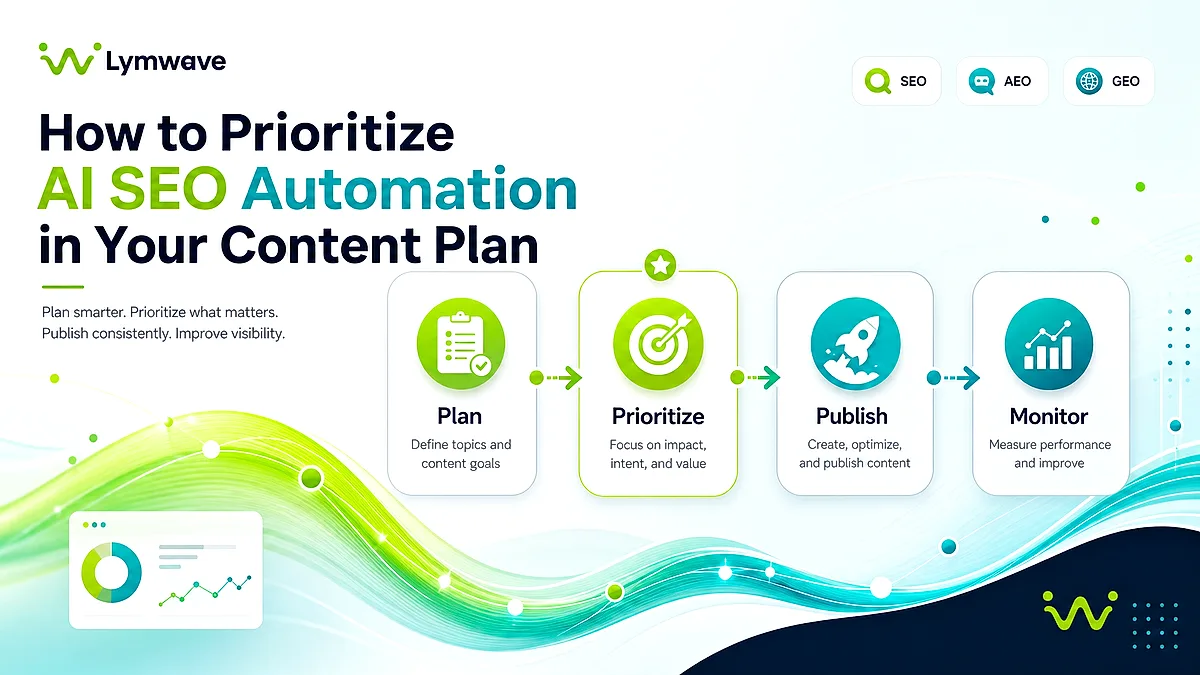
This guide sits in the AI SEO Automation topic cluster as a supporting resource.
Why prioritization matters
AI SEO automation is most useful when it removes friction from the right work. If a team automates every idea in the same way, it can publish faster while still missing the pages that matter most. Prioritization keeps the workflow tied to search intent, business value, editorial quality, and measurable improvement.
Quick answer: prioritize AI SEO automation by starting with content tasks that are repeated often, clearly connected to search demand, easy to review, and likely to strengthen a topic cluster. Automate planning, briefs, metadata, internal links, QA checks, publishing preparation, and refresh triggers before relying on fully automated publishing.
This matters for SaaS founders, small business owners, and content marketers because content plans usually contain more ideas than the team can handle. Some topics need a new article. Some need a refresh. Some only need metadata, internal links, or a clearer answer section. Automation should help make those choices visible instead of turning the whole backlog into drafts.
The safest approach is simple: automate the workflow around judgment before automating the final judgment itself. Let AI help organize the queue, identify missing inputs, generate working drafts, and catch publishing gaps. Keep humans responsible for strategy, claims, examples, positioning, and final approval.
What prioritization means
Prioritization means deciding which parts of the content plan deserve automation first and why. It is not only ranking topics by search volume. A topic with modest volume can be important if it supports a buyer question, fills a cluster gap, improves an existing page, or helps AI systems understand the relationship between your product and category.
In practice, prioritization looks at five signals.
| Signal | What to look for | Automation use |
|---|---|---|
| Intent clarity | The query has a clear question or workflow | Generate briefs and required sections |
| Business fit | The page supports a real offer, audience, or pain point | Keep examples and CTAs relevant |
| Cluster value | The topic links naturally to existing pages | Suggest internal links and related posts |
| Review safety | Claims can be checked without heavy risk | Route drafts through lighter approval |
| Measurement path | Performance can be tracked after launch | Set refresh and reporting triggers |
The priority is not always the flashiest article. Often it is the page that unblocks a cluster, clarifies a core workflow, or creates a repeatable pattern the team can reuse. That is why a content plan should separate new articles, refreshes, internal-link work, metadata updates, and answer-structure improvements.
It also helps to assign a simple priority label before work begins. Use do now for pages that support a current offer, fix a visible gap, or improve an article already earning impressions. Use schedule soon for useful supporting topics that strengthen a cluster but do not block the current plan. Use hold for ideas with unclear intent, weak business fit, or claims the team cannot review confidently yet.
How to choose what to automate first
Start by grouping the content plan into practical work types. A new educational post, a stale article refresh, a product-adjacent workflow page, and an internal-link cleanup task should not all go through the same automation path.
The first automation candidate is usually planning. AI can help turn a messy list of topics into clusters, map likely intent, surface questions to answer, and suggest which pages should support each other. This gives the team a cleaner queue before drafting begins.
The second candidate is briefing. A strong brief should define the reader, the problem, the main answer, required sections, internal links, entities, metadata, and claims that need review. Automating this step gives every draft a better starting point.
The third candidate is draft support. AI can create working material from the brief, but the draft should be treated as a starting point. The editor should still check whether the article answers the question quickly, avoids unsupported claims, and adds useful detail to the cluster.
The fourth candidate is optimization. This includes titles, meta descriptions, canonical paths, FAQ checks, image metadata, schema alignment, and internal-link suggestions. These repeated checks are easy to forget manually and valuable to enforce consistently.
The fifth candidate is refresh monitoring. Once a page is published, automation can watch age, query fit, impressions, CTR, internal-link coverage, and editorial notes. That helps the team improve existing content instead of only adding more URLs.
You can turn those steps into a small decision sequence:
-
Decide whether the topic deserves a new URL, a refresh, or an internal-link update.
-
Confirm the article has a clear reader, search intent, and business reason.
-
Generate a brief before generating the draft.
-
Review the draft against claims, examples, answer clarity, and related links.
-
Publish only after metadata, schema, image path, and internal links are checked.
-
Add a refresh signal so the page can be improved when search behavior changes.
This sequence keeps automation useful without making it reckless. The system moves repeated work forward, while the team still decides whether the page should exist and whether it is ready.
If the plan itself is still unclear, start with a calendar workflow. The guide on creating a 30-day SEO content plan with AI shows how to organize topics before the team starts generating articles.
How this supports SEO, AEO, and GEO
Prioritization helps SEO because it keeps the content plan connected to search intent and crawlable structure. The team can decide which pages need new content, which pages need refreshes, and which pages need better metadata or internal links.
It helps AEO, or answer engine optimization, because answer-ready content should be planned deliberately. Some topics need a definition, some need a checklist, some need a workflow, and some need a comparison. Prioritization helps choose the right format instead of forcing every page into the same outline.
It helps GEO, or generative engine optimization, because AI systems need consistent entity and category context. A prioritized plan makes sure important topics explain the brand, product category, workflow, audience, and problem clearly across the library.
The key is to connect each priority to an expected outcome. For SEO, the outcome may be better query coverage. For AEO, it may be a clearer direct answer. For GEO, it may be stronger entity language and more useful internal relationships between related pages.
For a deeper optimization pass after a draft exists, use the guide on optimizing blog posts for SEO, AEO, and GEO. Prioritization decides what enters the workflow; optimization makes sure the finished page is ready to publish.
A prioritized plan should also make tradeoffs explicit. If the team has one editorial slot, a high-intent refresh may beat a new awareness article. If a cluster has no useful entry point, a definition or workflow post may come first. If the site already has enough articles but weak internal links, the best automation task may be link mapping rather than drafting.
Common mistakes to avoid
The first mistake is automating the biggest keyword first without checking intent. High-volume topics can waste effort if they do not match the audience, offer, or content cluster.
The second mistake is treating every task as a new article. Some priorities are refreshes, internal links, metadata updates, schema checks, or clearer answer sections. A good content plan should make those work types visible.
The third mistake is skipping review gates. Automation can make drafts easier to create, but human review still needs to own claims, positioning, examples, sensitive topics, and final approval.
The fourth mistake is using the same workflow for every page. A comparison article, a how-to guide, a definition post, and a refresh task need different inputs and checks.
The fifth mistake is measuring only output volume. A prioritized plan should also track approved briefs, published pages, refreshed pages, internal-link coverage, query fit, and whether the content library becomes easier to navigate.
The final mistake is forgetting old content. AI SEO automation should help keep published pages useful over time. If the workflow only generates new drafts, the team can end up with a larger library that still has stale answers and weak links.
Another quiet mistake is letting automation hide ownership. Every priority should still have an owner, a review step, and a success signal. Otherwise the team may know that something was generated, but not whether it solved the right problem.
Frequently asked questions
How should you prioritize AI SEO automation in your content plan?
Start with content work that has clear search intent, business relevance, strong cluster value, manageable review risk, and a measurable path after publication. Planning, briefs, optimization checks, and refresh triggers are usually safer first steps than fully automated publishing.
Should AI SEO automation start with new articles or refreshes?
It depends on the library. New articles are useful for missing topics and supporting clusters. Refreshes are better when an existing URL already owns the intent but needs clearer answers, updated examples, better metadata, or stronger internal links.
How does prioritization support SEO, AEO, and GEO?
It supports SEO by focusing work on intent and structure, AEO by choosing answer-friendly formats, and GEO by keeping entity language and topic relationships consistent across the content library.
What should stay human-led?
Humans should own topic strategy, business fit, product positioning, proof, sensitive claims, competitive framing, and final approval. AI can organize and accelerate the workflow, but judgment should stay with the team.
What is the safest first automation step?
Start with the content plan and brief. A structured plan makes every later automation step safer because the draft, metadata, links, schema, and refresh checks all have clearer instructions to follow.
Useful next reads
AI SEO Automation Guide: How to Build a Content Engine That Publishes Consistently explains practical SEO, AEO, and GEO workflows for planning, publishing, measuring, and improving useful content consistently.
How to Create a 30-Day SEO Content Plan with AI explains practical SEO, AEO, and GEO workflows for planning, publishing, measuring, and improving useful content consistently.
How to Optimize Blog Posts for SEO, AEO, and GEO explains practical SEO, AEO, and GEO workflows for planning, publishing, measuring, and improving useful content consistently.
Turn this into a working content system
Audit your content, find AI visibility gaps, and build a publishing workflow that compounds.