

How to Prioritize AI Keyword Research in Your Content Plan
Learn how to prioritize AI keyword research with intent, business value, GSC signals, SEO/AEO/GEO coverage, and a practical content planning workflow.
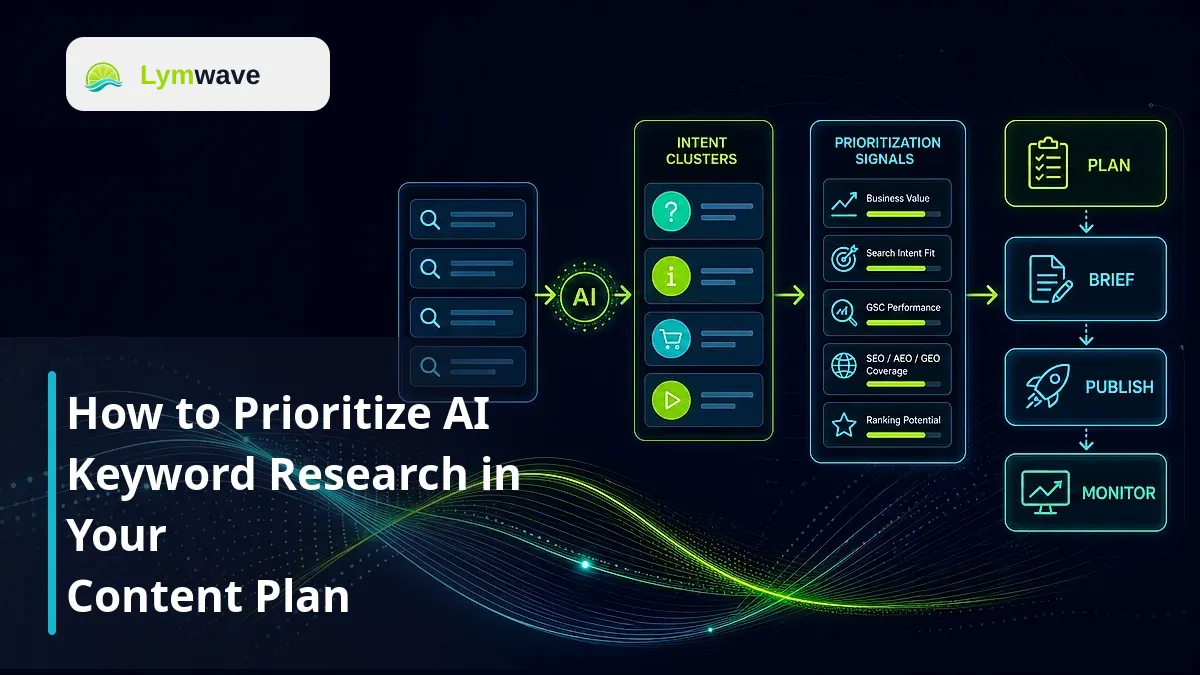
This guide sits in the AI SEO Automation topic cluster as a supporting resource.
Why prioritizing AI keyword research matters
AI keyword research can produce hundreds of topic ideas in minutes. That speed is useful only when the team has a way to decide what deserves a draft, what belongs in a refresh, and what should wait. Without prioritization, the content plan becomes a noisy list of keywords instead of a publishing system.
Quick answer: to prioritize AI keyword research in your content plan, score each idea by search intent, business relevance, audience fit, existing content coverage, Google Search Console evidence, internal-link opportunity, SEO/AEO/GEO value, and publishing readiness. Put the highest-scoring ideas into the next content cycle, then measure and refresh them after publication.
This matters for SaaS founders, small business owners, and content marketers because AI SEO automation reduces research and drafting effort, but it does not remove editorial judgment. A useful content plan still needs focus. The goal is not to publish every keyword. The goal is to publish the articles most likely to answer real questions, strengthen topical authority, and support the business without making unsupported performance promises.
Prioritization also protects quality. If every generated idea becomes a draft, editors spend their time rescuing weak topics. If the best ideas are selected first, the AI content workflow starts with sharper briefs, clearer reader intent, and better internal links.
What AI keyword research prioritization means
AI keyword research prioritization is the process of turning a large keyword or topic set into an ordered publishing plan. It combines automated discovery with human criteria: which ideas match the audience, which questions the site can answer credibly, which gaps matter now, and which topics fit the next 30 days of content.
A strong prioritization model looks beyond volume. Search volume can be helpful, but it does not tell the whole story. A low-volume keyword with buying intent, strong product relevance, and a clear content gap can be more useful than a broad keyword that attracts the wrong reader.
Use a simple scorecard:
| Signal | What to check | Why it matters |
|---|---|---|
| Intent | Is the reader looking to learn, compare, buy, or solve a task? | Prevents mismatched articles |
| Business fit | Does the topic connect to your product, service, or expertise? | Keeps traffic relevant |
| Coverage gap | Do you already answer this well? | Avoids duplicate content |
| Evidence | Do GSC, sales, support, or audit signals support the idea? | Grounds the plan in demand |
| Internal links | Can this article support existing pages? | Builds topical authority |
| SEO/AEO/GEO value | Can the article rank, answer, and clarify entities? | Improves visibility quality |
| Readiness | Can the team publish a useful version soon? | Keeps the plan realistic |
This is where automated SEO content becomes practical. AI can cluster terms, suggest angles, extract questions, and draft briefs, while the team decides which opportunities are worth the next publishing slot.
How to prioritize AI keyword research
Start by collecting candidate ideas from several sources. Use AI-generated keyword clusters, Google Search Console queries, site-audit findings, competitor content gaps, customer questions, sales objections, product use cases, and existing article performance. One source is rarely enough. A balanced plan blends search demand with business reality.
Next, normalize the ideas. Merge duplicates, rewrite vague terms into reader-facing topics, and group related keywords by intent. For example, "AI keyword research tools," "AI keyword research workflow," and "how to use AI for keyword research" may belong in the same cluster, but they may need different article angles depending on the reader.
Then score each idea. Keep the scoring lightweight so it can be repeated every planning cycle:
- Give business fit a score from 1 to 5.
- Give intent clarity a score from 1 to 5.
- Give evidence strength a score from 1 to 5.
- Give content gap size a score from 1 to 5.
- Give publishing readiness a score from 1 to 5.
The highest score does not automatically win. Use the score as a decision aid, then review the list as a plan. A calendar needs variety: a pillar article, supporting posts, refreshes, comparison topics, and practical how-to articles. If the top five ideas all say the same thing with different wording, choose the strongest one and move the rest into supporting notes.
Turn the selected idea into a brief before drafting. The brief should include the title, primary keyword, secondary terms, audience, search intent, questions answered, entities, internal links to consider, claims to avoid, and what the reader should be able to do after reading. A title alone is not enough input for a high-quality AI draft.
Keep a parking lot for good ideas that are not ready. Some topics need more customer evidence, stronger product context, or a related page to exist first. Saving those ideas with a reason makes the next planning cycle faster and keeps the current calendar focused.
For teams using Lymwave, this is the kind of decision path the platform is built to support: onboarding context, site audit signals, GSC insights, AI opportunity detection, daily SEO/AEO/GEO article generation, featured images, publishing integrations, translations where configured, Buffer social distribution, weekly reports, and visibility monitoring. Lymwave helps run the workflow, but it does not promise rankings, traffic, backlinks, or AI citations.
After publishing, keep the keyword research loop open. Review impressions, clicks, CTR, ranking headroom, internal-link coverage, and whether the article still matches the intended cluster. Some ideas will need a refresh. Some will need a stronger supporting article. Some should be left alone because they already do their job.
How this supports SEO, AEO, and GEO
Prioritization supports SEO by making sure each article has a clear role. The topic is chosen for intent, relevance, coverage, metadata potential, and internal-link value before drafting starts. That reduces orphan posts and duplicate angles.
It supports AEO by choosing topics that can answer a specific question directly. A prioritized AI content workflow should identify the main answer target, include concise definitions, add useful FAQs, and avoid burying the answer under generic setup copy.
It supports GEO by improving entity clarity. Generative systems need consistent signals about the brand, category, audience, workflow, and problem being solved. When a content plan intentionally covers AI SEO automation, SEO content automation, content planning, publishing workflows, and visibility monitoring, each article helps clarify the site's subject area.
Use this map when reviewing a prioritized plan:
| Goal | Prioritization question | Good sign |
|---|---|---|
| SEO | Can this page satisfy a clear search intent? | The brief has a distinct query group |
| AEO | Can the article answer a concrete question quickly? | The intro includes a direct answer |
| GEO | Are entities and workflows easy to summarize? | The copy names the category and audience |
| Authority | Does the post connect to related content? | Internal links are planned before publication |
| Quality | Can the team review the claims confidently? | The topic fits real expertise |
SEO, AEO, and GEO should not be separate chores added after the draft. They should shape which ideas enter the plan in the first place.
Common mistakes to avoid
The first mistake is prioritizing by search volume alone. High-volume terms are often broad, competitive, and loosely connected to revenue. They may belong in the plan, but they should not crowd out sharper topics with clearer intent.
The second mistake is creating a separate post for every keyword variant. AI makes this easy, which is exactly why the team needs restraint. Merge overlapping terms into one stronger article when they serve the same reader need.
The third mistake is ignoring existing content. Before creating a new URL, check whether an older page should be refreshed, expanded, internally linked, or consolidated. New articles are useful when they fill a real gap, not when they duplicate what already exists.
The fourth mistake is treating AI output as evidence. AI can suggest patterns, but it should not invent demand, performance claims, customer proof, or current facts. Use GSC, audits, customer context, and editorial review to ground decisions.
The fifth mistake is publishing without a feedback loop. Keyword research does not end when the article goes live. A practical plan records what was published, why it was chosen, what it links to, and when the team should review performance.
Frequently asked questions
How do I prioritize AI keyword research in a content plan?
Score each idea by intent clarity, business fit, content gap, evidence strength, internal-link value, SEO/AEO/GEO usefulness, and publishing readiness. Then select a balanced set of topics for the next content cycle.
Should AI choose which keywords to publish first?
AI can cluster, score, summarize, and suggest priorities, but the final decision should include human review. Product fit, claims, audience needs, and timing still require business judgment.
What is the most important signal for prioritization?
Business relevance is usually the first filter. A keyword with traffic potential but weak audience fit can create low-value visits, while a narrower topic with clear intent can support better content outcomes.
How does prioritization help AEO and GEO?
It pushes the team to choose topics with clear questions, concise answers, named entities, and visible workflow context. That makes articles easier for readers and AI systems to understand and summarize.
Where does Lymwave fit in this workflow?
Lymwave helps teams connect onboarding context, audits, GSC signals, content planning, article generation, featured images, publishing, translations, social distribution, reports, and visibility monitoring into one review-first SEO/AEO/GEO workflow.
Useful next reads
AI SEO Automation Guide: How to Build a Content Engine That Publishes Consistently explains practical SEO, AEO, and GEO workflows for planning, publishing, measuring, and improving useful content consistently.
How to Create a 30-Day SEO Content Plan with AI explains practical SEO, AEO, and GEO workflows for planning, publishing, measuring, and improving useful content consistently.
How to Optimize Blog Posts for SEO, AEO, and GEO explains practical SEO, AEO, and GEO workflows for planning, publishing, measuring, and improving useful content consistently.
Turn this into a working content system
Audit your content, find AI visibility gaps, and build a publishing workflow that compounds.