

How to Prioritize AI Content Briefs in Your Content Plan
Learn how to prioritize AI content briefs by intent, business fit, evidence, internal-link value, and SEO, AEO, and GEO readiness.
This guide sits in the AI SEO Automation topic cluster as a supporting resource.
Why prioritizing AI content briefs matters
AI content briefs are useful only when they help the team decide what should be drafted next. A content calendar can hold dozens of promising article ideas, but not every idea deserves the same urgency. Some briefs unlock commercial topics. Some fill obvious topical gaps. Some are better saved until Search Console, site audit, or customer evidence makes the angle clearer.
Quick answer: prioritize AI content briefs by scoring each topic against reader intent, business fit, available evidence, internal-link value, publishing readiness, and SEO, AEO, and GEO impact. The best next brief is the one that can become a useful, reviewable article without forcing the team to guess.
This matters for SaaS founders, small business owners, and content marketers because AI can draft quickly. Speed creates a new bottleneck: deciding which briefs deserve human review, image generation, internal links, publication, and measurement time. A clear prioritization process keeps AI SEO automation focused on useful work instead of filling the calendar with easy but low-impact posts.
If you already have a 30-day plan, prioritization turns that plan from a list into a publishing sequence. For a broader planning workflow, see how to create a 30-day SEO content plan with AI.
What prioritizing AI content briefs means
Prioritizing AI content briefs means deciding which approved article plans should move into drafting first. The brief itself should already define the audience, search intent, answer target, entities, internal links, metadata, and review rules. Prioritization adds one more question: why this brief now?
A practical priority model should be simple enough for weekly use. It does not need a complex scorecard with 20 fields. It needs a repeatable way to compare topics when resources are limited.
Useful criteria include:
| Priority signal | What to check | Why it matters |
|---|---|---|
| Intent clarity | Can the brief answer a specific reader problem? | Prevents generic drafts |
| Business fit | Does the topic connect to a real product or service workflow? | Keeps traffic relevant |
| Evidence | Do GSC, audit, customer, or sales signals support the topic? | Reduces guesswork |
| Internal-link value | Can the article strengthen existing cluster pages? | Builds topical authority |
| Content gap | Is the site missing a needed explanation? | Improves coverage |
| Review readiness | Can the team verify claims and product context? | Lowers editorial risk |
| Publishing path | Is the destination and format clear? | Avoids stalled drafts |
The result should be a ranked queue: draft now, brief further, refresh an existing page instead, or hold for more evidence.
How to prioritize AI content briefs
Start by grouping briefs into topic clusters instead of reviewing every idea as an isolated page. AI content briefs about automation, keyword research, publishing, and content quality may all support one larger AI SEO automation cluster, but they will not all have the same role.
Then review each brief with a short sequence.
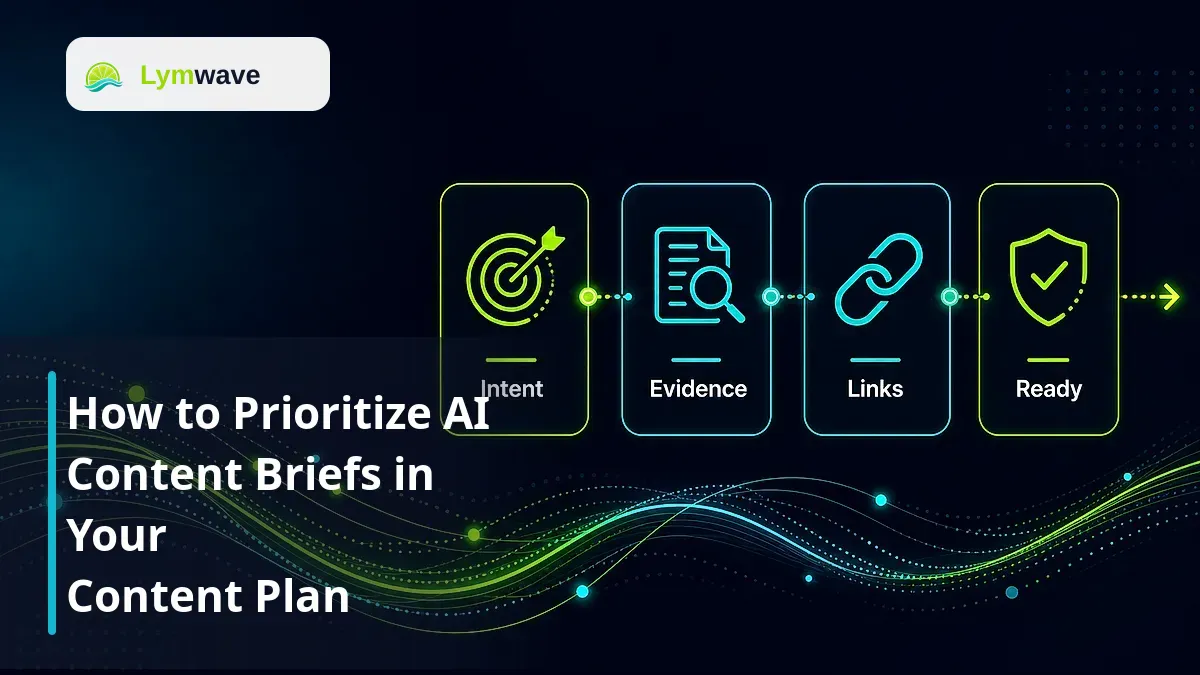
- Confirm the reader job.
Ask what the reader is trying to decide, understand, or do. A strong brief should answer one main intent quickly. If the intent is unclear, do not send the brief to drafting yet. Rewrite the angle first.
For example, "AI content briefs" is broad. "How to prioritize AI content briefs in your content plan" is clearer because it answers a planning and sequencing problem.
- Check business fit.
The article should attract readers who could benefit from your product, service, or workflow. This does not mean every article needs to be sales-led. It means the topic should connect naturally to the problems your product solves.
For Lymwave, a brief about prioritizing AI content briefs fits because it connects content planning, SEO/AEO/GEO quality, internal links, publishing, and measurement. Those are core parts of an AI content workflow.
- Look for evidence.
Prioritize briefs supported by data or observable gaps. Evidence can include Search Console queries, weak CTR, pages with ranking headroom, site audit findings, customer questions, sales objections, competitor coverage gaps, or missing internal-link targets.
If a brief has no evidence but seems strategically important, keep it in the plan, but place it behind briefs with stronger proof. For GSC-led planning, the workflow in how to build a content engine that publishes consistently is a useful reference.
- Estimate internal-link value.
A brief is more valuable when it can support existing pillar pages, comparison pages, solution pages, or related blog posts. Internal links help readers move through the topic and help search systems understand how the article fits.
Before drafting, list two or three existing URLs the article should support. If no useful links exist, the article may still be worthwhile, but it might belong earlier in a new cluster strategy rather than as an isolated post.
- Check SEO, AEO, and GEO readiness.
A brief should be ready for search engines, answer engines, and generative systems before drafting starts. That means the brief should include the main answer, related questions, entity coverage, clear section headings, and claims the reviewer can verify.
If the brief only says "write about AI content briefs," it is not ready. If it says "explain how to rank briefs by intent, business fit, evidence, internal links, publishing readiness, and measurement," it is much closer.
- Decide the next action.
Every brief should leave review with one decision:
- Draft now.
- Improve the brief.
- Refresh an existing article instead.
- Hold until more data is available.
- Remove it from the plan.
This decision is what keeps the content plan honest. A low-priority brief is not a failure. It may simply need more evidence, a sharper angle, or a better place in the cluster.
How this supports SEO, AEO, and GEO
Prioritized briefs help SEO because they reduce scattered publishing. Instead of drafting whatever topic is easiest, the team focuses on articles that strengthen topical coverage, answer real search intent, and connect to existing pages.
They support AEO because the brief defines the concise answer before the article is written. That makes the final post easier to scan, quote, and summarize. A good AEO-ready brief tells the draft what question to answer, what definition to make clear, and which follow-up questions belong in the FAQ.
They support GEO because the brief names the entities and workflows the article should explain consistently. Generative systems need clear context: product category, audience, workflow, related concepts, and credible boundaries. A prioritized brief gives the draft those signals before the model starts filling space.
The most useful briefs also include review rules. They should flag unsupported claims, performance promises, invented proof, or product details that require verification. For article-level quality checks, use how to optimize blog posts for SEO, AEO, and GEO as a companion workflow.
Common mistakes to avoid
The first mistake is prioritizing by keyword volume alone. Volume can be useful, but it does not show whether the topic matches your audience, product, or content gaps. A smaller query with strong buying or workflow intent can be more useful than a broad high-volume topic.
The second mistake is sending vague briefs straight to drafting. AI can make vague instructions sound polished, but the draft will usually need heavier editing. Fix the brief before spending drafting and review time.
The third mistake is treating every net-new article as better than a refresh. Sometimes the right move is to update an existing post, add missing sections, improve metadata, or create better internal links. If an existing URL already owns the intent, prioritize a refresh over a duplicate article.
The fourth mistake is ignoring publishing readiness. A brief may be strategically sound but still blocked by missing product facts, unclear screenshots, no internal-link targets, or an unavailable publishing destination. Put those briefs into "brief further" rather than letting them become stuck drafts.
The final mistake is never revisiting the priority queue. Search Console data, audits, product positioning, and customer questions change. Review the queue weekly or monthly so the next AI content brief still matches what the business needs now.
Frequently asked questions
What is the best way to prioritize AI content briefs?
The best way to prioritize AI content briefs is to score each brief against reader intent, business fit, evidence, internal-link value, content gap size, review readiness, and SEO, AEO, and GEO impact.
Should every AI content brief become a new article?
No. Some briefs should become refreshes, metadata updates, internal-link tasks, or held ideas. A new article makes sense when the intent is distinct and the site does not already answer it well.
How many AI content briefs should a team review at once?
Review enough briefs to cover the next publishing cycle. For a monthly plan, a team can rank the next 30 ideas, then do a tighter weekly review before drafting and publishing.
How do AI content briefs support answer engine optimization?
They support answer engine optimization by defining the direct answer, related questions, definitions, and section structure before drafting. This makes the final article easier to summarize accurately.
What should a prioritized AI content brief include?
It should include the audience, search intent, main answer, section outline, entities, internal links, metadata, review rules, evidence source, and a clear next action such as draft now, improve, refresh, hold, or remove.
Useful next reads
AI SEO Automation Guide: How to Build a Content Engine That Publishes Consistently explains practical SEO, AEO, and GEO workflows for planning, publishing, measuring, and improving useful content consistently.
How to Create a 30-Day SEO Content Plan with AI explains practical SEO, AEO, and GEO workflows for planning, publishing, measuring, and improving useful content consistently.
How to Optimize Blog Posts for SEO, AEO, and GEO explains practical SEO, AEO, and GEO workflows for planning, publishing, measuring, and improving useful content consistently.
Turn this into a working content system
Audit your content, find AI visibility gaps, and build a publishing workflow that compounds.