

How to Build a Workflow for SEO content automation
How to Build a Workflow for SEO content automation explains practical SEO, AEO, and GEO workflows for planning, publishing, measuring, and improving useful content consistently.
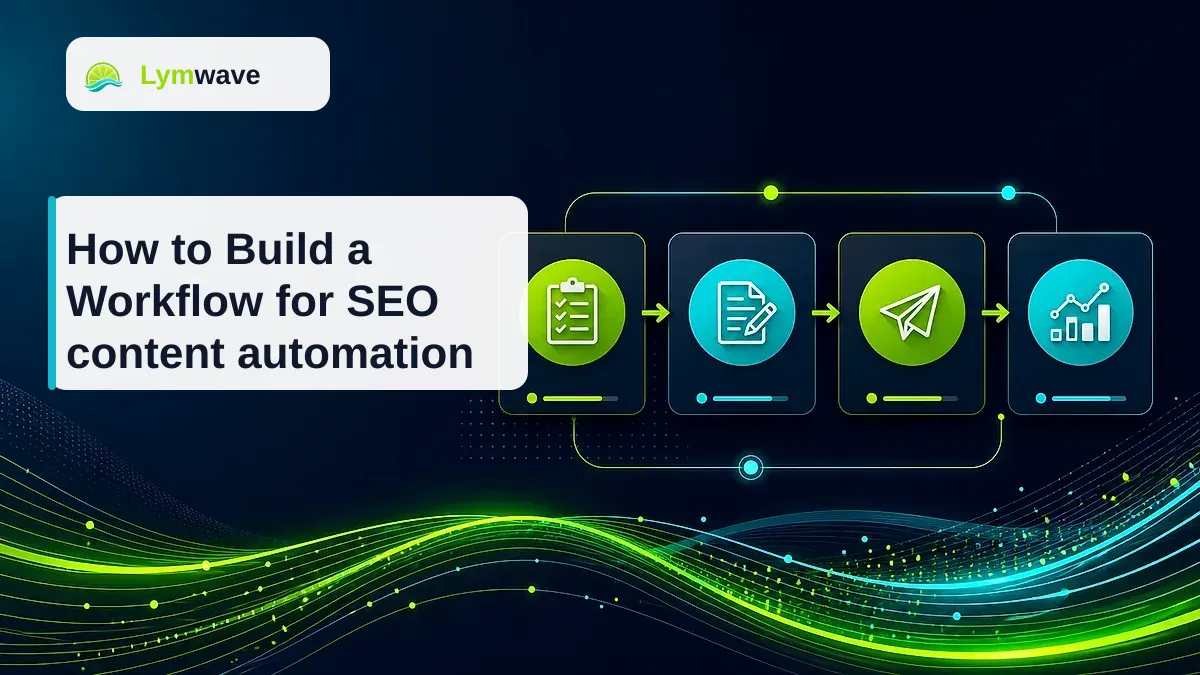
This guide sits in the AI SEO Automation topic cluster as a supporting resource.
Why How to Build a Workflow for SEO content automation matters
Quick answer: build an SEO content automation workflow by connecting topic selection, search intent, structured briefs, AI-assisted drafting, editorial review, internal linking, publishing checks, measurement, and refresh decisions into one repeatable operating rhythm.
SEO content automation works best when it is treated as a workflow, not a prompt. A prompt can produce a draft. A workflow decides whether the topic belongs in the content library, what the article should answer, how quality will be reviewed, where the post should link, and what happens after publication.
That distinction matters for SaaS founders, small business owners, and content marketers because speed can hide weak decisions. A team may publish more often but still create duplicate angles, thin explanations, missing links, weak metadata, or articles that never improve after performance data arrives.
A practical workflow gives automation boundaries. AI can help with topic grouping, brief creation, first drafts, metadata, FAQ ideas, image prompts, and reporting notes. Humans still own product truth, positioning, accuracy, prioritization, and final approval.
The goal is not to remove judgment. The goal is to make good judgment easier to repeat. A strong automated SEO content system helps the team publish consistently while keeping every page useful for readers, crawlable for search engines, answer-friendly for AEO, and clear enough for generative systems to summarize accurately.
What How to Build a Workflow for SEO content automation means
Building a workflow for SEO content automation means designing the full path from content opportunity to improved live article. The workflow starts before drafting and continues after publishing. If it ends when the article is generated, it is only a production shortcut.
Use these layers:
| Workflow layer | What it controls | Why it matters |
|---|---|---|
| Strategy | Audience, topic cluster, funnel stage, and business fit | Prevents random publishing |
| Planning | Calendar, priorities, internal links, and article roles | Turns ideas into ordered work |
| Briefing | Search intent, questions, entities, examples, and constraints | Gives AI useful context |
| Drafting | Structure, direct answer, sections, metadata, FAQ, and schema inputs | Produces a reviewable article |
| Review | Accuracy, specificity, product fit, claims, and usefulness | Protects quality |
| Publishing | Image, canonical URL, CMS or Git handoff, and live status | Makes the page operational |
| Measurement | Indexing, impressions, clicks, engagement, and refresh notes | Turns output into learning |
This keeps the content workflow grounded in decisions instead of raw volume. A good system can still publish quickly, but every article should have a reason to exist. It might support a pillar page, answer a narrow buyer question, fill a topic gap, or improve a weak section of an existing cluster.
The workflow should also separate new content from refresh work. If an idea overlaps an existing page, the better action may be to update the live article instead of creating another one. Automation is most useful when it helps the team make that call earlier.
How to approach How to Build a Workflow for SEO content automation
Start with a content source. Useful sources include Search Console queries, site audit findings, customer questions, onboarding answers, competitor gaps, product education needs, and known topic clusters. The source tells the team why the article should be created.
Then define the article role. Is it a pillar, supporting post, checklist, glossary answer, comparison, use case, or refresh? The role affects depth, examples, links, and measurement. A supporting post should not be judged exactly like a high-volume pillar guide.
Use this operating sequence:
- Choose the topic and audience. Define who the article helps and what question or task they bring. A workflow for creating a 30-day SEO content plan with AI can turn this into a practical publishing queue.
- Confirm search intent. Decide whether the reader wants a definition, checklist, workflow, troubleshooting guide, comparison, or decision support.
- Map the cluster. Identify the pillar page, related posts, and internal links that will help the reader continue. Use only live URLs.
- Write the brief. Include the H1, expected H2s, target audience, primary question, secondary keywords, entities, examples, metadata, and constraints.
- Generate the draft in sections. Keep the direct answer visible near the top, then move through definition, workflow, optimization, mistakes, and FAQ.
- Review for usefulness. Check whether each section adds a concrete decision, example, checklist, caveat, or next step.
- Prepare metadata and image assets. Add unique meta fields, canonical URL, Open Graph image, Twitter card, and a branded featured image.
- Publish and verify. Treat the page as ready only when the public URL returns a valid response and the image preview is available.
- Measure and refresh. Review indexing, impressions, clicks, internal links, and content gaps on a weekly or monthly rhythm.
A simple brief template can keep the system consistent:
| Brief field | Example decision |
|---|---|
| Primary question | What should the reader understand or do after reading? |
| Audience | Founder, marketer, agency, ecommerce team, or local business owner |
| Intent | Informational, commercial, comparison, or operational |
| Cluster role | Pillar, supporting post, glossary, checklist, or refresh |
| Links | Existing posts that genuinely help the reader |
| Quality bar | Direct answer, examples, restrained claims, visible FAQ, schema alignment |
The draft should then move from answer to workflow. Avoid long introductions that delay the point. For AEO and GEO, the page should be easy to summarize because the core answer, entities, audience, and workflow are plainly stated.
After drafting, run a pre-publish check. Confirm one H1, logical H2s, short paragraphs, no unsupported performance claims, useful links, matched FAQ content, complete metadata, and an image that is not generic stock art. The page-level process in how to optimize blog posts for SEO, AEO, and GEO is a useful companion here.
Finally, create a feedback loop. When a post earns impressions but few clicks, test the title and description. When it ranks for unexpected queries, update the intro or add a supporting section. When it gets no traction, check whether the topic is too broad, the angle overlaps another page, or internal links are missing.
Assign ownership for each stage so the workflow does not depend on one person remembering every handoff. One person or role can own topic approval, another can own editorial review, and another can own publishing verification. In a small team, the same person may hold several roles, but the checklist should still name the responsibility.
Keep the workflow visible in a simple tracker. Each article should move through clear states such as idea, brief, draft, review, scheduled, published, measured, and refresh queued. Those states make bottlenecks easier to see. If five articles sit in review, the problem is not topic generation. If three articles are published without links, the issue is the publishing checklist.
Also decide what information should flow back into future briefs. Useful notes include sections that needed heavy editing, repeated claims that were too broad, missing product context, internal links that should be suggested earlier, and questions readers or customers keep asking. This turns the workflow from a content factory into a learning system.
How this supports SEO, AEO, and GEO
The workflow supports SEO by making technical and editorial basics repeatable. Each article should have unique metadata, a clean canonical URL, relevant internal links, a crawlable structure, a useful featured image, and a clear relationship to the topic cluster.
It supports AEO by forcing the article to answer a real question quickly. A direct answer near the top, clear definitions, tables, lists, and FAQ content make it easier for readers and answer engines to extract the point without guessing.
It supports GEO by strengthening entity clarity. Generative systems need to understand the relationship between Lymwave, AI SEO Automation, AI content automation, SEO, AEO, GEO, automated SEO content, and the audience using the workflow. Consistent language helps those systems summarize the content accurately.
Use this checkpoint before publishing:
| Area | Workflow question |
|---|---|
| SEO | Is the page linked, indexable, and mapped to a cluster? |
| AEO | Does the article answer the main question in the first section? |
| GEO | Are the product, category, workflow, and audience easy to identify? |
| Editorial | Are claims specific, calm, and supportable? |
| Operations | Is there a live URL, image, and review plan? |
This is where automation becomes more than content volume. A repeatable workflow creates a quality floor. The team can still adjust each article, but the basic SEO, AEO, GEO, publishing, and measurement checks do not depend on memory.
Common mistakes to avoid
The first mistake is starting with drafting instead of strategy. If the workflow begins with "write an article about this keyword," the output may look finished while missing audience, intent, and cluster fit.
The second mistake is letting every idea become a new post. Some ideas should become refreshes, new sections, FAQ additions, or internal-link updates. Automation should help route the work, not multiply pages without judgment.
The third mistake is using vague briefs. AI performs better when the brief includes audience, search intent, entities, examples, internal links, product context, and constraints. A thin brief usually creates a generic article.
The fourth mistake is skipping editorial review. Polished writing can still be inaccurate, repetitive, or unsupported. Review for substance: does the post help a reader make a decision or complete a task?
The fifth mistake is linking to imagined future posts. Internal links should point to pages that exist and add context. Broken or irrelevant links weaken both reader trust and topic clarity.
The sixth mistake is measuring only traffic. Some workflow posts support topical authority, sales education, or internal linking before they become high-click pages. Track the article's intended role as well as impressions and clicks.
Finally, avoid treating automation as a one-time setup. The workflow should improve when performance data exposes weak titles, unclear sections, missing links, or new questions. The refresh loop is what turns automation into a durable content system.
Frequently asked questions
What should you know about How to Build a Workflow for SEO content automation?
You should know that the workflow needs to cover planning, briefs, drafting, review, publishing, internal links, measurement, and refreshes. The draft is only one part of the system.
How does How to Build a Workflow for SEO content automation support SEO, AEO, and GEO?
It supports SEO with crawlable structure and internal links, AEO with direct answers and FAQ content, and GEO with clear entity, product-category, audience, and workflow context.
What mistakes should you avoid with How to Build a Workflow for SEO content automation?
Avoid starting with a thin prompt, publishing every generated idea, skipping review, linking to missing pages, measuring only traffic, and leaving published content out of the improvement loop.
What should the first workflow step be?
Start by defining the article's source, audience, search intent, and cluster role. Those decisions shape the brief and prevent automation from producing disconnected content.
How often should the workflow be reviewed?
Review operations weekly and content performance monthly. Weekly checks catch publishing and quality issues, while monthly reviews show which pages need refreshed metadata, stronger links, or clearer answers.
Useful next reads
AI SEO Automation Guide: How to Build a Content Engine That Publishes Consistently explains practical SEO, AEO, and GEO workflows for planning, publishing, measuring, and improving useful content consistently.
How to Create a 30-Day SEO Content Plan with AI explains practical SEO, AEO, and GEO workflows for planning, publishing, measuring, and improving useful content consistently.
How to Optimize Blog Posts for SEO, AEO, and GEO explains practical SEO, AEO, and GEO workflows for planning, publishing, measuring, and improving useful content consistently.
Turn this into a working content system
Audit your content, find AI visibility gaps, and build a publishing workflow that compounds.