

How to Build a Workflow for AI SEO Automation
Learn how to build an AI SEO automation workflow that plans topics, drafts useful content, reviews quality, publishes consistently, and improves with performance data.
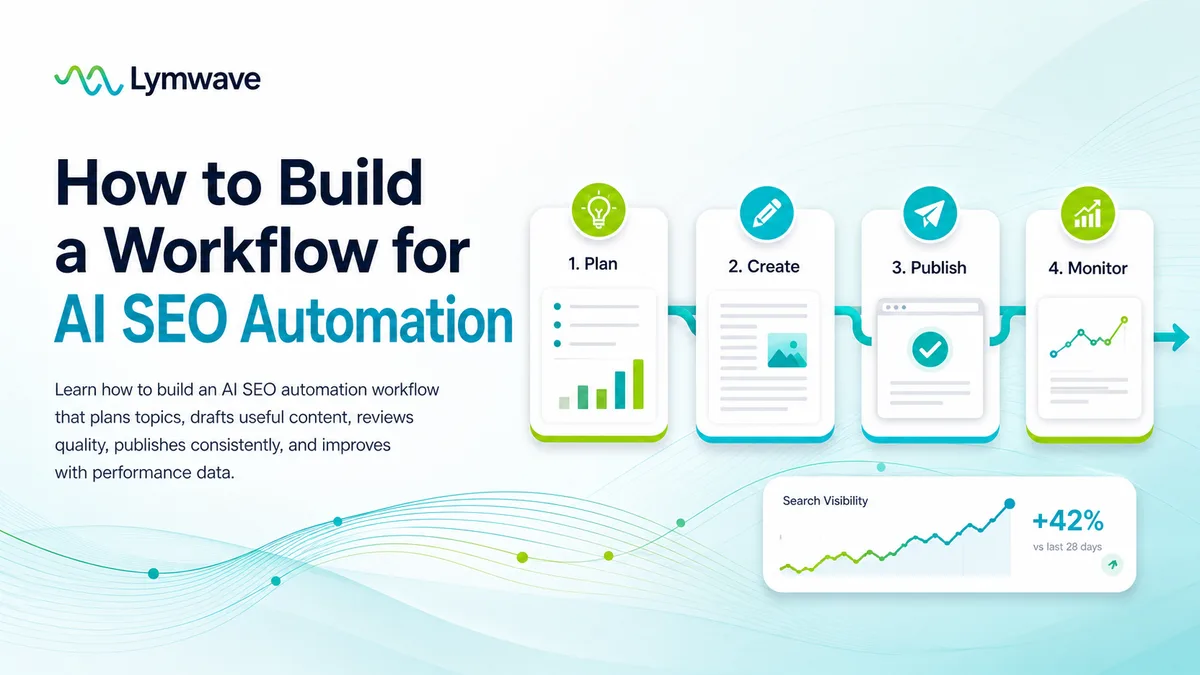
This guide sits in the AI SEO Automation topic cluster as a supporting resource.
Why an AI SEO automation workflow matters
Quick answer: to build a workflow for AI SEO automation, start with search intent and topic priorities, turn them into structured briefs, generate drafts with clear quality rules, review before publishing, add internal links, then measure and refresh content on a weekly rhythm.
AI SEO automation works best when it is treated as a content operating system, not a shortcut for producing more pages. A useful workflow helps the team decide what to publish, why it matters, how the draft should be reviewed, where the article should link, and what happens after it goes live.
That matters because automated SEO content can go wrong quietly. A team may publish faster but create overlapping articles, weak metadata, missing internal links, vague claims, or posts that never get refreshed. The issue is usually not the AI model itself. The issue is an unstructured process around it.
For SaaS founders, small business owners, and content marketers, the goal is a workflow that reduces coordination work without removing judgment. AI can speed up research, planning, drafting, metadata, image prompts, and reporting. Humans still decide positioning, product truth, audience fit, and whether the article is worth publishing.
The workflow below is built for practical SEO, AEO, and GEO content. It connects planning, production, publishing, and improvement so the content library gets stronger over time instead of becoming a pile of isolated posts.
What an AI SEO automation workflow means
An AI SEO automation workflow is a repeatable process for turning search opportunities into reviewed, published, measurable content. It covers the full path from topic discovery to refresh decisions.
A strong workflow usually has seven parts:
| Workflow layer | What it controls | Why it matters |
|---|---|---|
| Strategy | Topic clusters, audience, funnel stage, and business fit | Keeps content tied to a real purpose |
| Planning | Calendar, priorities, briefs, and internal-link targets | Turns ideas into scheduled work |
| Drafting | Article structure, examples, metadata, FAQ, and schema inputs | Gives AI clear boundaries |
| Review | Accuracy, usefulness, tone, product fit, and claims | Prevents low-quality automation |
| Publishing | CMS or Git handoff, images, canonical URL, and status | Makes the output operational |
| Measurement | Search Console, indexing, clicks, impressions, and reports | Shows what changed after publication |
| Improvement | Refreshes, rewrites, link updates, and new briefs | Turns evidence into better content |
This is different from asking AI to "write a blog post about a keyword." The workflow gives every article a role. One article might support a pillar guide. Another might answer a narrow question. Another might refresh an outdated topic with stronger examples.
The workflow also keeps SEO content automation from becoming generic. When briefs include audience, intent, entities, product context, internal links, and review criteria, AI drafts have a better chance of sounding specific and useful.
How to build the workflow step by step
Start with a clear content source. That might be Google Search Console data, a website audit, a competitor gap, an onboarding interview, or a manual topic list. The source matters because it tells the workflow why the article exists.
- Define the content goal.
Before generating anything, decide what the workflow is trying to improve. The goal might be building topical authority around AI SEO automation, explaining a product workflow, answering buyer questions, or filling a gap in an existing cluster.
Good goals are specific enough to guide decisions. "Publish more content" is weak. "Create supporting articles for the AI SEO automation guide so readers can understand planning, optimization, measurement, and publishing workflows" is much better.
- Build a topic queue.
Create a queue of article ideas with title, slug, primary keyword, search intent, audience, funnel stage, related posts, and expected role. The queue should include new posts and refreshes. If the content library already has older articles, the workflow should check whether a new idea should become a refresh instead.
For a deeper planning layer, use a structured calendar like creating a 30-day SEO content plan with AI. A monthly plan helps the team see clusters, avoid repetition, and publish in a sensible order.
- Turn each topic into a brief.
The brief should tell the AI what the article needs to accomplish. Include the article title, target audience, search intent, primary and secondary keywords, entities, internal links, questions to answer, metadata requirements, and any product facts that must be accurate.
A good brief also says what to avoid. For example: do not promise rankings, do not invent case studies, do not repeat the primary keyword unnaturally, do not use generic filler, and do not create visible links to posts that do not exist.
- Generate the draft in sections.
Use AI to draft the article against the brief, but keep structure visible. The article should have one clear H1, logical H2s, a direct answer near the top, concise paragraphs, useful examples, and an FAQ when the topic benefits from one.
For SEO, the draft should map to search intent. For AEO, it should answer the main question clearly enough that a reader can quote or summarize it. For GEO, it should use consistent entity language and explain relationships between the product, audience, workflow, and category.
- Add metadata, schema, and image instructions.
The workflow should produce a unique SEO title, meta description, canonical path, Open Graph copy, Twitter card type, and featured image path. The image step should use branded visuals rather than random stock photos. For Lymwave blog posts, the preferred image workflow is a branded signal wave, Lymy assistant, dashboard snapshot, or content system map.
The schema should match visible content. A blog post can use BlogPosting and BreadcrumbList. If the page has visible FAQ content, it can also use FAQPage.
- Run editorial review.
Review the article before publishing. Check whether the intro answers the main question, whether examples are concrete, whether claims are supportable, whether links are useful, and whether the article says anything a real reader would care about.
This step is where automation becomes safer. AI can draft quickly, but review protects the brand, the reader, and the site's content quality.
- Publish and confirm the live URL.
After approval, publish through the connected CMS, Git workflow, or manual export. Then verify the live URL. A generated file is not the same thing as a published page. The workflow should confirm that the canonical page returns a public 2xx response before treating it as ready for social publishing or reporting.
- Measure weekly.
Track what was planned, drafted, approved, published, indexed, and improved. Search Console impressions and clicks may take time, but operational signals appear immediately. Missed publish dates, missing images, weak links, or duplicate angles are all workflow signals.
For measurement, connect this article with how to measure AI SEO automation results once the page is live in the content library.
- Refresh based on evidence.
Automation should not stop at publication. Use weekly reports to decide whether the article needs better metadata, stronger internal links, a clearer answer, a new FAQ, updated examples, or a related supporting post.
The refresh loop is what makes the workflow compound. Every article teaches the system what to plan next.
How this supports SEO, AEO, and GEO
An AI SEO automation workflow supports SEO by making content easier to plan, publish, link, and refresh. Search engines need crawlable pages, useful headings, descriptive metadata, internal links, and consistent topic coverage. A workflow makes those steps repeatable.
It supports AEO by forcing each article to answer a real question. AEO-friendly content does not hide the answer under a long setup. It gives readers a clear explanation, then adds details, examples, and caveats.
It supports GEO by making entities and relationships explicit. The article should make it easy to understand that Lymwave is an AI-powered content marketing platform focused on SEO, AEO, GEO, content planning, automated publishing, and performance workflows. That context should be visible in natural language, not stuffed into metadata only.
Use this checklist before publishing:
| Area | Check |
|---|---|
| SEO | Does the article have unique metadata, canonical path, image, and useful internal links? |
| AEO | Does the intro answer the main question directly? |
| GEO | Are product, audience, category, and workflow entities clear? |
| Editorial | Are claims specific, calm, and supportable? |
| Operations | Is there a live URL, publishing status, and next review date? |
This is why workflow design matters more than output volume. A repeatable process gives every article the same basic quality floor while still allowing topic-specific judgment.
Common mistakes to avoid
The first mistake is automating before defining the content strategy. AI can create drafts from thin instructions, but thin instructions usually create thin articles. Start with the cluster, audience, and business purpose.
The second mistake is treating keywords as the whole brief. Keywords help, but the workflow also needs search intent, entities, questions, links, examples, product context, and review rules.
The third mistake is publishing without internal links. A post that does not connect to related content is harder for readers to navigate and harder for search systems to place inside a topic cluster. Link to the pillar guide and to useful supporting articles when the connection helps the reader.
The fourth mistake is skipping review because the draft looks polished. Polished writing can still be vague, inaccurate, or too generic. Review for substance, not just grammar.
The fifth mistake is measuring only traffic. Some articles build cluster coverage, support sales conversations, answer customer questions, or strengthen internal links before they earn many clicks. Track the role of the article as well as the raw numbers.
The sixth mistake is sending social posts before the page is live. Social publishing should happen only after the canonical URL is public and the preview image is available. Otherwise the workflow creates broken links and messy tracking.
Frequently asked questions
How do you build a workflow for AI SEO automation?
Build the workflow by connecting topic discovery, content planning, structured briefs, AI drafting, editorial review, internal links, publishing confirmation, weekly reporting, and refresh decisions into one repeatable process.
What should an AI SEO automation workflow include?
It should include topic clusters, search intent, audience context, article briefs, metadata, featured images, schema, review gates, publishing status, live URL checks, performance reporting, and refresh rules.
Should AI SEO automation publish without human review?
No. AI can speed up planning and drafting, but human review should check accuracy, positioning, claims, examples, links, and whether the article is genuinely useful before publication.
How does this workflow help answer engines and generative search?
It helps by creating clear answers, consistent entity language, useful FAQs, structured metadata, and connected topic coverage that people and AI systems can summarize more easily.
What is the biggest risk with automated SEO content?
The biggest risk is publishing more pages without a quality loop. A workflow should prevent duplicate angles, vague copy, missing links, unsupported claims, and articles that are never refreshed after launch.
Useful next reads
AI SEO Automation Guide: How to Build a Content Engine That Publishes Consistently explains practical SEO, AEO, and GEO workflows for planning, publishing, measuring, and improving useful content consistently.
How to Create a 30-Day SEO Content Plan with AI explains practical SEO, AEO, and GEO workflows for planning, publishing, measuring, and improving useful content consistently.
How to Optimize Blog Posts for SEO, AEO, and GEO explains practical SEO, AEO, and GEO workflows for planning, publishing, measuring, and improving useful content consistently.
Turn this into a working content system
Audit your content, find AI visibility gaps, and build a publishing workflow that compounds.