

How to Build a Workflow for AI Content Briefs
Learn how to build a repeatable AI content brief workflow that turns topics, intent, entities, internal links, and review rules into better SEO, AEO, and GEO drafts.
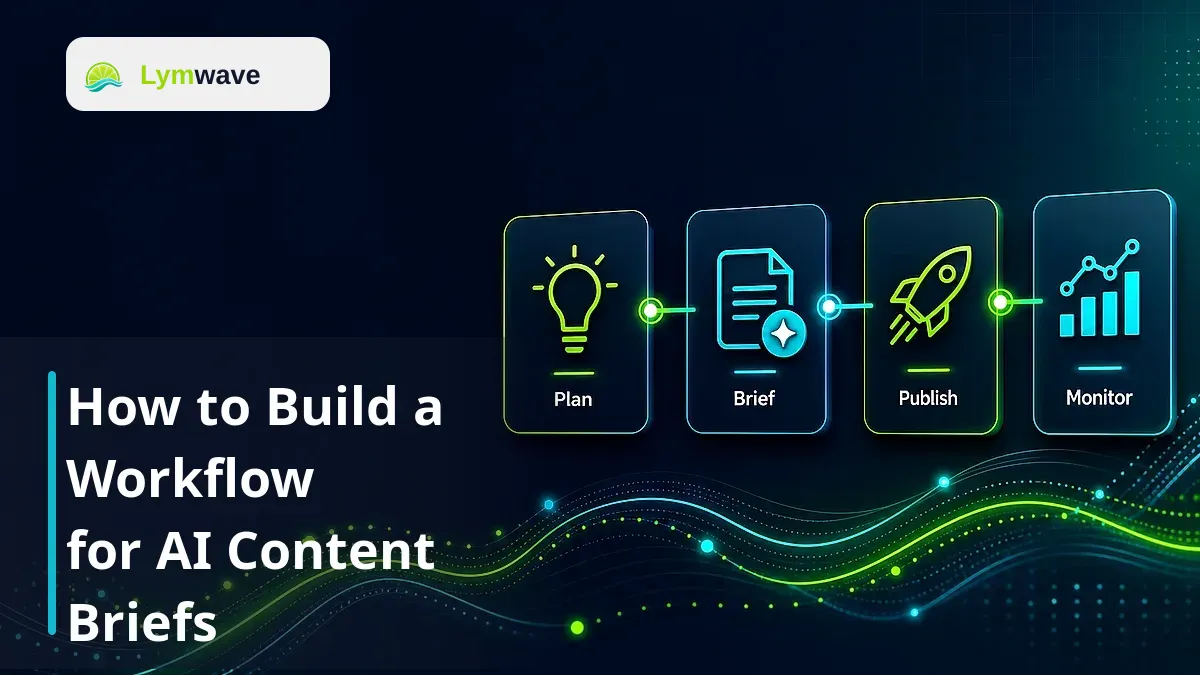
This guide sits in the AI SEO Automation topic cluster as a supporting resource.
Why an AI content brief workflow matters
Quick answer: build a workflow for AI content briefs by moving each topic through a repeatable sequence: approve the topic, define intent, choose the angle, gather entities and internal links, generate the brief, review it, then use it as the checklist for drafting and editing.
AI content briefs are useful only when they are part of a workflow. A single prompt can produce an outline, but a workflow turns briefing into a repeatable operating habit. It makes sure every article starts with the same core decisions before anyone asks AI to write a draft.
That matters because AI SEO automation can scale both good and weak decisions. If the topic is vague, the search intent is guessed, and internal links are chosen after drafting, the article may sound polished while still missing the reader's problem. A brief workflow catches those issues while they are still cheap to fix.
For SaaS founders, small business owners, and content marketers, the workflow also protects editorial judgment. The AI can help classify intent, organize research, suggest entities, draft questions, and prepare metadata. The team still decides what the page should say, what it should avoid, and how it connects to the rest of the site.
The goal is not a bigger brief. The goal is a cleaner handoff from planning to drafting to review.
That handoff is where consistent publishing starts to feel manageable.
What an AI content brief workflow means
An AI content brief workflow is the process that turns an article idea into an approved brief before drafting begins. It defines the inputs, the AI task, the human review step, the output format, and the handoff into writing.
A practical workflow should answer seven questions:
| Workflow question | What it controls | Why it matters |
|---|---|---|
| Why does this topic exist? | Page purpose | Prevents random content production |
| Who is the reader? | Depth and examples | Keeps the article useful |
| What is the search intent? | Structure and angle | Avoids mismatched content |
| What must the article answer? | AEO readiness | Makes the answer visible early |
| Which entities matter? | Topic clarity | Helps readers and AI systems understand context |
| Which internal links belong? | Library connection | Prevents orphan posts |
| What should reviewers check? | Quality control | Keeps automation accountable |
This is different from asking AI for an article outline. An outline lists sections. A brief workflow explains why those sections exist, how the article should differ from nearby posts, which links are approved, and what claims need human review.
The workflow also creates an artifact the team can reuse. A good brief can live in a CMS draft, task record, spreadsheet, markdown file, or content operations system. What matters is that the approved plan survives beyond the chat window. The editor should be able to compare the final draft against the brief.
If you already use an AI content workflow, the brief is the checkpoint between planning and generation. For broader planning, connect it to a calendar such as a 30-day SEO content plan. For review and optimization, connect it to a process for optimizing blog posts for SEO, AEO, and GEO.
How to build the workflow
Start with the content plan, not a blank prompt. A brief should come from an approved topic, a real reader problem, and a known role in the content library. If the topic has no role, pause before drafting.
Use this workflow:
- Select an approved topic. Choose the article from a content plan, Search Console opportunity, customer question, sales objection, or site audit finding. Avoid turning every loose keyword into a draft.
- Define the page job. Decide whether the article is a beginner guide, workflow, checklist, comparison, definition, or troubleshooting post.
- Write the reader problem. Use plain language. For example: "The reader needs a repeatable brief process before scaling AI-generated drafts."
- Classify search intent. Ask AI to identify whether the reader wants an explanation, process, template, comparison, or next-step decision.
- Map nearby content. Check existing posts so the new article does not repeat a published guide with a slightly different title.
- Generate the brief. Ask AI for the answer summary, H1, H2s, entities, internal-link targets, metadata draft, FAQ questions, and review notes.
- Review the brief. Fix weak angles, unsupported claims, invented links, missing entities, and bloated sections.
- Approve before drafting. Only send the brief into article generation after the plan is clear.
- Use the brief during editing. Compare the draft against the approved plan before publishing.
A simple AI prompt for the briefing step can be:
Create an SEO, AEO, and GEO content brief for this approved article topic.
Include audience, search intent, page role, one-sentence answer, H1, H2s,
required entities, internal-link targets, metadata draft, FAQ questions,
scope exclusions, and human review notes. Do not write the article yet.
The last sentence matters. "Do not write the article yet" keeps planning separate from drafting. It gives the team a chance to reject a weak angle before the output starts to feel finished.
The brief should include scope exclusions. For example, an article about building a workflow for AI content briefs should not become a full guide to keyword research, publishing integrations, or weekly reporting. Those topics can be linked or handled separately. Scope exclusions keep the article focused and reduce duplicate content.
The workflow should also name approved internal links. AI may suggest plausible links that do not exist, or it may ignore important pages that already support the cluster. Approved internal links keep the article connected to the library and help readers move to the next useful step.
For teams publishing regularly, store the brief in a structured format. A lightweight template works well:
| Field | Example instruction |
|---|---|
| Reader | SaaS founder or marketer building a repeatable content process |
| Intent | Wants a workflow, not a definition |
| Direct answer | Explain the brief sequence in one paragraph |
| Required sections | Inputs, workflow, review, mistakes, FAQ |
| Entities | AI SEO automation, SEO content automation, AEO, GEO |
| Internal links | Pillar guide, content plan guide, optimization guide |
| Review notes | Check claims, links, scope, and metadata before drafting |
The workflow can stay compact. Do not add a committee step for every article. The point is to make the critical decisions visible, not to slow the team down.
Lymwave is designed around this kind of operational loop: planning, briefing, article generation, internal links, featured images, publishing support, reports, and visibility monitoring. That does not remove human judgment. It gives human judgment a consistent place to happen.
How this supports SEO, AEO, and GEO
An AI content brief workflow supports SEO by making the page purpose explicit before drafting. The team chooses one intent, one angle, one H1, one metadata direction, and a short list of internal links. That makes the final article easier to crawl, review, and improve.
It supports AEO by requiring a direct answer early. If the brief includes the main question and short answer, the draft is less likely to hide the answer under long setup. The FAQ section also becomes easier to plan because the questions come from the brief rather than being bolted on at the end.
It supports GEO by clarifying entities and relationships. Generative systems need consistent context around the topic, brand category, workflow, and related concepts. A brief can map terms such as AI SEO automation, SEO content automation, AI content workflow, automated SEO content, AEO, and GEO into the article naturally.
Use this review checklist before a brief moves into drafting:
| Layer | Brief check | Pass condition |
|---|---|---|
| SEO | Does the article serve one search intent? | The sections support one reader problem |
| AEO | Is the direct answer planned near the top? | The brief includes a concise answer summary |
| GEO | Are key entities explained in context? | Terms are connected to the workflow |
| Editorial | Are claims reviewable? | The brief names what must be verified |
| Internal links | Are links approved and live? | No invented or missing URLs are listed |
| Operations | Is the next step clear? | The brief can move to draft, revise, or hold |
The workflow does not guarantee rankings, traffic, backlinks, or AI citations. It improves the inputs and review process that make useful content more repeatable.
Common mistakes to avoid
The first mistake is starting from a bare keyword. A keyword may show demand, but it does not define the reader, angle, examples, internal links, or review rules. Add context before asking AI for the brief.
The second mistake is letting the model choose the strategy alone. AI can suggest intent and structure, but the team should approve whether the article supports the business and the reader.
The third mistake is accepting a bloated brief. If the brief has too many sections, too many entities, and too many questions, the draft will feel unfocused. Prefer a smaller plan with clearer jobs.
Another mistake is skipping overlap checks. AI may create a brief that repeats an existing article. Compare the proposed sections against nearby posts before drafting. If the overlap is high, change the angle or merge the idea into an existing page.
Do not leave internal links until the end. Internal links shape the article's role in the content library. Choose them during briefing, then confirm they are useful in the final edit.
Do not treat metadata as a separate task. The SEO title, meta description, canonical path, Open Graph description, and FAQ plan should match the brief. If the metadata promises a workflow, the article should deliver a workflow.
Finally, avoid marking the brief approved when no one has reviewed it. A workflow is only useful if the approval step is real. Even a five-minute review can catch wrong links, thin answers, unsupported claims, and duplicate sections.
Frequently asked questions
What should you know about building a workflow for AI content briefs?
You should know that the workflow matters as much as the prompt. A good process defines the topic, audience, intent, angle, entities, links, metadata, and review rules before AI writes the draft.
How does building a workflow for AI content briefs support SEO, AEO, and GEO?
It supports SEO by planning intent and internal links, AEO by requiring a direct answer and FAQ coverage, and GEO by mapping important entities into the article before drafting begins.
What mistakes should you avoid when building a workflow for AI content briefs?
Avoid starting from a bare keyword, letting AI own the strategy, accepting bloated briefs, skipping overlap checks, inventing internal links, and approving briefs without review.
What should every AI content brief workflow produce?
Every workflow should produce an approved brief with audience, reader problem, search intent, page role, answer summary, section plan, entities, internal links, metadata direction, scope exclusions, and review notes.
Should AI write the article immediately after the brief?
Not automatically. Review the brief first. Once the plan is clear, the article draft has a better chance of being useful, specific, and connected to the rest of the content library.
Useful next reads
AI SEO Automation Guide: How to Build a Content Engine That Publishes Consistently explains practical SEO, AEO, and GEO workflows for planning, publishing, measuring, and improving useful content consistently.
How to Create a 30-Day SEO Content Plan with AI explains practical SEO, AEO, and GEO workflows for planning, publishing, measuring, and improving useful content consistently.
How to Optimize Blog Posts for SEO, AEO, and GEO explains practical SEO, AEO, and GEO workflows for planning, publishing, measuring, and improving useful content consistently.
Turn this into a working content system
Audit your content, find AI visibility gaps, and build a publishing workflow that compounds.