

How to Build a Workflow for AI Blog Strategy
Build an AI blog strategy workflow that turns evidence into reviewed, connected, measurable content without automating editorial judgment.
This guide sits in the AI SEO Automation topic cluster as a supporting resource.
An AI blog strategy works best as a controlled decision process, not a prompt followed by automatic publishing. The workflow should help a team choose worthwhile topics, create useful pages, keep claims reviewable, and learn from what happens after publication.
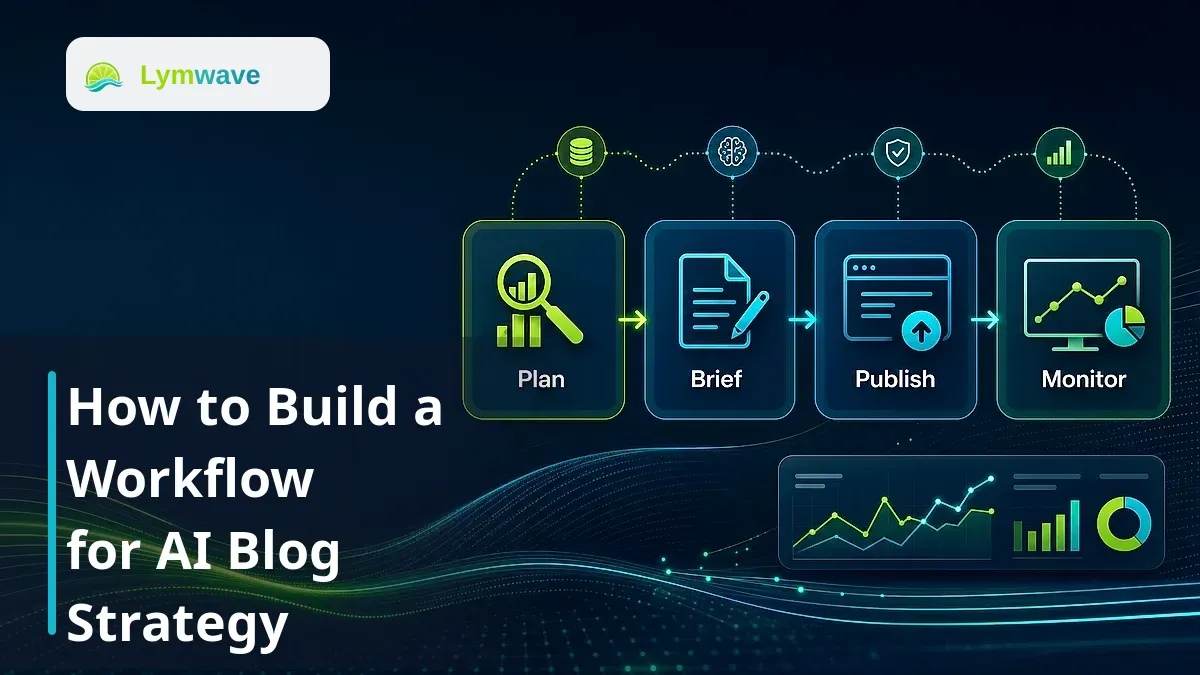
Quick answer: build the workflow in eight stages: define the audience and objective, collect evidence, decide whether to create or update, approve a content brief, generate a draft, review it, publish and connect the page, then measure results and feed the evidence into the next plan. Automate repeatable preparation and validation while keeping topic approval, factual judgment, and publication accountable to people.
Why an AI blog strategy needs a workflow
AI makes producing plausible ideas and drafts inexpensive. It does not make every idea relevant, every statement accurate, or every new URL necessary. Without a workflow, the easiest activity to automate becomes the default: creating more articles.
A defined process changes the question from “What can we generate?” to “What should this blog explain next, and why?” It creates checkpoints before expensive or public actions and makes the source of each decision visible.
The workflow prevents topics from entering the calendar without evidence, new pages from duplicating useful URLs, and structurally valid drafts from bypassing factual review. It also makes internal linking, publishing verification, and measurement part of the process. The goal is to place human judgment where the business accepts risk or makes a strategic choice.
What an AI blog strategy workflow means
An AI blog strategy workflow is the repeatable path from business context and evidence to a reviewed article, a connected public page, and a documented follow-up decision. It defines inputs, owners, quality gates, outputs, and feedback for each stage.
It is broader than an article-generation pipeline. A generation pipeline may turn a title and brief into copy, metadata, schema, and an image. The strategy workflow determines whether that title deserves a page, what role it plays, what evidence the draft may use, who approves it, and how the result affects future priorities.
| Layer | Main question | Typical output |
|---|---|---|
| Strategy | Who should the blog serve, and which problem matters? | Audience, objective, topic boundaries |
| Evidence | What supports this opportunity? | Customer questions, audit findings, query data, product context |
| Planning | Should the team create, refresh, consolidate, or wait? | Approved content action and cluster role |
| Production | What does the page need to answer? | Brief, draft, metadata, image, schema |
| Governance | Is the page accurate, useful, and safe to publish? | Review record and approval |
| Distribution | Where does the page belong in the site and publishing system? | Live URL, internal links, destination result |
| Learning | What should change next? | Measurement notes and a new planning decision |
AI SEO automation can support every layer, but it should not silently merge them. A model that proposes an idea is not the same as evidence that the idea is worth pursuing. A structurally complete draft is not the same as an approved page.
An eight-stage AI blog strategy workflow
1. Define the audience, objective, and boundaries
Begin with a short strategy record. Name the primary audience, the business or reader problem the blog can credibly address, the product or expertise relationship, and the desired reader outcome.
Also record topics the team cannot support, claims that require specialist review, and subjects that do not fit the business.
A useful strategy statement identifies the audience, the content system it needs, and the areas the business can explain credibly. It should be specific enough to reject unrelated ideas while leaving room for distinct articles.
2. Collect evidence before generating a plan
Use AI to summarize evidence, not replace it. Bring together signals that reveal real questions and weaknesses:
- customer interviews, sales calls, onboarding questions, and support requests;
- site audits and missing or weak topic coverage;
- Google Search Console queries, impressions, clicks, and page-query relationships;
- product workflows and terminology the business can explain accurately;
- existing article performance and maintenance needs; and
- competitor coverage used to identify gaps, not copy positioning.
Store the source and date with each opportunity. An AI-generated topic without an external or first-party signal remains a hypothesis.
3. Choose create, refresh, consolidate, or wait
Do not send every opportunity into new-article generation. Compare the intended audience, search intent, direct answer, and subtopics with the current content library.
Choose one action:
- Create when the intent is important and no existing page answers it well.
- Refresh when a relevant URL exists but its answer, evidence, structure, or metadata is weak.
- Consolidate when several pages compete for substantially the same need.
- Wait when evidence, expertise, review capacity, or business relevance is insufficient.
Assign each approved creation a role such as pillar, supporting guide, checklist, comparison, or glossary explanation. Then place it in a realistic 30-day SEO content plan alongside refresh and linking work.
4. Build and approve the content brief
The brief is the contract between strategy and production. It should contain enough context to prevent the draft from becoming generic, while remaining short enough to review before writing begins.
Include:
- the intended reader and task;
- one primary intent and a concise answer target;
- the page's cluster and journey role;
- important entities and questions;
- evidence, examples, and product context that may be used;
- factual claims that need sources or should be avoided;
- live internal-link targets;
- required metadata and structured-data types; and
- a definition of editorial readiness.
A person should approve the brief because it fixes the direction of the article. Generation should not begin simply because a title exists.
5. Generate the draft and page package
Once the brief is approved, AI can assemble the first version of the article, title alternatives, excerpt, SEO title, meta description, featured-image prompt, FAQ answers, and schema inputs.
Keep the output traceable to the approved brief. If the model lacks a required fact or example, it should flag the gap rather than inventing proof. Product claims should come from supplied context. Statistics and time-sensitive statements should be verified against current primary sources before publication.
Use generation to reduce blank-page work, not to remove ownership. The draft is a review artifact.
6. Run automated checks and editorial review
Automated validation should catch predictable failures first:
- missing or duplicate metadata;
- incorrect canonical paths;
- more than one H1 or a broken heading hierarchy;
- unsupported image formats or mismatched social images;
- broken internal links;
- missing answer targets or FAQ mismatches;
- suspicious repetition or keyword stuffing; and
- schema that does not match visible content.
Then an editor checks the parts that require judgment: whether the answer is useful, the scope is honest, examples are meaningful, claims are supported, product language is accurate, and the next step fits the reader.
The SEO, AEO, and GEO optimization guide provides a page-level review framework. Passing it improves readiness; it does not guarantee rankings, traffic, or citations.
7. Publish, verify, and connect the page
Publishing is a controlled handoff, not the end of the workflow. Verify that the intended destination received the correct title, body, image, metadata, canonical URL, and status. Confirm that the public page is accessible and indexable when it should be.
Add useful outgoing links from the new page and identify older pages that should link back. A supporting article should help readers reach a foundational guide, a related task, or a relevant product workflow without forcing them through an unrelated sales path.
Record the final URL, publication date, destination, approver, and any deviations from the brief. If publishing fails, keep the article in a recoverable review state rather than marking the workflow complete.
8. Measure, decide, and feed the result back
Measurement should produce a decision. Start with leading indicators that the team can inspect quickly: review completion, publishing success, crawlability, indexability, internal links, and alignment with the brief.
After enough time has passed, inspect relevant queries, impressions, clicks, reader paths, conversions appropriate to the page role, and cluster-level coverage. For AI-search monitoring, repeat a stable set of representative questions and record whether the brand and page are described accurately. Treat individual generated answers as variable observations, not deterministic rankings.
Finish each review with one action: keep, improve, expand, consolidate, redistribute, or retire. Add the evidence and decision to the next planning cycle. This feedback loop is what turns content production into strategy.
How to run the workflow with a small team
A lean team does not need eight meetings or eight separate tools. It needs clear ownership and compact state.
Use a board with stages such as Evidence, Decision, Brief Review, Draft Review, Approved, Published, and Measure. Each item should show its owner, next action, and blocking issue.
Assign accountability by decision:
| Decision | Suggested owner |
|---|---|
| Audience, category, and business fit | Founder or marketing lead |
| Evidence quality and topic choice | Content strategist or subject owner |
| Brief and factual review | Editor or subject-matter reviewer |
| Technical validation and publishing | Automated workflow with an accountable operator |
| Performance interpretation | Marketing lead with product or sales context |
Set cadence according to capacity. A weekly planning review can approve a small number of briefs and surface stalled items. Draft review can happen asynchronously. A monthly content review can compare recently published cohorts, identify refresh work, and adjust the next plan.
Use queues and retry logic for generation, images, translations, scheduling, and publishing because those operations can fail. Use idempotency controls so a retry does not create duplicate articles or publish the same page twice. Keep failure states visible and recoverable.
Lymwave connects business context, site audits, Search Console signals, content planning, SEO/AEO/GEO generation, publishing, distribution, reporting, and visibility checks. Its role in this workflow is to carry approved context across stages and expose exceptions. People still own priorities, claims, editorial approval, and interpretation.
How the workflow supports SEO, AEO, and GEO
SEO, answer engine optimization, and generative engine optimization depend on many of the same foundations: accessible pages, clear intent, useful answers, consistent entities, supported claims, and connected content.
| Area | Workflow contribution | Check before publication |
|---|---|---|
| SEO | Evidence-led intent, crawlable URLs, metadata, and internal links | Is the page distinct, indexable, and connected to its cluster? |
| AEO | Concise answers, definitions, steps, tables, and visible FAQs | Can the primary answer be extracted without losing necessary context? |
| GEO | Clear brand, category, audience, and entity relationships | Are names and claims consistent, specific, and supportable? |
The workflow supports SEO by stopping duplicate intent, AEO by defining the answer target before drafting, and GEO by preserving entity and product context.
No workflow can guarantee a search ranking or an AI citation. It can improve the quality and consistency of the signals under the team's control.
Common workflow mistakes to avoid
The first mistake is automating before defining policy. A fast workflow will amplify vague priorities. Decide who the content serves, what evidence qualifies an idea, and which approvals are required before increasing volume.
The second is treating validation as editorial approval. Schema, metadata, link, and formatting checks are necessary, but they cannot judge whether an example is honest or a recommendation fits the business.
The third is generating the article before checking existing URLs. Make create, refresh, consolidate, or wait an explicit gate.
The fourth is hiding exceptions. Editors do not need every system log, but they do need to see a failed publish, missing evidence, outdated brief, unresolved link, or unsupported claim.
The fifth is measuring workflow output as strategy success. Draft count and cycle time describe operations. Pair them with page usefulness, relevant discovery, reader journeys, and decisions that improve the portfolio.
Finally, avoid building a rigid process that cannot learn. If review data never changes the audience, brief, cluster, cadence, or maintenance plan, the workflow is a production line rather than a strategy system.
Frequently asked questions
How do you build a workflow for AI blog strategy?
Define the audience and objective, collect evidence, choose whether to create or update, approve a brief, generate a draft, review it, publish and connect the page, then measure the result. Give every stage an owner, input, output, and quality gate.
Which AI blog workflow decisions should remain human-reviewed?
People should approve audience priorities, topic selection, the content brief, factual and product claims, sensitive recommendations, and publication. Automation can prepare evidence, generate drafts, run structural checks, manage queues, and surface exceptions.
What should be automated first?
Start with repeatable, reversible work: collecting known inputs, checking existing URLs, preparing briefs, generating first drafts, validating metadata and links, and tracking publishing status. Add automatic publication only after review gates and recovery paths are reliable.
How does the workflow support SEO, AEO, and GEO?
It gives each page a distinct intent, concise answer target, consistent entities, useful internal links, complete metadata, and matching structured data. These controls improve search and answer readiness without promising rankings or citations.
How often should the workflow be reviewed?
Review blocked work and leading quality signals weekly, query fit and recent content monthly, and audience priorities, cluster coverage, and business contribution quarterly. Change the cadence when the team has enough evidence to make a useful decision.
Useful next reads
AI SEO Automation Guide: How to Build a Content Engine That Publishes Consistently explains practical SEO, AEO, and GEO workflows for planning, publishing, measuring, and improving useful content consistently.
How to Create a 30-Day SEO Content Plan with AI explains practical SEO, AEO, and GEO workflows for planning, publishing, measuring, and improving useful content consistently.
How to Optimize Blog Posts for SEO, AEO, and GEO explains practical SEO, AEO, and GEO workflows for planning, publishing, measuring, and improving useful content consistently.
Turn this into a working content system
Audit your content, find AI visibility gaps, and build a publishing workflow that compounds.