

How to Build an AI-Assisted Content Production Workflow
Turn expert knowledge into useful articles with an AI-assisted workflow for evidence, briefs, drafting, editorial review, publishing, and improvement.
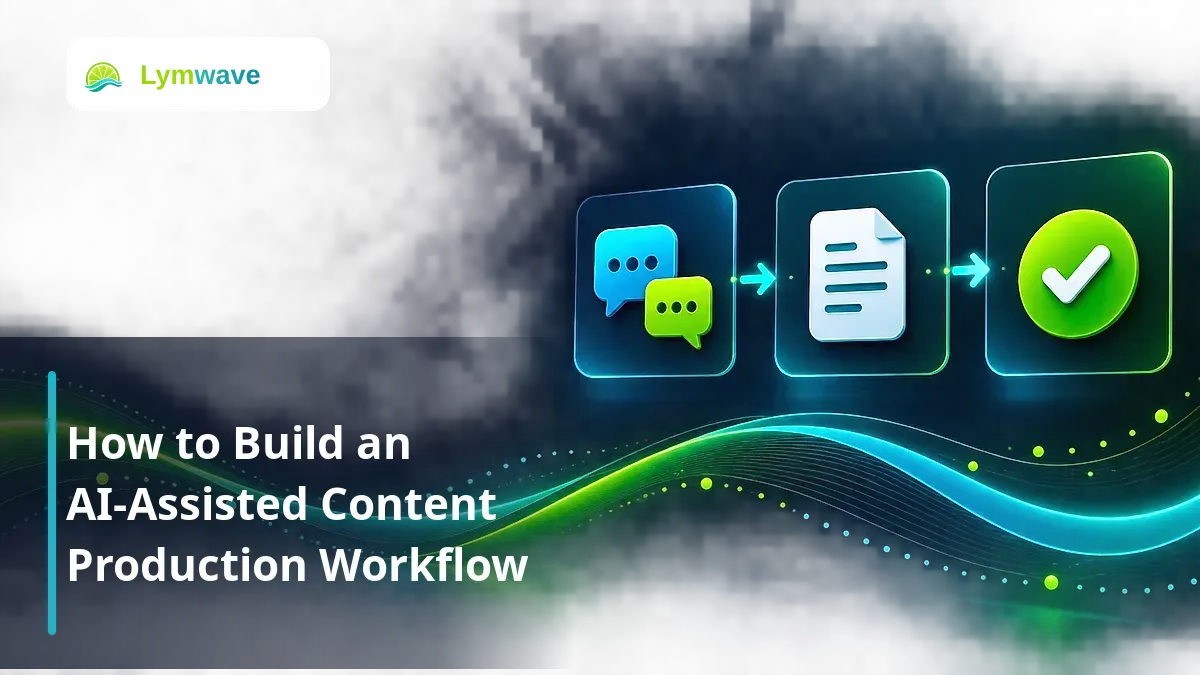
This guide sits in the AI SEO Automation topic cluster as a supporting resource.
Build an AI-assisted content production workflow by capturing original knowledge, organizing evidence, approving a brief, drafting with clear constraints, and reviewing the result before publication. Give each handoff an owner and a specific output. Start with one article so you can find missing inputs and editing bottlenecks before increasing volume.
For SaaS founders, small business owners, and content marketers, the hard part is often extracting what the business knows. A model can produce fluent paragraphs while missing the practical detail that makes an article worth reading. This guide explains how to turn an expert conversation into a useful, reviewed article, using a shared document and a small production board.
Start with a reader problem and original input
Choose a question that someone on your team can answer from experience. A support conversation, implementation lesson, or recurring sales question can provide a stronger starting point than a broad keyword alone. Remove customer identifiers and use only material you have permission to share.
For example, a fictional project-management SaaS team might hear this question repeatedly: how should a small agency move active client projects into a new workspace? That gives the article a concrete reader, task, and boundary. It does not require an exhaustive guide to project management.
Check your existing library before commissioning the piece. If an article already answers the same question, improve it. If the question is different, write a one-sentence distinction in the brief. This helps prevent a queue of similar articles with slightly different titles.
Google's people-first content guidance asks publishers to assess originality, usefulness, sourcing, and the value added beyond existing sources. Use those questions when selecting an assignment. A distinctive example or an explanation of a difficult decision can make the article useful even when the general topic is familiar.
For a broader view of topic selection and publishing, see the AI SEO automation guide.
Capture expert knowledge before asking for a draft
Run a short interview with the person who understands the work. Ask for the sequence they actually follow, where beginners get stuck, and what changes their recommendation. Request an example of a failed approach as well as a successful one.
Useful interview questions include:
- What must the reader have ready before starting?
- Which decision causes the most confusion?
- What would you check before saying the task is complete?
- When would you recommend a different approach?
Keep raw notes separate from approved facts. An interviewee might describe an old product screen, make an estimate, or mention an exception from memory. Those details need checking before they become instructions.
Create a small evidence ledger with three fields: the proposed claim, its supporting source, and its status. A source can be a current help page, an approved screenshot, a reproducible demonstration, or an expert's clearly attributed judgment. Mark unsupported claims as unresolved instead of asking the model to supply a convincing explanation.
AI can group interview notes into themes and identify missing details. Ask it to preserve uncertainty and point back to the relevant note. Then have the expert confirm the summary. This gives the writer a smaller, more reliable input packet while keeping the original context available.
Define the handoffs and review capacity
Keep the production board small enough that everyone knows what each state means. One person can hold several roles, but every article needs a named owner who can answer questions and move it forward.
| Stage | Owner | Output required for the next stage |
|---|---|---|
| Input ready | Subject expert | Approved notes, sources, and unresolved questions |
| Brief ready | Editor | Reader problem, scope, outline, and evidence |
| Draft ready | Writer | Complete article with source references and metadata |
| Approved | Reviewer | Accepted revision with factual gaps resolved |
| Published | Publisher | Live URL and completed page checks |
Add a blocked reason when an article cannot advance. “Waiting for confirmation of export behavior” gives the expert a useful task. “Needs work” does not. Identify the person who can unblock it and the exact question they need to answer.
Set a work limit based on review capacity. If the editor can assess two articles this week, filling the board with twenty drafts creates waiting work. Start with a smaller batch and measure how long review takes. Increase drafting only when the next stage can accept it.
Use the same article record throughout production. Keep the brief, source packet, draft revision, feedback, and publication URL together so reviewers do not have to reconstruct decisions from chat messages.
Write a brief the model can follow
A useful brief defines what the reader should be able to do after reading. It also tells the model which material is authoritative and which questions remain open. Keep the brief short enough that the writer and reviewer will actually use it.
Copy this structure into your next assignment:
Reader: Who is trying to complete the task?
Question: What specific problem should the article answer?
Outcome: What decision or action should become easier?
Evidence: Which approved notes and sources support the answer?
Required example: What practical situation should the article explain?
Boundaries: Which topics, claims, or product capabilities are outside scope?
Reviewer: Who checks the facts, and who approves publication?
Add relevant internal links and a proposed outline after the brief. Give each section a job: explain a prerequisite, show a decision, demonstrate a step, or answer an objection. Remove sections that exist only to repeat the keyword.
When scheduling several assignments, use a 30-day content plan to coordinate topics and owners. Keep the plan separate from the evidence packet; a calendar entry cannot replace the material needed to write the article.
Turn an interview into a draft: a worked example
Consider the fictional agency-migration article. The expert's initial notes say: select one active project, confirm its owner, map the current statuses, test the transfer, and compare the result before moving more projects. The expert also says migrations “usually take an afternoon,” without a measured basis.
The editor accepts the sequence as a proposed approach, asks for a demonstration of the transfer steps, and excludes the time claim. The article's promise becomes “prepare and test your first project migration.” It does not promise a particular duration or claim that every system supports the same import method.
The model receives the approved notes with this instruction:
Draft a practical guide for an agency owner moving one active project. Use the approved notes for factual instructions. Explain why each check matters. Label the scenario as illustrative. Do not invent product features, durations, customer results, or quotations. Return unsupported questions separately for review.
The first draft might still say “all comments transfer automatically.” The reviewer checks that sentence against the evidence packet. If the demonstration did not establish comment transfer, the sentence is removed or replaced with a test the reader should perform. Fluency is not evidence.
A stronger paragraph would tell the reader to compare the original and test project for owners, statuses, attachments, and discussion history, noting any differences before proceeding. The exact comparison checklist must fit the tools involved. The article teaches a decision process without inventing a universal feature.
Save substantive reviewer comments back into the brief. If reviewers repeatedly ask for prerequisites, make prerequisites a required input next time. This is how a workflow improves: recurring corrections change the assignment, rather than becoming permanent editing labor.
Review facts and usefulness in separate passes
First, check factual claims. Follow source links, verify instructions, and distinguish documented behavior from editorial recommendations. Review headings, image captions, and metadata too; an accurate article can still have an exaggerated description.
Google's guidance on generative AI content emphasizes accuracy, quality, and relevance, including metadata. It also warns that generating many pages without adding user value may violate its scaled content abuse policy. Treat these as reasons to assess each article's contribution before release.
Next, read as someone attempting the task. Can the reader identify the first action? Are prerequisites explained before they are needed? Does an example clarify a real decision? Cut introductions that delay the answer and paragraphs that restate a heading without adding information.
Keep review feedback actionable. “Explain how the owner checks the imported project” is easier to resolve than “make this more helpful.” Separate required corrections from stylistic preferences so a draft does not circulate indefinitely over minor wording choices.
Approval should identify the reviewed revision. If a later edit changes instructions, factual claims, or the article's promise, send the changed material back to the reviewer. Record the accepted version before the publisher prepares the page.
Publish with SEO, AEO, and GEO checks
For search engine optimization, check that the title describes the article, the page has a coherent heading structure, internal links work, and the intended public URL is accessible. Use a relevant image with descriptive alternative text. Confirm the canonical URL and indexing settings match the publication plan.
For answer engine optimization and generative engine optimization, prioritize clear explanations, explicit context, and support for claims. Define unfamiliar terms when they first appear. Give a direct answer before expanding into qualifications and examples. These are editorial choices that make information easier to understand; they do not guarantee selection by an answer system.
Google's generative AI optimization guide is the primary reference for its own Search experiences. Avoid assuming advice for one service is a universal rule for every AI platform. Check the relevant platform's current guidance when making technical decisions.
After publication, open the live page on desktop and mobile. Compare the visible article with the approved revision, check the image and links, and confirm any structured data reflects the visible content. For a fuller editorial checklist, use the guide to optimizing posts for SEO, AEO, and GEO.
Measure the workflow and improve the inputs
Track a few operational measures for the first batch: time waiting for expert answers, review time per article, and the number of substantive revisions. These show where the production process needs attention. A faster first draft is useful only if it does not create more downstream work.
Keep those measures separate from content outcomes. Readers' questions, relevant visits, and meaningful next actions can inform whether the article serves its purpose. A rise in impressions alone does not establish that the workflow caused growth or that an AI service is citing the page.
At the end of each week, choose one improvement based on repeated friction. Missing examples suggest a better interview. Unsupported claims suggest tighter evidence instructions. Long approval queues suggest a smaller batch or clearer reviewer ownership. Update the brief template and try the change on the next article.
Start with one approved source packet, one owner, and one complete publication cycle. Once that process works, reuse the structure for the next question your audience needs answered.
Frequently asked questions
What should you automate first?
Start with organizing approved notes, proposing outlines, and checking mechanical consistency. Keep topic selection, factual verification, and final approval assigned to people who understand the subject and audience. Expand automation when you can reliably review its output.
Can one person run this workflow?
Yes. A solo founder can collect evidence, approve the brief, draft, and publish. Keep those steps separate and revisit the draft after a break. Ask an appropriate expert to check claims outside your knowledge instead of relying on the model to verify itself.
What if the source material is incomplete?
Pause the affected claim, ask a specific question, or narrow the article's scope. An incomplete evidence packet does not become complete when rewritten fluently. Publish only when the article's remaining claims and instructions can be supported.
How do you know whether the workflow is helping?
Compare review effort, blocked handoffs, and correction patterns across similar assignments. Check reader feedback and relevant content outcomes separately. Use the observations to improve inputs and ownership before increasing article volume.
Useful next reads
AI SEO Automation Guide: How to Build a Content Engine That Publishes Consistently explains practical SEO, AEO, and GEO workflows for planning, publishing, measuring, and improving useful content consistently.
How to Create a 30-Day SEO Content Plan with AI explains practical SEO, AEO, and GEO workflows for planning, publishing, measuring, and improving useful content consistently.
How to Optimize Blog Posts for SEO, AEO, and GEO explains practical SEO, AEO, and GEO workflows for planning, publishing, measuring, and improving useful content consistently.
Turn this into a working content system
Audit your content, find AI visibility gaps, and build a publishing workflow that compounds.