

Automated SEO Workflows for Small Businesses
Learn how small businesses can automate SEO planning, content production, publishing, measurement, and improvement without losing quality control.
This guide sits in the AI SEO Automation topic cluster as a supporting resource.
Why Automated SEO Workflows for Small Businesses Matter
Small businesses rarely struggle because they lack SEO ideas. They struggle because research, writing, review, publishing, and measurement compete with sales, customer service, and delivery. An article may start with good intentions, sit in a draft folder for weeks, and launch without a clear plan for what happens next.
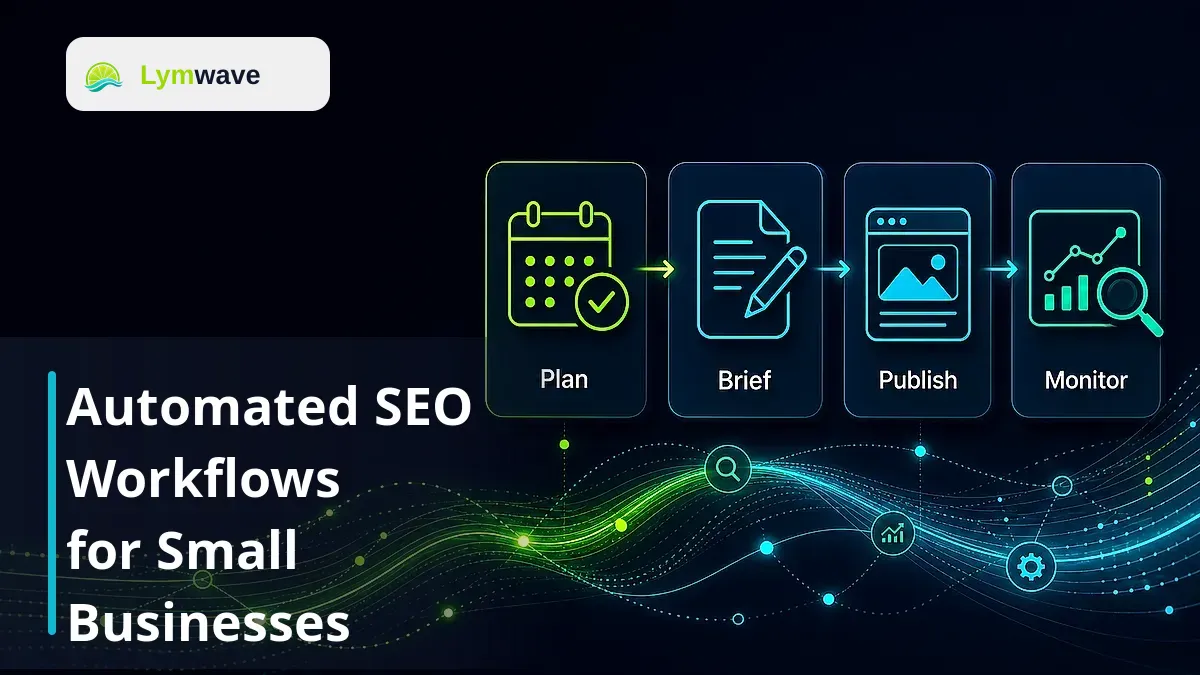
Quick answer: an automated SEO workflow connects topic selection, content briefs, drafting, quality checks, publishing, and performance review. Automation handles repeatable movement and analysis; a person still owns business priorities, factual accuracy, brand judgment, and final approval.
That distinction matters. The goal is not to produce the largest possible volume of automated SEO content. It is to make a small team more consistent without making its content generic. A useful system reduces handoffs, preserves context between stages, and shows the owner what requires attention.
For a local service company, that might mean turning recurring customer questions into helpful pages and checking which queries attract qualified visitors. For a SaaS founder, it might mean connecting product positioning, search demand, editorial review, and scheduled publishing. The tools can differ, but the operating principle stays the same: automate predictable work and keep consequential decisions visible.
What an Automated Small-Business SEO Workflow Means
An automated small-business SEO workflow is a defined sequence in which data and content move from one stage to the next with minimal manual coordination. It is broader than using AI to write an article. Writing is only one part of the system.
A complete workflow usually covers six jobs:
| Stage | Automation can handle | A person should own |
|---|---|---|
| Discover | Collect audit findings, search queries, and content gaps | Choose problems connected to real customers and offers |
| Plan | Group topics, suggest priorities, and fill a calendar | Set business value, audience, and publishing capacity |
| Brief | Draft intent, questions, entities, and internal links | Confirm the angle, claims, and product context |
| Create | Produce a structured first draft and metadata | Add expertise, examples, evidence, and brand voice |
| Publish | Format, schedule, and send approved content to a CMS | Approve the final page and publishing destination |
| Improve | Monitor queries, flag weak pages, and suggest refreshes | Decide whether to update, consolidate, redirect, or wait |
This division prevents two bad extremes. A fully manual process becomes fragile because every step depends on someone remembering the next task. A fully autonomous process can publish confident mistakes or flood the site with pages that have no distinct purpose.
The right level of AI SEO automation depends on risk. Automatically collecting topic signals is low risk. Automatically publishing a legal, medical, financial, or strong performance claim is high risk. Each stage needs an explicit rule for what may proceed, what needs review, and what stops the workflow.
Small teams also need one source of context. The workflow should carry forward the target audience, search intent, relevant entities, internal-link candidates, product facts, prohibited claims, and approval state. When these inputs live in separate spreadsheets and chat threads, automation accelerates the wrong version of the brief.
The broader architecture follows the same principle: build a consistent content engine around controlled stages, shared context, and explicit approvals rather than isolated generation tasks.
How to Build the Workflow
Start with one narrow loop. A small business does not need a complicated collection of agents and integrations on day one. It needs a dependable path from a validated topic to a reviewed page, followed by a simple feedback cycle.
1. Define the outcome and guardrails
Choose one measurable job for the workflow. Examples include publishing two useful articles per month, answering the ten questions prospects ask most often, or refreshing pages that receive impressions but weak clicks. Then define boundaries: approved offers, audiences, regions, source material, tone, claims that require evidence, and topics that should never publish automatically.
Assign a named owner to strategy, review, and publishing even if one person fills every role. Ownership prevents an automated task from becoming nobody's responsibility.
2. Build a focused opportunity queue
Combine a few reliable inputs: customer questions, website audit findings, existing content gaps, product knowledge, and Search Console data when enough data exists. Score ideas by reader need, business relevance, evidence available, and effort. Search volume alone is not a sufficient priority signal for a small company.
Keep the queue short enough to review. A list of 20 credible opportunities is more useful than 2,000 exported keywords. If planning is the immediate bottleneck, use this 30-day SEO content plan workflow to turn the queue into a realistic schedule.
3. Standardize the brief
Create one brief template that includes the reader, primary intent, direct answer, supporting questions, entities, internal links, proof requirements, and next step. The brief should also state why this page deserves to exist instead of being merged into an existing article.
The AI content workflow may draft these fields, but the owner should verify them before writing begins. A weak brief produces a polished but interchangeable article faster.
4. Draft with evidence and constraints
Generate the article section by section from the approved brief. Require concise paragraphs, one H1, logical H2 and H3 headings, a direct answer near the top, and natural keyword use. Feed the system approved business facts and source material instead of asking it to invent examples.
Review the draft for factual accuracy, specificity, duplication, brand voice, and unsupported claims. Product details, customer outcomes, prices, regulations, and comparisons need particular care because they can change or create risk.
5. Add a publishing gate
Only approved content should move into the publishing integration. Before release, check the title, meta description, canonical URL, image, image alt text, internal links, mobile formatting, and visible structured-data content. Confirm that the featured image and social preview are relevant and fast-loading.
The gate can be a simple status change from draft to approved. What matters is that generation completion is not treated as publication approval.
6. Measure and improve
After publishing, confirm that the page is crawlable and indexed. Then review query fit, impressions, clicks, conversions or qualified actions, and movement into related pages. Compare results with the intended reader task rather than judging the article only by traffic.
Create decision rules. A page with impressions and low click-through rate may need a clearer title. A page attracting irrelevant queries may need sharper intent. A page with qualified visits but low conversion may need a better next step. A page with no visibility may need more time, stronger internal links, consolidation, or a different topic—not an automatic rewrite every week.
How the Workflow Supports SEO, AEO, and GEO
SEO, answer engine optimization, and generative engine optimization are three review lenses for the same useful page. A well-designed workflow captures their requirements before drafting and checks them again before publishing.
| Lens | Workflow requirement | Practical check |
|---|---|---|
| SEO | Clear intent, crawlable structure, metadata, and internal links | Does the page match a real query and connect to related content? |
| AEO | Direct definitions, concise answers, and visible FAQs | Can a reader understand the main answer without reading the whole page? |
| GEO | Explicit entities, relationships, and carefully bounded claims | Can an AI system summarize the page without guessing missing context? |
| Trust | Evidence, ownership, updates, and human review | Are claims accurate, current, and appropriate for the business? |
The workflow supports SEO by maintaining alignment from the opportunity through the title, headings, metadata, and links. It supports AEO by requiring answer-ready passages instead of burying the conclusion. It supports GEO by connecting entities in clear prose: for example, explaining how AI content automation supports SEO planning while human review controls business claims.
Structured data should match visible content. BlogPosting and BreadcrumbList data can describe the page, while FAQPage data is appropriate when the same questions and answers appear on the page. Schema should never introduce answers that readers cannot see.
Use the detailed SEO, AEO, and GEO blog optimization guide as the final editorial review for each article.
Common Mistakes to Avoid
The most common mistake is automating production before defining strategy. Faster drafts do not solve unclear positioning, weak offers, or topics disconnected from customer needs.
Another mistake is measuring output instead of outcomes. Article count and word count show activity, not value. Track whether the workflow publishes on schedule, attracts relevant searches, answers customer questions, and contributes to meaningful actions.
Avoid these additional failures:
- Publishing without a gate. Generation should end in review, not automatic approval by default.
- Using one template for every intent. A comparison, tutorial, local service page, and definition need different evidence and structure.
- Treating keywords as the audience. Real readers have situations, constraints, objections, and next steps.
- Inventing expertise. Automation should use approved sources and flag missing evidence rather than fill gaps confidently.
- Creating orphan pages. Every new article should connect to relevant existing content and, where useful, to a product or service path.
- Refreshing on a timer alone. Update when search data, product changes, factual drift, or content quality creates a reason.
- Adding too many tools. Each integration adds maintenance. Start with the smallest system that closes the full loop.
Finally, do not expect automation to guarantee rankings, AI citations, or traffic. It can improve consistency, coverage, and operational quality. Search visibility still depends on the usefulness of the page, competition, site authority, technical health, and time.
Frequently Asked Questions
What should a small business automate first in SEO?
Start with low-risk coordination: collecting opportunities, maintaining a content queue, creating structured briefs, running repeatable quality checks, and scheduling approved pages. Keep topic strategy, facts, claims, and final publishing approval under human control.
How do automated SEO workflows support SEO, AEO, and GEO?
They preserve search intent, direct answers, entity context, metadata, internal links, and review requirements from planning through publication. This makes pages easier for search engines to crawl, answer engines to extract, AI systems to understand, and people to use.
Can a small business automate SEO without a full content team?
Yes. One owner can operate a narrow workflow with clearly separated planning, review, and approval passes. The important requirement is explicit ownership, not team size.
Should AI-generated SEO content publish automatically?
Only when the content type is low risk and the business has reliable validation rules. Most small businesses should require approval before public release, especially for product claims, comparisons, prices, regulated advice, or customer examples.
How should a small business measure the workflow?
Measure operational reliability, content quality, relevant search visibility, and business contribution. Useful signals include approval time, publishing consistency, query fit, qualified visits, internal-link movement, leads, and refresh decisions—not article volume alone.
Useful next reads
AI SEO Automation Guide: How to Build a Content Engine That Publishes Consistently explains practical SEO, AEO, and GEO workflows for planning, publishing, measuring, and improving useful content consistently.
How to Create a 30-Day SEO Content Plan with AI explains practical SEO, AEO, and GEO workflows for planning, publishing, measuring, and improving useful content consistently.
How to Optimize Blog Posts for SEO, AEO, and GEO explains practical SEO, AEO, and GEO workflows for planning, publishing, measuring, and improving useful content consistently.
Turn this into a working content system
Audit your content, find AI visibility gaps, and build a publishing workflow that compounds.