

Automated SEO Workflows for Agencies
Learn how agencies can automate SEO planning, production, approval, publishing, reporting, and refreshes without losing client context or quality control.
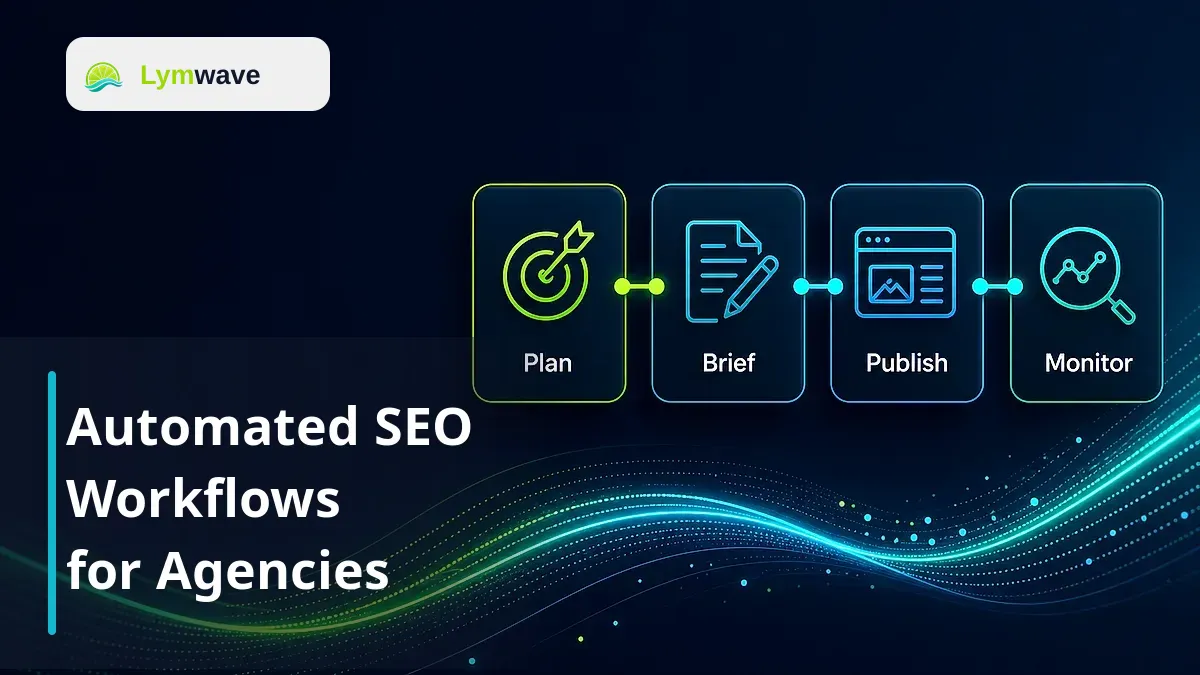
This guide sits in the AI SEO Automation topic cluster as a supporting resource.
Why Automated SEO Workflows for Agencies Matter
Quick answer: Agencies should automate repeatable SEO operations—not client strategy. The best workflows connect research, planning, briefs, production, review, publishing, reporting, and refreshes while preserving account-specific context and human approval.
Agency SEO delivery becomes difficult at the handoffs. A strategist identifies an opportunity, an account manager translates it for the client, a writer turns it into a draft, an editor checks it, and a publisher moves it into a CMS. When these steps live in separate documents and inboxes, small delays multiply across every account.
Automation can make that operating system more reliable. It can assemble research into a brief, route work to the right reviewer, prepare metadata, suggest internal links, record approval status, and surface content that needs attention. The benefit is not merely faster writing. It is fewer dropped requirements, clearer ownership, and a more predictable path from opportunity to published improvement.
This distinction matters because agencies cannot use one generic process for every client. Each account has its own audience, products, proof, risk tolerance, brand voice, publishing access, and approval rules. A useful AI content workflow standardizes the process while keeping those inputs separate.
The objective is controlled scale. Teams should be able to handle more planned work without making every client sound alike or allowing unsupported claims to pass through. The broader content engine connects planning, publishing, measurement, and improvement; this article focuses on the agency orchestration layer.
What Automated SEO Workflows for Agencies Mean
An automated agency SEO workflow is a defined sequence in which software handles repeatable transitions and checks while specialists retain strategic and editorial decisions. It turns a collection of individual tasks into a visible production system.
The workflow usually spans six operating areas:
| Area | Useful automation | Human responsibility |
|---|---|---|
| Discovery | Consolidate search, site, and content signals | Decide which opportunities fit the client strategy |
| Planning | Cluster topics and prepare a reviewable calendar | Set priorities, sequencing, and commercial relevance |
| Production | Assemble briefs, drafts, metadata, and image prompts | Validate expertise, examples, claims, and brand voice |
| Approval | Route stages and record decisions | Approve, request changes, or reject work |
| Publishing | Prepare destination-ready content and status updates | Control credentials, timing, and final release |
| Improvement | Surface aging pages and performance changes | Choose refresh, consolidation, or retirement actions |
This model separates the reusable agency method from client-specific data. The reusable layer can include brief templates, quality gates, required metadata, naming conventions, status definitions, and reporting formats. The account layer contains the client's positioning, audience, approved claims, exclusions, competitors, internal links, and CMS destination.
That separation protects quality and confidentiality. A system should never borrow examples, language, or strategic assumptions from one client to complete another client's article. Tenant boundaries, access controls, and traceable approvals are operational requirements, not optional technical details.
Automation also needs a clear source of truth. A status such as “approved” should mean the same thing to the strategist, editor, account manager, and publisher. If a workflow updates several tools but nobody knows which status is authoritative, it has automated confusion rather than delivery.
The right starting point is a narrow service line. An agency might automate educational blog production first, then add content refreshes or landing-page briefs after the first workflow is dependable. This makes it easier to measure cycle time, revision volume, and review capacity without redesigning the entire operation at once.
How to Approach Automated SEO Workflows for Agencies
Begin by mapping the current process before choosing automation. List every state from the initial opportunity to the post-publication review, including who owns it, what information is required, and what must be true before the work advances.
A practical implementation follows these steps:
- Create an account context record. Store the client's audience, offers, category language, approved product facts, tone, restricted claims, conversion paths, important URLs, and publishing rules.
- Define the opportunity intake. Decide which inputs can create work: keyword research, content gaps, site audits, search-console signals, sales questions, product changes, or scheduled refreshes.
- Score before generating. Rank opportunities by relevance, intent, existing coverage, business value, confidence, and effort. Automation should not turn every detected phrase into an article.
- Build a structured brief. Require a clear question, reader stage, angle, entities, supporting evidence, internal-link targets, product boundaries, and expected next action.
- Add explicit quality gates. Separate strategic approval, factual review, editorial review, optimization checks, and final publishing approval when the account requires them.
- Prepare the complete publishing package. Include the article, title, description, canonical path, featured image, schema settings, links, and destination status before handoff.
- Close the loop. Schedule measurement and refresh decisions so published work returns to the planning system instead of disappearing from view.
For a new account, a fixed planning window is easier to govern than an unlimited queue. The method in how to create a 30-day SEO content plan with AI gives clients something concrete to approve and gives the agency a bounded production forecast.
Capacity rules are as important as generation rules. If an editor can review eight articles per week, producing thirty drafts does not create throughput; it creates inventory. Limit work in progress, expose blocked stages, and measure the time spent waiting for client feedback separately from active production time.
Use exceptions deliberately. Low-risk educational posts may follow a standard approval path, while regulated topics, comparison pages, or product claims may require a subject-matter reviewer. The system should route these differences from stored rules instead of relying on someone to remember them.
Reporting should describe workflow health as well as search performance. Useful operational measures include brief-to-approval time, revision rounds, publish completion rate, refresh backlog, and the share of work blocked by missing client input. These measures help the agency improve delivery without pretending that publication alone guarantees rankings or revenue.
How This Supports SEO, AEO, and GEO
A structured workflow supports SEO by making intent, metadata, crawl paths, internal links, and content ownership part of the production definition. Instead of remembering optimization at the end, the agency checks it before publishing.
It supports answer engine optimization by requiring concise answers and self-contained explanations. A strong brief identifies the main question, related questions, useful definitions, and the level of detail a reader needs. Editors can then verify that the opening answers the query directly before the article expands into evidence and process.
It supports generative engine optimization by keeping entity language and factual context consistent across the client's content library. Stable descriptions of the brand, category, audience, products, and workflows make individual pages easier to interpret. This is not a reason to repeat exact phrases. It is a reason to avoid contradictory or vague descriptions.
An agency can use one review grid across these layers:
| Layer | Review question | Evidence in the workflow |
|---|---|---|
| SEO | Does the page own a distinct intent? | Approved topic map, canonical path, metadata, and internal links |
| AEO | Can the main answer stand alone? | Direct opening answer, clear headings, definitions, and FAQs |
| GEO | Are entities and claims clear and consistent? | Account context, approved facts, source-aware examples, and review history |
| Editorial | Is the article useful and defensible? | Named reviewer, revision record, and final approval |
The practical checklist in how to optimize blog posts for SEO, AEO, and GEO can become a reusable gate instead of a last-minute inspection. That consistency is especially useful when different freelancers or account teams contribute to the same client library.
No workflow can guarantee rankings, citations, traffic, or conversions. What automation can do is improve the completeness, consistency, and traceability of the work that an agency controls.
Common Mistakes to Avoid
The first mistake is automating an undefined process. If ownership, required inputs, and approval rules are unclear, adding software only moves the confusion faster. Map the workflow and remove unnecessary stages before automating transitions.
The second is using one template for every account. Standard fields are useful, but the audience, evidence, examples, risks, and conversion path must remain specific. Client context should shape the brief before generation begins.
Another mistake is measuring output instead of throughput and quality. Draft count is easy to increase. Approved, published, internally linked, and maintained content is harder—and far more relevant to an agency's delivery promise.
Do not allow silent publishing. Credentials and integrations should follow least-privilege access, and consequential actions should have clear approval and audit records. A failed or partial publish should be visible rather than reported as complete.
Avoid unbounded queues. When automated production outruns reviewers, work becomes stale and revision costs rise. Set limits based on editorial and client-approval capacity, then increase volume only when the full path remains healthy.
Finally, do not treat reporting as the end of the workflow. Performance signals should create review decisions: retain, refresh, expand, consolidate, redirect, or stop. An automated content operation becomes valuable when it helps the agency make the next decision, not when it simply generates another dashboard.
Frequently Asked Questions
What should you know about automated SEO workflows for agencies?
They are operating systems for repeatable delivery, not hands-off writing machines. Software can coordinate research, briefs, production, checks, publishing, reporting, and refreshes, while people retain strategy, factual judgment, client communication, and approval.
Which SEO tasks should an agency automate first?
Start with stable, repetitive tasks such as opportunity intake, brief assembly, metadata preparation, status routing, quality checklists, internal-link suggestions, publishing packages, and refresh reminders. Keep strategic prioritization and sensitive claims under human review.
How do automated workflows protect each client's brand?
Maintain separate account context, permissions, approved facts, exclusions, tone guidance, and publishing destinations. Every generated brief should inherit the correct account context, and reviewers should be able to trace which inputs and approvals shaped the final article.
How do these workflows support SEO, AEO, and GEO?
They support SEO through consistent intent and technical publishing checks, AEO through direct answers and clear structure, and GEO through stable entity language, defensible claims, and coherent context across the content library.
What should an agency measure after implementation?
Track cycle time, time waiting for approval, revision rounds, work in progress, publish completion, refresh backlog, and relevant search or business outcomes. Use the data to improve bottlenecks rather than promising results the workflow cannot guarantee.
Useful next reads
AI SEO Automation Guide: How to Build a Content Engine That Publishes Consistently explains practical SEO, AEO, and GEO workflows for planning, publishing, measuring, and improving useful content consistently.
How to Create a 30-Day SEO Content Plan with AI explains practical SEO, AEO, and GEO workflows for planning, publishing, measuring, and improving useful content consistently.
How to Optimize Blog Posts for SEO, AEO, and GEO explains practical SEO, AEO, and GEO workflows for planning, publishing, measuring, and improving useful content consistently.
Turn this into a working content system
Audit your content, find AI visibility gaps, and build a publishing workflow that compounds.