

AI SEO Automation for Small Businesses
AI SEO automation for small businesses explains practical SEO, AEO, and GEO workflows for planning, publishing, measuring, and improving useful content consistently.
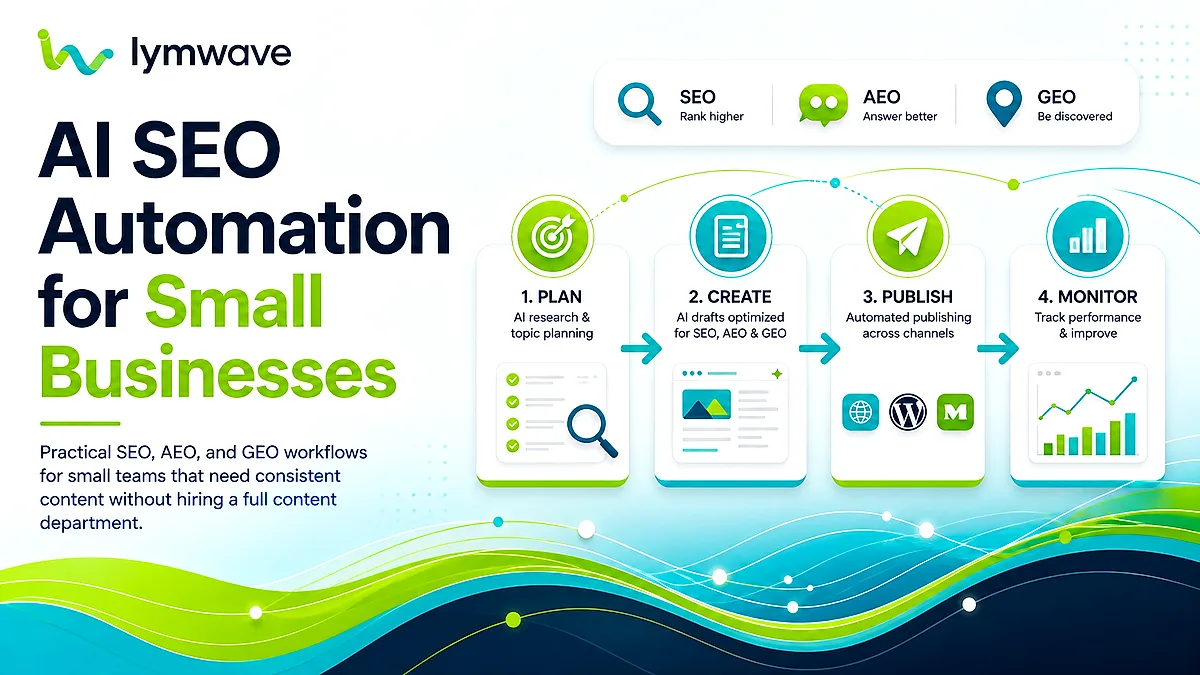
This guide sits in the AI SEO Automation topic cluster as a supporting resource.
Why small businesses need a simpler SEO workflow
Quick answer: AI SEO automation helps small businesses plan, create, review, publish, and improve useful content around real customer questions without turning marketing into a full-time production job.
Most small businesses do not have a separate SEO strategist, editor, analytics person, designer, and publisher. The owner, founder, or one marketer is often responsible for everything: sales calls, customer service, operations, website updates, and the blog that somehow still needs to rank.
That is why automation can help. Not because a business needs hundreds of generic articles, but because it needs a calmer way to keep useful content moving. A practical workflow can turn service knowledge, customer questions, local expertise, and search intent into approved pages that are easier for people and search systems to understand.
The goal is not to publish as much as possible. The goal is to stop losing good ideas in notes, inboxes, call transcripts, and half-written drafts. Small-business SEO works best when the website clearly explains what the business does, who it helps, where it serves customers, and what questions buyers ask before contacting the team.
AI can support that work by organizing topics, creating briefs, drafting first versions, suggesting internal links, preparing metadata, and flagging old content for refresh. Human review still matters. The business owner or marketer should approve claims, examples, service details, location language, and final publishing.
What automation should actually do
For a small business, automation should remove repetitive coordination work. It should not create an oversized content machine that nobody has time to review.
Useful automation tasks include:
- Turning customer questions into blog post ideas.
- Grouping service, location, and problem-based topics into simple clusters.
- Creating briefs with audience, intent, entities, and internal links.
- Drafting articles from approved outlines.
- Writing SEO titles, meta descriptions, excerpts, and FAQ sections.
- Suggesting links to related service pages, guides, and older posts.
- Preparing content for WordPress, Webflow, GitHub, or another publishing workflow.
- Watching older posts for refresh opportunities.
- Summarizing what was published and what should improve next.
The best starting point is usually a narrow one. Pick one core service, one audience, or one local market. Build content around the questions people already ask before buying. Then expand only when the review process feels manageable.
Automation should also protect quality. A small business cannot afford pages that sound polished but make vague claims, use the wrong service language, or imply expertise the team does not have. The workflow should make it easy to review every article before it goes live.
A good rule is simple: automate the repeatable parts, keep judgment on the business-specific parts. Let AI help with structure, drafts, metadata, and organization. Keep humans in charge of promises, prices, availability, proof, service details, and local nuance.
This is especially important for regulated, local, or trust-heavy businesses. A clinic, tax advisor, legal consultant, contractor, or financial service cannot publish casual claims just because a draft sounds confident. The workflow should include a short checklist for sensitive details: is the service available, is the location language accurate, are claims supportable, and would the business be comfortable saying this directly to a customer?
A practical small-business workflow
The workflow does not need to be complicated. It should be easy enough to run every week without becoming another unfinished project.
Start with this sequence:
- Collect real questions. Use sales calls, emails, support chats, reviews, Search Console queries, and staff notes. The best small-business content often begins with questions customers already ask.
- Choose one topic cluster. Focus on one service, customer problem, location, or buying stage. Avoid jumping between unrelated topics every week.
- Create a short brief. Include the reader, the question, the service context, entities to mention, internal links, and claims to avoid.
- Generate the first draft. Use the brief as the control layer. The draft should answer the main question quickly and stay grounded in the business.
- Review for accuracy. Check service details, location language, examples, fees or timelines, and any statement that could affect customer expectations.
- Prepare metadata and FAQs. Add a unique title, meta description, canonical path, BlogPosting schema, and FAQ schema when the questions are visible in the article.
- Publish through a repeatable path. Use the same CMS or repository workflow each time so publishing does not depend on memory.
- Measure and refresh. Watch impressions, clicks, CTR, rankings, AI visibility, and outdated sections. Improve existing pages before creating too many new ones.
If the business is starting from scratch, use a short publishing plan rather than a giant keyword spreadsheet. The process in creating a 30-day SEO content plan with AI can be adapted into a small weekly cadence: a few priority articles, a few refreshes, and clear review time.
This workflow is also useful for service-area businesses. A plumber, accountant, clinic, consultant, or niche retailer may need pages that explain specific problems, local availability, common decisions, and next steps. Those articles should feel practical, not like generic industry summaries.
Keep the cadence realistic. A small business might schedule one planning session at the start of the month, one weekly review block, and one publishing window. That is enough to maintain momentum without pretending content can run with no attention. If the owner can review only two drafts per month, the automation workflow should respect that limit instead of filling a queue with unapproved articles.
How this supports SEO, AEO, and GEO
Small-business content has to do more than include keywords. It should be clear enough for search engines, answer engines, generative AI systems, and real customers to understand.
For SEO, automation helps with consistency. It can keep the business publishing around one topic cluster at a time, generate unique metadata, suggest internal links, and prevent the blog from becoming a pile of disconnected posts.
For AEO, automation helps pages answer questions directly. A useful small-business article should include a short answer, plain definitions, step-by-step guidance, and FAQs when those questions genuinely match the page. That makes the content easier to quote, summarize, and scan.
For GEO, automation helps reinforce entity context. The page should consistently explain the business category, audience, service, location when relevant, workflow, and problem being solved. Generative systems need that context to understand when the business may be relevant.
The strongest small-business pages usually combine practical detail with restraint. They explain what the customer should know, what the business can help with, and what the next step is. They do not invent proof, guarantee rankings, or make claims that the team would not say on a sales call.
Before publishing, use the SEO, AEO, and GEO optimization guide as a final review layer. It helps check whether the page has a clear H1, useful headings, direct answers, structured data, internal links, and credible entity language.
Common mistakes to avoid
The first mistake is trying to automate too much too quickly. A small business does not need a complex content operation on day one. It needs a workflow that can survive a busy week.
The second mistake is creating thin location or service variations. Do not publish near-identical pages for every small phrase, area, or audience unless the intent and content are meaningfully different. Weak variations can dilute the site instead of strengthening it.
The third mistake is skipping review. AI can write confidently about details it does not actually know. Review every service claim, comparison, timeline, price mention, location statement, and proof point before publishing.
The fourth mistake is ignoring older content. Many small businesses already have pages that could perform better with a refresh, clearer internal links, stronger FAQs, or updated service details. New content and refresh work should move together.
The fifth mistake is measuring only traffic. Traffic is useful, but small businesses also need qualified inquiries, better explanations, stronger service pages, and fewer repeated customer questions. A smaller article that helps real buyers can be more valuable than a broad post that brings the wrong visitors.
If the goal is a complete operating loop rather than isolated drafts, the broader AI SEO automation guide explains how planning, publishing, visibility checks, and improvement can work together.
Measure a few practical signals each month: which posts earned impressions, which pages produced inquiries, which search queries revealed missing explanations, and which older pages now feel outdated. That review keeps automation tied to business outcomes instead of letting it drift into content volume for its own sake.
Frequently asked questions
What should small businesses automate first?
Start with topic ideas, briefs, metadata, FAQ sections, internal-link suggestions, and first drafts for low-risk educational content. Keep final review and publishing approval with a human.
Does AI SEO automation replace a marketer or business owner?
No. It reduces repetitive production work, but a person still needs to own service accuracy, positioning, customer promises, local details, and publishing decisions.
How often should a small business publish?
Publish at a pace the team can review. One useful article or refresh per week is often better than a burst of generic posts that nobody maintains.
How does this help answer engine optimization?
It helps by adding direct answers, clear definitions, practical headings, and FAQ sections that match visible page content. Those elements are easier for readers and answer systems to parse.
What is the biggest risk?
The biggest risk is publishing vague or inaccurate content at scale. Use short briefs, human review, internal-link checks, and refresh workflows so automation stays useful and controlled.
Useful next reads
AI SEO Automation Guide: How to Build a Content Engine That Publishes Consistently explains practical SEO, AEO, and GEO workflows for planning, publishing, measuring, and improving useful content consistently.
How to Create a 30-Day SEO Content Plan with AI explains practical SEO, AEO, and GEO workflows for planning, publishing, measuring, and improving useful content consistently.
How to Optimize Blog Posts for SEO, AEO, and GEO explains practical SEO, AEO, and GEO workflows for planning, publishing, measuring, and improving useful content consistently.
Turn this into a working content system
Audit your content, find AI visibility gaps, and build a publishing workflow that compounds.