

AI SEO Automation for SaaS Companies
AI SEO automation for SaaS companies explains practical SEO, AEO, and GEO workflows for planning, publishing, measuring, and improving useful content consistently.
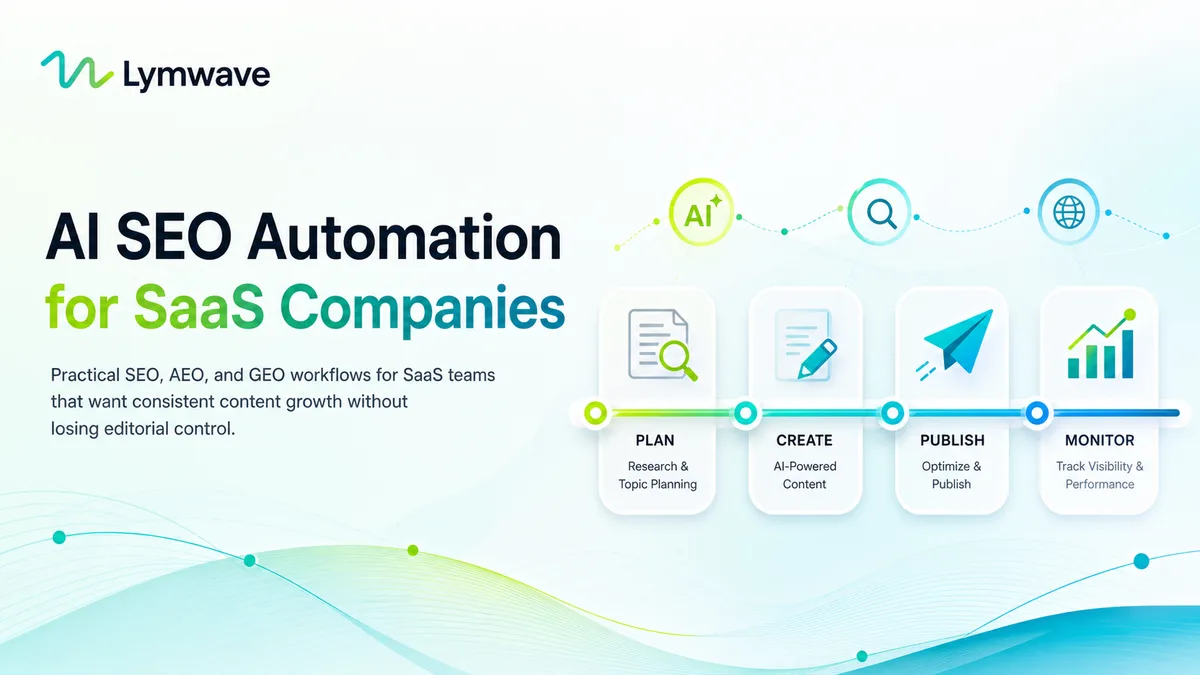
This guide sits in the AI SEO Automation topic cluster as a supporting resource.
Why AI SEO automation matters for SaaS teams
Quick answer: AI SEO automation helps SaaS teams turn product knowledge, search intent, content planning, drafting, internal linking, publishing, and performance review into a repeatable workflow instead of a scattered set of manual tasks.
SaaS content teams have a particular problem: they need useful content before every product category, use case, integration, comparison, and customer question is obvious in analytics. Waiting for perfect data can slow growth, but publishing generic articles creates another problem. It fills the site with pages that do not explain the product, the category, or the customer workflow clearly enough to win search visibility.
Automation is useful when it helps the team move from idea to reviewed content with less operational drag. It is not useful when it simply generates more drafts for editors to rescue.
For a SaaS company, the goal should be a controlled content system. The system should identify topics, map them to product value, create briefs, draft useful articles, suggest internal links, prepare metadata, support publishing, and measure whether the page is helping. The human role stays important: choose the strategy, review the claims, protect the product voice, and decide what gets published.
That is the difference between AI writing and a real AI content workflow. One creates text. The other supports consistent, accountable organic growth.
This matters most when the company has more content needs than editorial capacity. A founder may need integration pages, comparison content, onboarding education, template posts, feature explainers, and refreshes for older articles. A small marketing team may have one person handling strategy, writing, analytics, and publishing. Automation can keep those jobs moving, but only if the workflow is narrow enough to review and repeat.
What automation should handle
The best SaaS use cases for automation are repeatable, structured, and easy to review. They are not the moments where a founder needs to invent positioning from scratch or make a risky claim about the market.
Use automation for tasks such as:
- Turning keyword and customer questions into article ideas.
- Grouping ideas into topic clusters.
- Creating briefs with search intent, entities, audience, and angle.
- Drafting articles from approved outlines.
- Building SEO titles, meta descriptions, excerpts, and FAQ sections.
- Suggesting internal links to existing posts and product pages.
- Preparing content for WordPress, Webflow, GitHub, or another publishing destination.
- Flagging posts that need refreshes after ranking, CTR, or visibility changes.
- Creating lightweight reports that show what was published and what changed.
These tasks work well because they have a clear input, expected output, and review path. The team can check whether the generated page answers the right query, connects to the right product workflow, and uses accurate language.
Avoid asking automation to replace strategy. A SaaS company still needs to know which segment it serves, which use cases matter, what product claims are true, and which pages should not exist yet. AI can help organize and execute the plan, but it should not quietly become the strategy owner.
A simple rule helps: automate the parts of content production that should be consistent, and keep judgment on the parts that shape the business. Templates, briefs, link suggestions, metadata, and status reporting should be consistent. Positioning, roadmap claims, competitive conclusions, and customer proof need human control.
The same rule applies to product-led content. Automation can draft an article about a workflow, but the team should provide the exact product behavior, limits, integrations, screenshots, or support language that makes the article trustworthy. Without that context, the article may sound polished while still being too vague to help a buyer.
A practical workflow for SaaS content
A useful workflow starts with search demand, but it should not stop there. SaaS content needs to connect the query to a buyer problem, a product category, and a practical next step.
Use this sequence:
- Choose a content goal. Decide whether the page should explain a category, support a use case, compare workflows, answer a setup question, or refresh an existing article.
- Group related topics. Put keywords, questions, integrations, and customer objections into clusters so the site builds topical authority instead of publishing isolated posts.
- Write a focused brief. Include the primary intent, audience, entities, product context, internal links, and claims that must be avoided.
- Generate the first draft. Use the brief as the control layer, not a loose prompt. The draft should follow the article structure and answer the main question early.
- Review for truth and usefulness. Check product claims, examples, definitions, and whether the article would help the intended reader make a decision.
- Prepare metadata and schema. Add a unique title, description, canonical, BlogPosting schema, FAQ schema when useful, and a featured image with alt text.
- Publish through a controlled path. Send approved content to the CMS or repository only after review.
- Measure and refresh. Watch rankings, impressions, CTR, AI visibility, internal-link gaps, and outdated sections.
If you are building the process from zero, start with the structure in creating a 30-day SEO content plan with AI. That keeps the first month narrow enough to review while still building momentum.
The same workflow can scale later. The important part is that each article has a reason to exist before it is drafted.
For SaaS teams, that reason should be visible in the brief. A good brief should say which audience the article serves, what job they are trying to complete, what product category language matters, and which internal page the reader should understand next. If the brief cannot answer those questions, the article is probably not ready for automation.
It also helps to separate net-new publishing from refresh work. New articles build coverage. Refreshes protect and improve existing visibility. A healthy automation workflow should do both: create new pages for clear gaps, then revisit older posts when Search Console, rankings, or AI visibility checks show that the page is slipping or incomplete.
How the workflow supports SEO, AEO, and GEO
Modern SaaS content has to work across search engines, answer engines, and generative AI systems. Those surfaces reward slightly different signals, but they all benefit from clear structure and credible explanations.
For SEO, automation helps with coverage and consistency. It can keep titles unique, map articles into clusters, suggest internal links, and ensure that each page targets a specific intent instead of drifting across several topics.
For AEO, automation helps pages answer questions directly. A good workflow can add short answer blocks, concise definitions, comparison sections, and FAQ entries that match visible content. This makes the page easier for answer systems and readers to parse.
For GEO, automation helps build stronger entity context. SaaS pages should consistently name the product category, audience, workflow, integrations, and problem being solved. Generative systems need that context to understand what the brand does and when it may be relevant.
The workflow should also protect against unsupported claims. SaaS teams often want confident copy, but AI can overstate product capabilities, invent customer proof, or imply integrations that do not exist. Review rules matter here. They keep the content credible while still allowing the team to publish consistently.
The strongest pages usually combine all three layers. They target a clear search intent, answer the main question in plain language, and reinforce the entity context around the product. For example, a post about automated publishing should explain what automated publishing means, how the workflow is reviewed, which CMS destinations are supported, and why the process matters to the audience. That combination is more useful than a page that repeats a keyword without adding workflow detail.
For a broader optimization checklist, use the guide to optimizing blog posts for SEO, AEO, and GEO as a review layer before publishing.
Common mistakes to avoid
The first mistake is measuring success only by publishing volume. More posts can help, but only when they answer useful questions, fit the site architecture, and remain accurate over time. A daily publishing workflow without review can create cleanup work faster than it creates visibility.
The second mistake is creating too many similar pages. SaaS sites are especially vulnerable to thin variations such as one article for every tiny audience, integration, or feature phrase. If the pages do not have meaningfully different intent, examples, or next steps, consolidate the idea or create one stronger guide.
The third mistake is ignoring internal links. Automation should connect new posts to related articles, product pages, solution pages, and supporting guides. Without those links, good content can become hard for readers and crawlers to discover.
The fourth mistake is skipping refresh work. SaaS products change, search demand changes, and AI visibility can shift. A strong workflow includes recrawls, Search Console review, article refreshes, and updates to outdated sections.
The fifth mistake is treating AI output as publication-ready by default. Even strong drafts need review for factual accuracy, product fit, tone, claims, and reader usefulness. The review step is not a bottleneck; it is the control that lets automation be trusted.
If your team wants a complete system rather than isolated generation, the broader AI SEO automation guide explains how to connect planning, publishing, visibility checks, and improvement loops.
One more mistake is choosing tools before defining the operating model. A SaaS team should know who approves topics, who reviews drafts, how publishing destinations are connected, how failed publishes are handled, and when articles are refreshed. Tooling can support those decisions, but it cannot fix an unclear workflow by itself.
Keep the first version small. Pick one topic cluster, one publishing cadence, one review checklist, and one reporting rhythm. Once that works, add more clusters, more destinations, or more automation. This keeps the system understandable while the team learns which parts of the workflow actually save time.
Frequently asked questions
What should SaaS companies automate first?
Start with briefs, topic clustering, metadata, internal-link suggestions, and first drafts for low-risk educational content. These tasks save time while still giving editors clear review points.
Does AI SEO automation replace a content marketer?
No. It reduces repetitive work, but a content marketer or founder still needs to own positioning, product accuracy, editorial judgment, and publishing decisions.
How does this help answer engine optimization?
It helps by adding direct answers, clear definitions, FAQ sections, and logical heading structure. Those elements make content easier for answer systems to summarize and easier for readers to scan.
How does this support generative engine optimization?
It strengthens entity context by consistently explaining the SaaS product category, audience, workflows, integrations, and problems solved. That context can improve how generative systems understand the brand.
What is the biggest risk of automating SaaS content?
The biggest risk is publishing generic or inaccurate content at scale. Use approved briefs, human review, internal-link checks, and refresh workflows to keep automation useful and controlled.
Useful next reads
AI SEO Automation Guide: How to Build a Content Engine That Publishes Consistently explains practical SEO, AEO, and GEO workflows for planning, publishing, measuring, and improving useful content consistently.
How to Create a 30-Day SEO Content Plan with AI explains practical SEO, AEO, and GEO workflows for planning, publishing, measuring, and improving useful content consistently.
How to Optimize Blog Posts for SEO, AEO, and GEO explains practical SEO, AEO, and GEO workflows for planning, publishing, measuring, and improving useful content consistently.
Turn this into a working content system
Audit your content, find AI visibility gaps, and build a publishing workflow that compounds.