

AI Keyword Research for Agencies
Use AI keyword research for agencies to plan SEO, AEO, and GEO content across client portfolios, briefs, approvals, reporting, and repeatable publishing workflows.
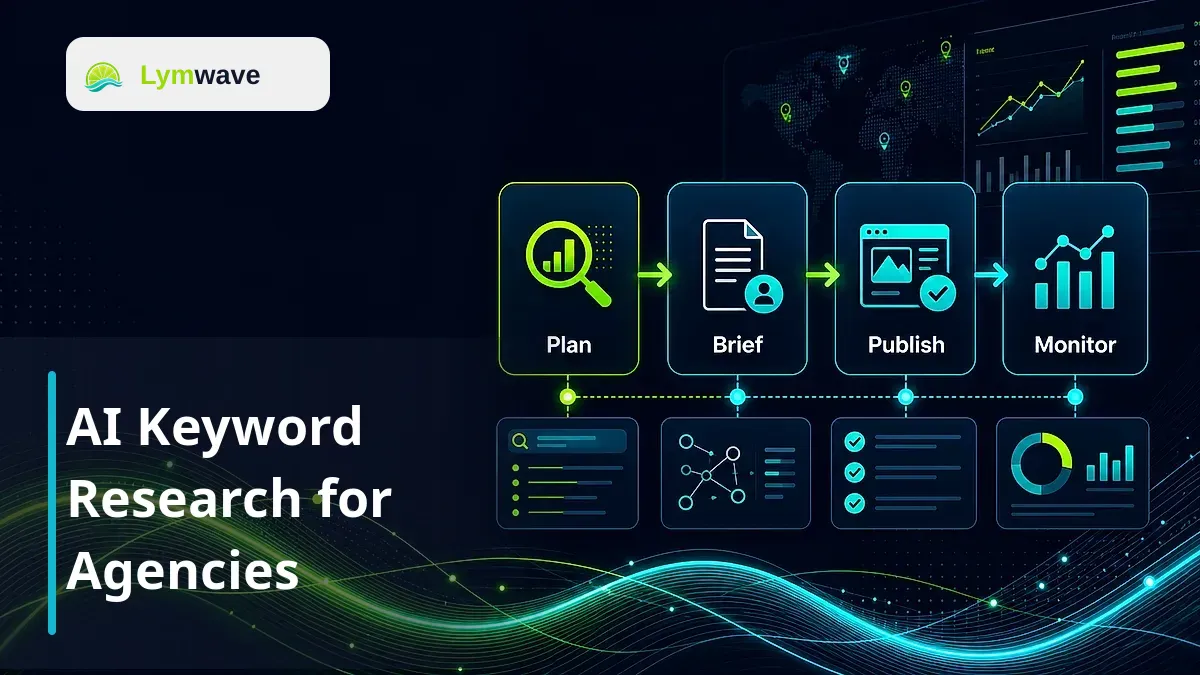
This guide sits in the AI SEO Automation topic cluster as a supporting resource.
Why AI keyword research matters for agencies
Quick answer: AI keyword research for agencies helps teams turn client goals, search intent, entity coverage, approval constraints, and reporting needs into a repeatable content planning workflow.
Agency keyword research has a different shape than in-house research. An in-house team usually plans around one product, one brand voice, and one set of stakeholders. An agency has to repeat the process across different clients, markets, content histories, approval styles, and commercial goals.
That makes speed useful, but consistency even more important. AI can help cluster keywords, identify questions, map intent, draft briefs, and spot content gaps faster than a manual-only process. But the agency still needs a framework for deciding which topics deserve content, which topics should refresh existing pages, and which opportunities are too weak to recommend.
The value is not a larger spreadsheet. The value is a clearer operating system: research that turns into briefs, briefs that turn into useful content, content that supports SEO, AEO, and GEO, and reporting that explains why the work matters.
For agencies serving SaaS founders, small business owners, and content marketers, the practical goal is to build a keyword workflow that scales without becoming generic. Each client still needs audience context, product or service nuance, conversion paths, and editorial judgment. AI should make those inputs easier to organize, not replace them.
What AI keyword research for agencies means
AI keyword research for agencies is the process of using AI-assisted analysis to discover, group, prioritize, brief, and measure content opportunities across client accounts. It combines search demand, intent classification, entity mapping, content inventory review, stakeholder context, and reporting signals.
The output should be a client-ready content plan, not a pile of keyword suggestions.
| Research layer | What it answers | Agency use |
|---|---|---|
| Client goals | What business outcome should content support? | Leads, demos, booked calls, signups, local inquiries |
| Audience intent | What does the searcher need now? | Education, comparison, implementation, proof, next steps |
| Existing content | What should be updated before creating something new? | Refresh thin guides, merge overlap, improve internal links |
| Entity coverage | What concepts must the content clearly include? | Product categories, services, use cases, locations, workflows |
| Brief quality | What does the writer or AI workflow need to know? | Angle, examples, links, claims, review notes, CTA fit |
| Reporting signal | How will the agency explain progress? | Impressions, clicks, rankings, engagement, assisted conversions |
This matters because agencies often manage content at portfolio scale. Without a structured workflow, two problems appear quickly. One team produces disconnected articles that look busy but do not support a strategy. Another team over-automates and creates generic pages that sound polished but do not reflect the client.
A better workflow keeps AI inside defined boundaries. The model can sort messy research, propose clusters, draft briefs, and summarize gaps. The agency decides the strategy, validates claims, checks product fit, and translates the plan into work the client can approve.
How to build a practical agency keyword workflow
Start with client context before opening the AI tool. Gather the client's positioning, ICP, services or product categories, sales objections, existing content, priority markets, conversion goals, and any search or analytics data the client can share. If the agency skips this step, AI will fill gaps with generic assumptions.
Then use a repeatable workflow:
- Define the account objective. Decide whether the keyword plan should support awareness, lead generation, product education, comparison content, local demand, retention, or a mix.
- Inventory existing assets. Review current pages, blog posts, landing pages, rankings, and internal links before recommending new work.
- Collect search and customer language. Combine keyword data with sales calls, support questions, reviews, competitor pages, and client FAQs.
- Cluster by intent. Separate educational, commercial, comparison, implementation, and measurement queries.
- Map topics to the funnel. Assign each topic to awareness, consideration, decision, or post-purchase support.
- Score the opportunity. Prioritize by business value, search intent, product fit, content gap, difficulty, and reporting usefulness.
- Create briefs. Turn approved topics into H1s, direct answers, related entities, internal links, examples, metadata, and review notes.
- Publish, measure, and refresh. Track performance, conversions, and content gaps so the next sprint improves the system.
If the agency needs to turn a prioritized set of topics into a production calendar, the process in how to create a 30-day SEO content plan with AI is a practical next step.
A useful agency scorecard can stay simple:
| Priority factor | Strong signal | Weak signal |
|---|---|---|
| Client relevance | The topic supports a stated business goal | The topic is only broadly related |
| Intent clarity | The searcher has a clear problem and next step | The query could mean several unrelated things |
| Content gap | Existing pages do not answer it well | A current page already satisfies the intent |
| Differentiation | The client can add a useful angle or example | The result would repeat generic advice |
| Measurement value | Progress can be reported with search or conversion data | The topic has no clear success signal |
For agencies, the handoff matters as much as the research. A brief should tell a writer, editor, or AI content workflow what the page is meant to accomplish. Include the target audience, search intent, funnel stage, primary question, internal links, related entities, examples to include, claims to avoid, and conversion path.
That structure makes approvals easier. Clients can review the intent and angle before the full article is drafted. Editors can check whether the content answers the right question. Account managers can explain why a topic made the plan.
It also protects margins. The agency can reuse the workflow across accounts while still customizing the strategy for each client. The repeatable part is the system. The client-specific part is the judgment.
How this supports SEO, AEO, and GEO
Agencies now need to plan content for traditional search, answer engines, and generative AI systems. Those surfaces are connected. A strong page should be crawlable, useful to readers, easy to summarize, and explicit about the entities and workflows it covers.
For SEO, AI keyword research helps agencies build cleaner topic clusters. A pillar article can connect to supporting posts, comparison pages, implementation guides, and measurement content. That structure helps readers navigate the subject and gives search engines a clearer view of topical depth.
For AEO, the keyword workflow should capture the questions a buyer or stakeholder asks in plain language. Briefs should include a direct-answer intro, descriptive headings, concise FAQ answers, and tables where they clarify decisions. The review process in how to optimize blog posts for SEO, AEO, and GEO is useful for this layer.
For GEO, agencies need stronger entity consistency. A page should clearly state the client category, audience, use cases, services, product terms, locations when relevant, and related workflows. Generative systems are more likely to summarize content accurately when the page uses consistent category language and avoids vague claims.
A strong agency workflow captures:
- client goals and conversion paths
- audience questions and direct answers
- product, service, and category entities
- funnel stage and search intent
- existing pages that should be linked or refreshed
- metadata and schema aligned with visible content
- claims that need client approval
- performance signals for refresh decisions
The risk is treating SEO, AEO, and GEO as separate deliverables. That can create duplicated work and conflicting recommendations. It is usually better to build one content planning workflow with checks for all three.
For a broader system view, connect the research process to briefs, publishing, measurement, and ongoing improvement instead of treating keyword discovery as a one-time deliverable.
Reporting closes the loop. Agencies should review impressions, clicks, rankings, engagement, conversions, assisted conversion paths, content decay, and AI visibility snapshots where available. If a topic earns impressions but weak clicks, the title and meta description may need work. If a page gets traffic but no conversion support, the CTA or internal links may need improvement. If an article ranks for the wrong query, the brief may have grouped intent too broadly.
Common mistakes to avoid
The first mistake is using AI to generate keywords before defining the client strategy. Without positioning, audience, and conversion context, the output will often be broad and hard to defend.
The second mistake is recommending new content when an existing page should be refreshed. Agencies can protect client budgets by checking current rankings, impressions, internal links, and content overlap before creating another article.
The third mistake is flattening intent across clients. Two clients may target similar keywords but need different content because their buyers, offers, sales cycles, and proof points are different.
The fourth mistake is overusing the primary keyword. Repetition can make content feel mechanical. Use the primary phrase naturally in the metadata, H1, and early copy, then rely on clear headings, related entities, examples, and direct answers.
The fifth mistake is creating internal-link plans with missing pages. A cluster map can include future ideas, but visible links should point only to published content. Broken or empty links weaken the reader journey.
The sixth mistake is reporting only activity. Clients do not need to hear that AI produced more ideas. They need to understand which topics were prioritized, what was published or refreshed, what changed in search visibility, and what the next decision should be.
The seventh mistake is skipping approval notes. Agency content often needs legal, product, founder, or account-team review. Briefs should flag sensitive claims, required examples, and areas where the client needs to confirm accuracy.
Frequently asked questions
What should agencies know about AI keyword research?
Agencies should use AI keyword research to standardize discovery, clustering, briefing, and reporting while still applying client-specific strategy and editorial review. The workflow should make better decisions easier, not simply create more keyword ideas.
How does AI keyword research for agencies support SEO, AEO, and GEO?
It supports SEO by building clearer topic clusters, AEO by capturing direct questions and concise answers, and GEO by strengthening entity language around the client category, audience, services, products, and workflows.
Which keyword opportunities should an agency prioritize first?
Prioritize opportunities with clear client relevance, strong intent, visible content gaps, natural product or service fit, and measurable reporting value. A lower-volume query can be worth more when it supports a high-intent buyer or important conversion path.
Can agencies automate the entire keyword research process?
No. Agencies can automate discovery support, clustering, brief drafting, and reporting summaries, but human review is still needed for strategy, client nuance, competitive positioning, claim accuracy, and approval readiness.
What should be included in an agency keyword brief?
Include the audience, search intent, funnel stage, target question, related entities, internal links, examples, metadata, schema notes, claims to verify, client approval notes, and the intended conversion path.
Useful next reads
AI SEO Automation Guide: How to Build a Content Engine That Publishes Consistently explains practical SEO, AEO, and GEO workflows for planning, publishing, measuring, and improving useful content consistently.
How to Create a 30-Day SEO Content Plan with AI explains practical SEO, AEO, and GEO workflows for planning, publishing, measuring, and improving useful content consistently.
How to Optimize Blog Posts for SEO, AEO, and GEO explains practical SEO, AEO, and GEO workflows for planning, publishing, measuring, and improving useful content consistently.
Turn this into a working content system
Audit your content, find AI visibility gaps, and build a publishing workflow that compounds.