

AI Content Planning for Small Businesses
Learn how small businesses can use AI to plan focused, credible content across SEO, AEO, and GEO without overwhelming a lean team.
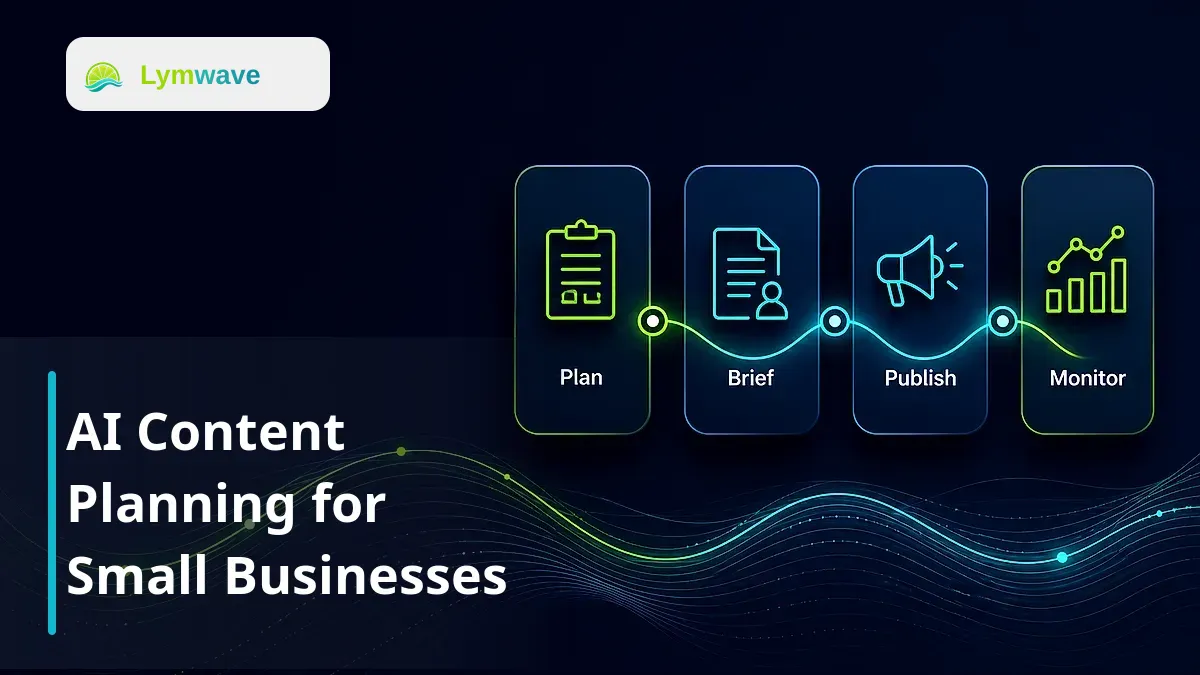
This guide sits in the AI SEO Automation topic cluster as a supporting resource.
Why AI-assisted planning matters for a lean team
Quick answer: A small business can use AI to turn customer questions, search intent, business priorities, existing pages, and realistic publishing capacity into a focused content plan. AI should speed up research, clustering, and briefing. People should still choose priorities, verify claims, protect brand voice, and approve every publication.
Small businesses rarely lack ideas. They lack time to decide which ideas deserve attention, turn them into useful briefs, review drafts, and learn from published work. A founder may be the subject-matter expert, editor, and final approver. A marketer may also manage email, social media, partnerships, and reporting. In that environment, an ambitious calendar can become a queue of unfinished drafts.
AI content planning is valuable when it reduces that decision burden. It can group similar questions, identify gaps in an existing library, map ideas to search intent, and prepare consistent briefs. The result should be fewer, better-defined assignments—not a flood of generic articles.
What AI content planning actually means
AI content planning is the structured use of AI to help decide what to create, why it matters, how it fits the existing site, and what the team can realistically publish. It comes before drafting. It is not the same as asking a model to generate a list of titles or write a full article from one keyword.
A useful plan combines five inputs:
- Audience evidence: sales questions, support messages, customer interviews, reviews, and recurring objections.
- Search evidence: relevant queries, intent patterns, existing rankings, and gaps in the current library.
- Business relevance: services, products, differentiators, sales priorities, and topics the business can discuss credibly.
- Content inventory: current pages, overlapping posts, outdated information, and internal-link opportunities.
- Editorial capacity: who can provide expertise, review claims, prepare images, publish, and measure results.
AI can organize these inputs faster than a person working through an empty spreadsheet. It can also expose conflicts. A keyword may look attractive but have little connection to the offer. A topic may fit the product but require evidence the team does not have. A proposed publishing schedule may exceed the available review time.
| Planning layer | Question to answer | Useful output |
|---|---|---|
| Audience | Who needs this and what are they trying to solve? | Reader, problem, and buying context |
| Search | What intent should the page satisfy? | Primary query, related questions, and page type |
| Business | Why is the topic relevant to the offer? | Product or service connection without a forced pitch |
| Editorial | What will make the page credible? | Expert input, examples, sources, and reviewer |
| Operations | Can the team publish and maintain it? | Owner, status, due date, and refresh trigger |
A practical AI content planning workflow
1. Set one measurable planning goal
Begin with a narrow outcome for the next planning cycle. Examples include strengthening one topic cluster, supporting a new service, answering common sales objections, or improving pages that already receive impressions. “Get more traffic” is too broad to guide prioritization.
Give the AI system the business context behind the goal: the audience, offer, location or market, current content, conversion path, brand constraints, and publishing capacity. Remove confidential customer data and avoid treating unverified model suggestions as research findings.
2. Build a question inventory
Collect real questions from customer-facing sources before adding keyword ideas. Sales calls, contact forms, support tickets, onboarding notes, and search performance data reveal the language people use. Ask AI to normalize duplicates and group related questions, but keep the original wording available for review.
Classify each group by intent:
- Learn: definitions, explanations, and early problem discovery.
- Solve: practical workflows, checklists, and troubleshooting.
- Evaluate: alternatives, comparisons, costs, and suitability.
- Act: product, service, integration, or implementation decisions.
This step prevents a common imbalance: publishing many introductory posts while leaving purchase-related questions unanswered.
3. Audit before creating
Compare the question groups with existing pages. For each topic, decide whether to keep, refresh, consolidate, or create. AI can help summarize coverage and identify apparent gaps, but a person should inspect the pages before approving the recommendation.
Refreshing a page is often more practical than creating a competing one. A page may need a clearer direct answer, a better example, updated details, or stronger internal links. Consolidation may be appropriate when several thin posts target nearly identical intent.
4. Score ideas with small-business constraints
Use a simple scoring model instead of accepting every plausible idea. Rate each item from one to three for audience demand, business relevance, credibility, cluster value, and effort. High-demand topics should not win automatically if the business cannot add useful expertise.
| Factor | Strong signal | Warning sign |
|---|---|---|
| Audience demand | Repeated real questions or relevant query evidence | The idea came only from an AI suggestion |
| Business relevance | Clear connection to a service, product, or customer journey | Traffic potential with no useful next step |
| Credibility | The team has evidence or subject expertise | The draft would depend on invented examples |
| Cluster value | Strengthens or connects important existing pages | Creates an isolated post |
| Effort | Fits available research and review time | Requires data, design, or expertise the team lacks |
Choose a small set of high-confidence items. A lean team benefits more from four publishable briefs than twenty vague assignments.
5. Turn priorities into review-ready briefs
For each approved idea, ask AI to prepare a brief with the reader, intent, direct-answer target, working title, page type, sections, entities, evidence needs, internal links, and call to action.
Add an explicit “do not claim” field when a topic creates risk. This can prevent unsupported performance promises, invented customer outcomes, inaccurate product details, and false certainty. Name the human reviewer who can verify the final draft.
If the team needs a calendar after the priorities are approved, follow the 30-day SEO content plan workflow. Planning the topics and scheduling production are related, but they are different decisions.
6. Match the schedule to the bottleneck
Publishing capacity is usually limited by expert review, not AI drafting speed. Schedule around that bottleneck. If the founder can review one article each week, generating five drafts per week creates inventory, not progress.
Use visible statuses such as planned, briefed, drafting, expert review, editorial review, approved, published, and revisit. Each item should have one owner and one next action.
7. Measure decisions, not just output
After publishing, review whether the page was indexed, matched relevant queries, earned engagement, supported conversions, and improved the surrounding cluster. Early data may be limited, so avoid declaring success or failure from one metric after a few days.
How the plan supports SEO, AEO, and GEO
A good plan supports SEO by assigning each page a distinct search intent, useful role, clean internal-link path, and maintenance expectation. It reduces duplicate topics and orphan posts. It also makes metadata and page structure easier to review because the page purpose is clear before drafting.
It supports answer engine optimization (AEO) by naming the question each page should answer directly. A brief can require a concise answer near the beginning, followed by definitions, steps, comparisons, or FAQs that help a reader understand the reasoning. The answer should be specific enough to stand alone without oversimplifying the topic.
It supports generative engine optimization (GEO) by keeping entity relationships clear and claims supportable. A connected cluster can consistently explain the brand, category, audience, problem, and workflow. That clarity is more useful than repeating an exact-match keyword throughout every heading.
| Layer | Planning decision | Review question |
|---|---|---|
| SEO | Intent, page role, keyword theme, and internal links | Does this page add a distinct, crawlable resource? |
| AEO | Direct question, short answer, and supporting format | Can the main answer be understood quickly and accurately? |
| GEO | Entities, evidence, category context, and consistent language | Are claims clear enough to summarize without losing important context? |
Before publication, apply the SEO, AEO, and GEO optimization guide to the finished draft. Planning creates the requirements; final review confirms that the visible page fulfills them.
Common mistakes to avoid
The first mistake is confusing volume with a plan. AI can create hundreds of ideas, but an unranked list does not explain what should be published, updated, or ignored. Limit the backlog to work the team can assess and maintain.
The second mistake is starting with keywords while ignoring customer evidence. Search data matters, but real questions reveal vocabulary, objections, and context that keyword tools may flatten. Use both sources and investigate disagreements between them.
Other common problems include:
- Planning new pages without auditing existing content.
- Choosing topics with traffic potential but weak business relevance.
- Automating drafts before briefs and evidence requirements are approved.
- Allowing AI to invent statistics, examples, product features, or customer results.
- Repeating the same keyword in every heading instead of answering related questions.
- Creating a calendar that ignores expert and editorial review time.
- Publishing pages without verified internal links or a useful next step.
- Measuring success only by article count.
Do not outsource brand positioning to the model. AI can summarize supplied context, but it does not know which trade-offs the business wants to own. A person should decide the point of view, validate product language, and remove generic advice that could apply to any company.
Finally, keep the system small enough to operate. One reliable intake form, one prioritization method, one brief template, and one visible status board are usually enough. Add automation only when a repeated manual step is understood and stable.
Frequently asked questions
How can a small business use AI for content planning?
Use AI to organize customer questions, search evidence, business priorities, current pages, and publishing capacity. Let it group topics, identify overlaps, prepare scoring inputs, and draft briefs. Keep topic approval, evidence checks, brand decisions, and final publication human-led.
What should an AI content plan include?
Each planned item should include the audience, search intent, primary question, page role, business relevance, evidence needs, internal links, format, owner, status, and next action. A schedule should also reserve time for expert review, editing, publishing, and measurement.
How often should a small business publish content?
Publish only as often as the team can maintain quality and complete reviews. A small business may get more value from two strong articles and two updates per month than from weekly generic drafts. Choose the cadence based on the slowest necessary review step.
Can AI choose all the topics automatically?
AI can suggest and organize topics, but it should not make the final choice alone. Models may overvalue generic search themes, miss business constraints, or propose subjects the team cannot support credibly. A person should approve every priority.
How does AI content planning help SEO, AEO, and GEO?
It helps SEO by clarifying intent, page roles, and internal links; AEO by planning direct answers and answer-friendly formats; and GEO by maintaining consistent entity context and supportable claims across a connected content cluster.
What should remain human-led?
People should own strategy, positioning, customer privacy, evidence, subject-matter review, brand voice, risk decisions, and publication approval. AI is most useful as a planning and production assistant inside those boundaries.
Useful next reads
AI SEO Automation Guide: How to Build a Content Engine That Publishes Consistently explains practical SEO, AEO, and GEO workflows for planning, publishing, measuring, and improving useful content consistently.
How to Create a 30-Day SEO Content Plan with AI explains practical SEO, AEO, and GEO workflows for planning, publishing, measuring, and improving useful content consistently.
How to Optimize Blog Posts for SEO, AEO, and GEO explains practical SEO, AEO, and GEO workflows for planning, publishing, measuring, and improving useful content consistently.
Turn this into a working content system
Audit your content, find AI visibility gaps, and build a publishing workflow that compounds.