

AI Content Planning for Agencies
Build an agency AI content plan that coordinates client evidence, search intent, approvals, production capacity, and measurable improvement.
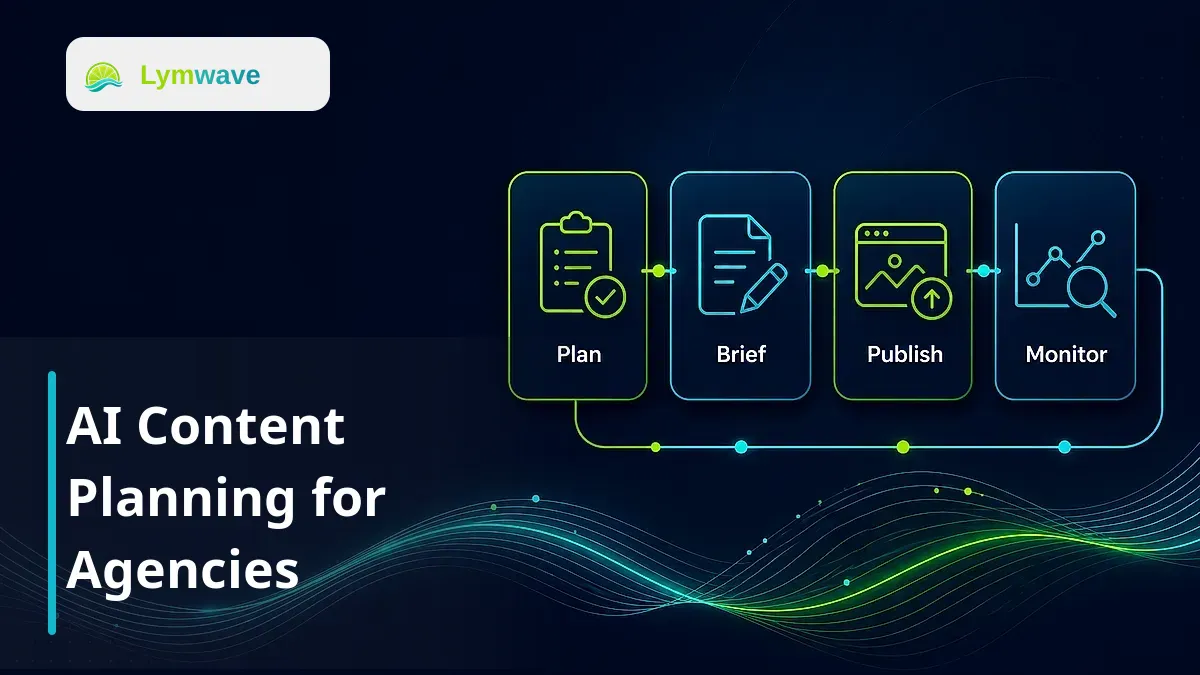
This guide sits in the AI SEO Automation topic cluster as a supporting resource.
An agency should use AI to organize client evidence, search intent, existing content, production capacity, and approval rules into prioritized briefs. Strategists should still approve page roles, claims, differentiation, and publication. That division of work helps an agency increase useful throughput without giving every client the same generic strategy or voice.
The difficult part is rarely generating ideas. The real planning problem is deciding what deserves production, what evidence is available, who must approve it, and how the work fits alongside every other account.
Why agency planning needs more than a topic list
A topic list says what an agency could write. A content plan explains why a specific page should exist, which audience and intent it serves, how it connects to the client's offer, what makes it credible, and how it will move through production.
In a multi-client environment, a weak decision can consume strategy, expert review, design capacity, and client attention before anyone notices that the page overlaps existing content or lacks a meaningful point of view.
AI can reduce the administrative load around planning. It can normalize inputs, group questions, compare briefs, identify apparent duplication, and prepare consistent planning records. It cannot decide what a client is qualified to claim or which trade-offs support that client's positioning. Those decisions require account context and human judgment.
An agency-ready plan should connect five layers:
| Planning layer | Agency question | Required output |
|---|---|---|
| Client context | What does this business sell, to whom, and under what constraints? | Approved positioning, audience, offer, and exclusions |
| Search demand | What problem or decision is the reader trying to resolve? | Intent, query theme, related questions, and page type |
| Existing coverage | What already ranks, overlaps, or needs improvement? | Create, refresh, consolidate, or leave unchanged |
| Evidence | What can make the page specific and defensible? | Sources, expert input, examples, and claims to avoid |
| Operations | Can the agency and client complete the work? | Owner, reviewer, status, due date, and next action |
What AI content planning means for an agency
AI content planning is the controlled use of models to turn supplied business context and search evidence into decisions, briefs, schedules, and review tasks. It is not the automatic conversion of a keyword list into a publishing calendar.
Each client needs a separate context package containing approved product language, target audiences, market boundaries, current pages, conversion paths, and claim restrictions. The agency should define which sources are authoritative and when information must be rechecked.
This context becomes the input to a repeatable planning process. The repeatability belongs in the method and data structure, not in the final recommendations. Two clients can use the same scoring model and brief template while receiving completely different priorities because their evidence, offers, authority, and capacity differ.
Useful automation can:
- Group customer questions without discarding their original wording.
- Compare proposed topics with existing pages.
- Classify intent and suggest a page format.
- Turn approved priorities into first-pass briefs.
- Flag missing evidence, owners, approvals, or links.
Strategy leads should retain control over priority, differentiation, risk, budget, and approval. A model may recommend a comparison page, but the agency must confirm that the client can support and maintain it fairly.
A practical multi-client planning workflow
1. Create a bounded client context package
Start with approved facts rather than a broad prompt. Record the client's offer, audience, locations or markets, sales motion, differentiators, prohibited claims, subject-matter experts, current content, and business priorities for the planning period.
Keep client data separated and remove personal or confidential information the workflow does not need. Give context an owner and review date so retired details do not shape future briefs.
2. Define the planning objective
Choose one primary outcome for the cycle, such as building authority around a service, supporting a launch, addressing sales objections, improving an underperforming cluster, or consolidating competing pages. A narrow objective makes prioritization explainable to the client.
Add operating limits before generating recommendations: expert hours, editing capacity, design needs, publishing access, and approval lead time. Drafting speed is not delivery capacity.
3. Build an evidence-backed opportunity set
Combine search performance, keyword research, site-search terms, sales questions, support themes, community language, and the current content inventory. Ask AI to group overlaps and show the evidence attached to each opportunity.
Label the source of every item. A repeated customer objection and a model suggestion can both be useful, but they should not receive the same confidence score.
4. Decide whether to create, refresh, or consolidate
Audit existing URLs before adding new ones. For each opportunity, choose among creating a page, refreshing current coverage, consolidating competing pages, or taking no action. AI can surface likely overlap based on titles and content, but a strategist should inspect the intent and page quality before approving the decision.
This prevents avoidable overlap and net-new work when a focused update would be more valuable. It also reveals internal-link opportunities early.
5. Score value, confidence, and effort separately
Use a compact scoring model that can be explained without a proprietary black box.
| Dimension | Strong signal | Risk signal |
|---|---|---|
| Audience value | Repeated questions tied to a real problem or decision | Broad interest with no clear reader outcome |
| Business fit | Natural connection to the client's offer and journey | Traffic potential with a forced conversion path |
| Evidence confidence | First-party expertise, reliable sources, or useful examples | Claims depend on assumptions or invented detail |
| Cluster contribution | Strengthens a deliberate set of related pages | Creates an isolated article with no useful links |
| Delivery effort | Fits research, review, design, and publishing capacity | Requires unavailable expertise or approval time |
Keep scores visible with a short rationale tied to supplied input. The account lead should be able to override them and record why.
6. Convert approved work into production briefs
A useful brief states the audience, search intent, central question, direct answer, page role, expected sections, entities, evidence requirements, internal links, conversion path, and reviewer. Include claim boundaries and unresolved questions rather than allowing a writer to discover them after drafting.
Separate shared agency standards from client direction. Accessibility and editorial statuses may be common; voice, positioning, proof, product terminology, and calls to action should come from client context.
A repeatable production foundation should connect planning to drafting, review, publishing, and measurement without treating those stages as one automatic action.
7. Schedule around approval capacity
Plan backward from the bottleneck. If a client expert can review two pieces per month, scheduling eight new drafts creates a queue rather than a content program. Reserve review windows and define what happens when feedback is late.
Use a small status set: planned, briefed, drafting, agency review, client review, approved, scheduled, published, and revisit. Every item needs one owner and one next action.
Once priorities and owners are approved, the 30-day SEO content plan workflow can turn them into a practical schedule.
8. Close the loop with page-level learning
Define the review question while planning the page. After publication, check indexation, relevant query coverage, engagement, assisted conversions where available, and the effect on linked pages. Use enough time and context to avoid declaring success from a short-lived movement in one metric.
Feed observations back into planning. A different intent, frequent client corrections, or a new customer question should influence future priorities.
How the plan supports SEO, AEO, and GEO
For SEO, the plan gives each page a distinct intent, page role, canonical path, internal-link purpose, and maintenance expectation. Auditing before creation reduces duplicate coverage, while evidence-based prioritization directs production toward pages the client can make genuinely useful.
For answer engine optimization (AEO), each brief should name the primary question and require a concise answer near the beginning. Definitions, steps, tables, and visible FAQs should clarify the answer, not pad the page. The short response must remain accurate when quoted without the surrounding sales copy.
For generative engine optimization (GEO), planning should make the client's entity relationships and factual boundaries explicit. Consistent product names, audience descriptions, category language, and supported claims make content easier to summarize accurately. Clear sourcing and named reviewers matter more than repeating a target phrase in every heading.
| Layer | Planning decision | Agency quality check |
|---|---|---|
| SEO | Intent, page role, topic theme, canonical, and links | Does the page add distinct, crawlable value? |
| AEO | Main question, direct answer, and supporting format | Can the answer stand alone without becoming misleading? |
| GEO | Entities, evidence, attribution, and claim limits | Could a system summarize the page without inventing context? |
Before publication, apply the SEO, AEO, and GEO optimization guide to the completed draft. The plan defines the requirements; final review confirms that the visible page actually satisfies them.
Common agency mistakes to avoid
The most common failure is standardizing the recommendation instead of the process. Reusable intake forms, scoring rules, and brief fields improve operations. Reusing the same topic map, point of view, and language across clients makes the work interchangeable.
Other costly mistakes include:
- Mixing context or confidential information between client workspaces.
- Treating AI suggestions as observed search or customer evidence.
- Creating new pages before reviewing current URLs and intent overlap.
- Promising a publishing cadence that ignores client approval capacity.
- Allowing briefs to proceed without sources, expert input, or claim limits.
- Measuring agency productivity only by drafts or published article count.
- Automating publication before factual, brand, and legal reviews are complete.
- Reporting rankings or conversions without the time range and measurement context.
Do not hide strategy behind a score. Clients should understand why a topic was prioritized, what supports it, and how success will be reviewed.
Finally, keep the workflow proportionate. A smaller account may need one context document, one opportunity table, and one monthly review. More fields and automations are useful only when they reduce a repeated coordination problem.
Frequently asked questions
How should an agency use AI for content planning?
Use AI to organize approved client context, customer questions, search evidence, current pages, capacity, and approval rules. Let it group opportunities, identify possible overlap, prepare scoring inputs, and draft briefs. Keep prioritization, positioning, evidence review, and publication approval with accountable people.
How can an agency prevent every client's content from sounding the same?
Use a separate context package for each client and distinguish shared process standards from client-specific strategy. Require briefs to include the client's audience language, point of view, proof, exclusions, terminology, and reviewer. Evaluate drafts against those inputs rather than a generic agency voice prompt.
What belongs in an agency content brief?
Include the audience, intent, central question, direct answer, page role, differentiated angle, evidence needs, entities, structure, internal links, conversion path, claim limits, owner, and reviewers. Also record unresolved questions so they are settled before drafting or publication.
Can an agency automate topic selection completely?
No. Automation can organize evidence and recommend priorities, but final selection requires knowledge of client strategy, authority, risk, budget, and capacity. A strategist should approve the page role and rationale for every production item.
How should agencies plan content across SEO, AEO, and GEO?
Plan one useful page that serves all three. Assign a distinct search intent and internal-link role for SEO, a concise primary answer and clear supporting formats for AEO, and consistent entities, evidence, attribution, and claim boundaries for GEO.
What should agencies measure after publication?
Review indexation, relevant query visibility, engagement, assisted conversions where available, internal-link effects, client correction load, and maintenance needs. Compare results with the page's original purpose and use the findings to improve the next planning cycle.
Useful next reads
AI SEO Automation Guide: How to Build a Content Engine That Publishes Consistently explains practical SEO, AEO, and GEO workflows for planning, publishing, measuring, and improving useful content consistently.
How to Create a 30-Day SEO Content Plan with AI explains practical SEO, AEO, and GEO workflows for planning, publishing, measuring, and improving useful content consistently.
How to Optimize Blog Posts for SEO, AEO, and GEO explains practical SEO, AEO, and GEO workflows for planning, publishing, measuring, and improving useful content consistently.
Turn this into a working content system
Audit your content, find AI visibility gaps, and build a publishing workflow that compounds.