

AI content planning: Common Mistakes and How to Avoid Them
Learn the common AI content planning mistakes and use an evidence-led workflow to build focused, reviewable content for SEO, AEO, and GEO.
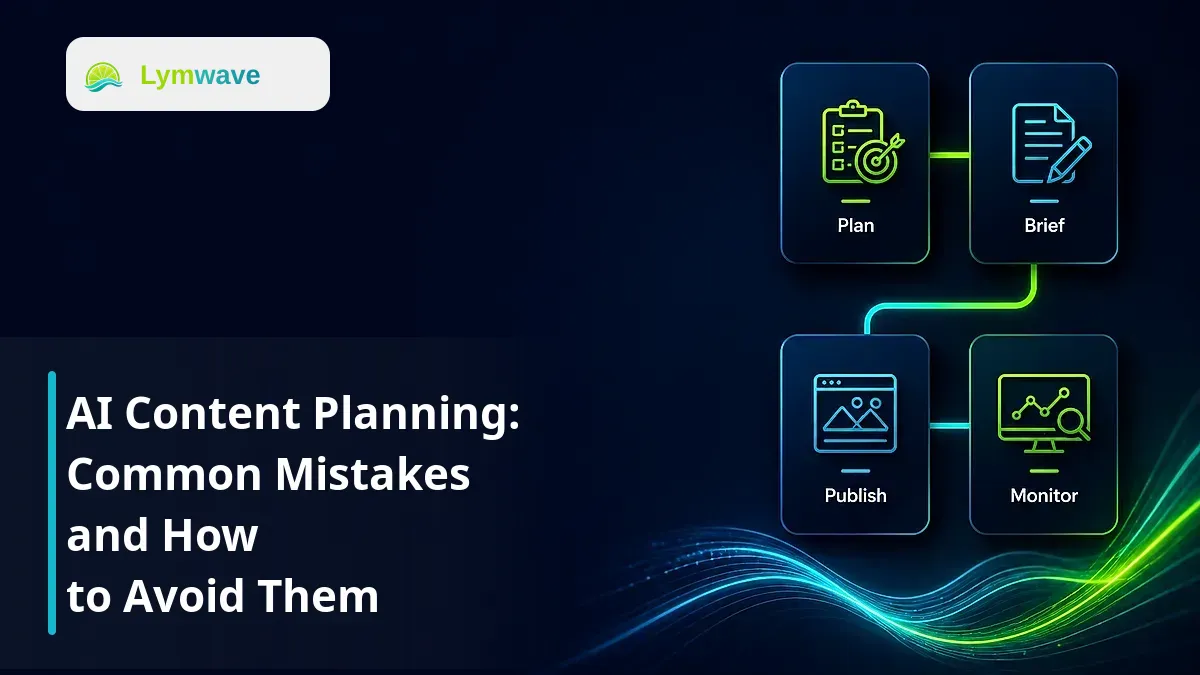
This guide sits in the AI SEO Automation topic cluster as a supporting resource.
AI content planning uses automation to organize audience evidence, search opportunities, article roles, briefs, internal links, and production capacity into a publishing plan. The most common failure is treating AI output as the plan itself. A useful plan still needs human decisions about what deserves a page, what evidence supports it, and how each article helps a reader.
Quick answer: use AI to analyze and structure planning inputs, but validate audience fit, intent, overlap, claims, priorities, and review capacity before anything enters production. Measure published work and feed the findings back into the next plan.
This guide is for SaaS founders, small business owners, and content marketers who want the speed of AI SEO automation without creating a backlog of repetitive, weakly supported articles.
Why AI content planning matters
Generating titles is easy. Choosing the right work is harder.
A content plan determines which reader problems receive time, budget, expert input, and a permanent URL. A poor decision made during planning travels through the entire AI content workflow: the brief starts with the wrong intent, the draft repeats existing material, internal links feel forced, and measurement cannot explain what the page was meant to achieve.
Good planning creates a decision trail. For every proposed article, the team can identify:
- the primary audience and problem;
- the evidence behind the opportunity;
- the page's distinct answer and role;
- its relationship to existing content;
- the expertise and sources required;
- the reviewer and publishing dependencies; and
- the signal that will trigger a later refresh, consolidation, or retirement.
That structure makes automation safer and more useful. It also prevents output volume from becoming a substitute for editorial progress.
What AI content planning means
AI content planning is the assisted process of converting business context, audience questions, site data, search evidence, and editorial constraints into a prioritized production roadmap. The model can cluster ideas, summarize inputs, identify possible gaps, compare outlines, draft briefs, and flag likely overlap. People remain responsible for evidence, priorities, factual standards, and approval.
It helps to separate three artifacts that teams often confuse:
| Artifact | Purpose | Decision it supports |
|---|---|---|
| Idea list | Captures possible subjects and questions | Is this worth investigating? |
| Content plan | Prioritizes create, refresh, consolidate, defer, or reject actions | What should we work on and why? |
| Production calendar | Assigns sequence, owners, dependencies, and dates | When can we complete the work well? |
An AI-generated list is therefore an input, not a finished strategy. A content plan becomes operational only when it connects an opportunity to a reason, a distinct page role, and available capacity.
The same principle applies to keywords. A keyword can describe demand, but it cannot decide whether a new article is the right response. The better action may be to improve an existing page, combine overlapping drafts, add a missing section, or decide that the topic falls outside the business's credible scope.
How to approach AI content planning
A dependable process uses small gates. Each gate removes weak or ambiguous work before it consumes more resources.
1. Start with evidence, not a blank prompt
Collect audience language from support, sales, onboarding, product feedback, and subject-matter experts. Add the current content inventory, site-audit findings, Search Console data when available, and relevant search research. Label every input as observed evidence, internal judgment, or an AI-generated hypothesis.
This distinction matters. A model can propose a sensible question, but the proposal does not prove that the audience asks it or that the site should answer it.
2. Define the decision rule
Score candidates with a compact, repeatable set of criteria:
- Reader value: does the topic help the priority audience decide or act?
- Business relevance: does it fit the product, category, and real expertise?
- Evidence: is it supported by customer, search, site, or performance signals?
- Distinct intent: will the answer differ meaningfully from current pages?
- Cluster contribution: does it strengthen a useful topic path?
- Readiness: are sources, examples, reviewers, and publishing capacity available?
Then choose an action: create, refresh, consolidate, defer, or reject. The action is more important than the score because it turns analysis into a commitment.
3. Give every approved page one job
Write the target reader, primary intent, direct answer, and expected next step in plain language. Compare the proposed answer with live content before approving a new URL. If two candidates serve the same person with the same answer, they probably belong together.
Map the article to a pillar or supporting role, but do not force a cluster shape that produces unnecessary pages. A useful 30-day SEO content plan should contain fewer clear commitments rather than a large unranked queue.
4. Build a reviewable brief
The brief should state the direct answer, scope, exclusions, essential questions, relevant entities, internal-link opportunities, evidence requirements, and prohibited claims. It should also define the title, slug, metadata direction, image concept, and appropriate structured data.
Assign a reviewer before drafting. If no one can verify the subject, either narrow the claim, locate a qualified source, or defer the page. Automation should never turn an evidence gap into confident prose.
5. Plan around the whole pipeline
Generation speed is only one part of throughput. Include research, expert review, editing, image production, metadata, internal links, publishing, quality assurance, distribution, measurement, and maintenance.
Sequence foundational material before pages that depend on it. Mix new articles with refresh and consolidation work. A controlled content engine should connect every stage without allowing generation speed to bypass evidence or review.
6. Close the feedback loop
After publication, confirm indexability, canonical metadata, structured data, image delivery, and link integrity. Later, compare the queries and reader behavior you observe with the intended audience and answer. Decide whether to wait, improve, consolidate, redistribute, or plan supporting coverage.
Record the decision and why it was made. That learning is more valuable to the next planning cycle than another generic batch of ideas.
How this supports SEO, AEO, and GEO
SEO, answer engine optimization, and generative engine optimization share a need for clear, useful, well-structured information. Planning can support all three without creating separate versions of the article.
| Discipline | Planning choice | Resulting content quality |
|---|---|---|
| SEO | Distinct intent, sensible URL roles, internal links, crawlable metadata, and measured query fit | Pages have a clearer purpose in the site architecture |
| AEO | Direct answers, visible questions, concise definitions, and FAQ content matched to the page | Answers are easier to extract without losing essential context |
| GEO | Explicit entities, consistent category language, supported claims, and clear relationships | Generative systems receive more precise brand and topic context |
These practices improve clarity and technical readiness. They do not guarantee rankings, traffic, citations, or inclusion in an AI-generated answer. The safest approach is to optimize the same useful page for multiple discovery surfaces, then verify it with the SEO, AEO, and GEO optimization guide.
Common mistakes to avoid
Mistake 1: Measuring the plan by title count
A list of 100 ideas may look productive while hiding the absence of prioritization. Limit the active plan to items with a documented reader, evidence, distinct answer, owner, and decision. Store the rest as hypotheses, not commitments.
Mistake 2: Using search volume as the only priority
Demand matters, but relevance, credibility, intent, and business value matter too. Use several decision factors and record why a lower-volume topic may deserve priority—or why a high-volume topic does not fit.
Mistake 3: Skipping the existing-content review
Phrase variations can lead to several pages answering the same question. Compare intent and answers, not only keywords. Refresh or consolidate when a current URL can serve the reader better.
Mistake 4: Treating generated claims as evidence
Fluent text can still contain unsupported statements. Briefs should identify which claims need primary sources, internal expertise, or qualification. If evidence is unavailable, remove or narrow the claim.
Mistake 5: Automating vague briefs
A model cannot reliably infer the audience, exclusions, proof standard, or intended outcome from a headline alone. Require a direct answer and boundaries before drafting. Better inputs make automated SEO content more reviewable.
Mistake 6: Scheduling for generation speed
If drafts arrive faster than people can verify them, the workflow creates review debt. Set publishing capacity from the slowest quality-critical stage, usually research, expert review, approval, or maintenance.
Mistake 7: Publishing without a link role
An isolated page is harder for readers and crawlers to discover in context. Plan useful links from existing pages and to logical next steps. Keep machine-facing related-page metadata aligned with visible navigation.
Mistake 8: Never changing the plan
A frozen calendar ignores new customer questions, product changes, site issues, and performance evidence. Review status regularly, but change priorities only when meaningful evidence justifies the disruption.
Mistake 9: Reporting output instead of outcomes
Article count says little about reader value or discovery. Compare observed query fit, useful engagement, assisted journeys, content overlap, and maintenance needs with the original plan. Avoid claiming that automation caused results when the evidence cannot support causation.
Frequently asked questions
What should you know about AI content planning?
AI content planning is a decision process, not just idea generation. AI can organize evidence and accelerate analysis, while people validate audience needs, intent, priorities, claims, overlap, and approval.
How does AI content planning support SEO, AEO, and GEO?
It assigns distinct intent to pages, plans direct answers and visible questions, maps useful internal links, clarifies entities, and sets evidence requirements. Those choices help readers, search engines, answer systems, and generative systems interpret the content.
What mistakes should you avoid with AI content planning?
Avoid prioritizing by title count or search volume alone, ignoring existing pages, treating generated claims as evidence, using vague briefs, exceeding review capacity, publishing orphan content, freezing the calendar, and measuring only output.
Can an AI tool build the plan automatically?
It can collect and cluster inputs, propose actions, score candidates, draft briefs, and flag overlap. A responsible owner should still approve the evidence, page role, priority, factual standard, resources, and publication decision.
How often should the plan be reviewed?
Review workflow status routinely and revisit priorities when meaningful customer, product, site, search, or performance evidence changes. Do not rebuild the plan because of a few days of noisy data.
What is the simplest quality gate?
Ask why the page should exist. If the team cannot name the reader, evidence, distinct answer, role in the content library, and qualified reviewer, keep the topic out of production.
Useful next reads
AI SEO Automation Guide: How to Build a Content Engine That Publishes Consistently explains practical SEO, AEO, and GEO workflows for planning, publishing, measuring, and improving useful content consistently.
How to Create a 30-Day SEO Content Plan with AI explains practical SEO, AEO, and GEO workflows for planning, publishing, measuring, and improving useful content consistently.
How to Optimize Blog Posts for SEO, AEO, and GEO explains practical SEO, AEO, and GEO workflows for planning, publishing, measuring, and improving useful content consistently.
Turn this into a working content system
Audit your content, find AI visibility gaps, and build a publishing workflow that compounds.