

AI Blog Strategy: Common Mistakes and How to Avoid Them
Learn the most common AI blog strategy mistakes and how to fix weak priorities, generic drafts, content overlap, review gaps, and misleading measurement.
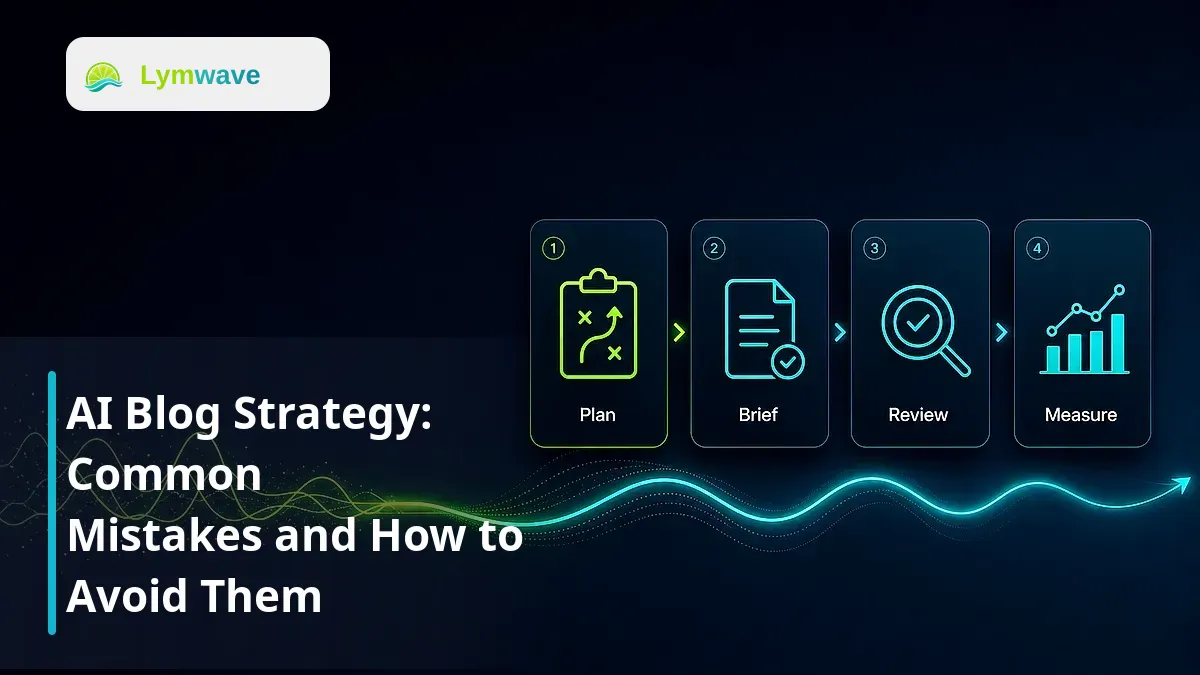
This guide sits in the AI SEO Automation topic cluster as a supporting resource.
AI can make blog planning and production faster, but it also makes weak decisions easier to repeat. A vague strategy can become a full calendar of overlapping topics, generic drafts, and pages that nobody has time to review.
Quick answer: the most common AI blog strategy mistakes are starting with an output quota, choosing topics without evidence, ignoring existing content, accepting generic briefs, automating editorial approval, publishing isolated pages, and measuring production instead of reader or business outcomes. Avoid them by placing explicit decisions, evidence, and human review gates before generation and publication.
This guide is for SaaS founders, small business owners, and content marketers using AI SEO automation. It diagnoses the system behind weak content rather than polishing drafts.
Why AI blog strategy mistakes compound quickly
A manual content mistake may affect one article. An automated mistake can shape every topic, brief, draft, link, and publishing decision that follows.
For example, a broad instruction such as “write about AI marketing” may produce plausible titles. Without checks for audience fit, existing URLs, or available expertise, those ideas can move directly into a calendar even when several serve the same intent.
The problem is not AI use itself. It is allowing generation to happen before the important constraints are defined. A controlled system separates four kinds of work:
- Strategy: choose the audience, subject area, and desired reader outcome.
- Evidence: collect customer questions, search signals, existing-page data, and product context.
- Production: turn an approved opportunity into a brief, draft, image, and page package.
- Learning: compare the published page with its intended role and decide what to change.
What a sound AI blog strategy means
An AI blog strategy is a repeatable decision system for choosing, creating, reviewing, publishing, and improving content with AI assistance. It should state what automation may do, what evidence it must use, and what a person must approve.
The strategy is not a prompt library or a list of keywords. Those are production inputs. A sound strategy answers:
- Who is the blog for?
- What problems and category should the site explain?
- How will the team identify a worthwhile opportunity?
- When should an existing page be refreshed or consolidated?
- What facts, examples, and product context can reviewers verify?
- Who approves the article and its claims?
- Which signals will inform the next decision?
The central idea is simple: automation should execute an approved policy, not quietly invent one.
Common AI blog strategy mistakes and how to fix them
1. Starting with a publishing quota
“Publish 30 posts” describes activity, not strategy. It does not identify the reader, the questions worth answering, the site's current gaps, or the team's review capacity.
Typical symptom: the calendar fills before anyone can explain why its first five articles deserve to exist.
How to fix it: define one audience, one content objective, and a focused topic cluster first. Then set cadence according to the number of useful articles the team can review and maintain. A 30-day SEO content plan should show the rationale and dependencies behind each slot, not just a sequence of dates.
2. Treating generated ideas as evidence
AI models are good at producing plausible topic lists. Plausibility does not establish demand, business relevance, or a content gap.
Typical symptom: priorities are defended with phrases such as “the model suggested it” rather than customer questions, Search Console data, site audits, or sales and support context.
How to fix it: attach at least one evidence source to every planned item. Record whether the signal comes from customers, current queries, an incomplete topic cluster, a product workflow, or a documented business priority. Treat unsourced AI suggestions as hypotheses to investigate.
3. Ignoring the existing content library
A new article may compete with a page that already answers the same intent. Generating another URL can split internal links, confuse maintenance ownership, and leave readers choosing between near-duplicates.
Typical symptom: several titles differ, but their intended reader, direct answer, and subtopics are nearly identical.
How to fix it: inventory live URLs before approving new ones. Compare the proposed audience, intent, direct answer, and cluster role with existing pages. Choose explicitly among create, refresh, consolidate, or wait. A new draft should not be the default outcome.
4. Using a generic brief
A keyword, title, and target word count do not give an AI system enough context to produce a distinctive article. Without an audience, answer target, source rules, internal links, and product context, the model falls back to broadly familiar advice.
Typical symptom: the draft is grammatically polished but could appear on any competitor's website.
How to fix it: require the brief to contain:
- the intended reader and task;
- the direct answer;
- scope and exclusions;
- important entities and questions;
- evidence or sources needed;
- original examples or first-party context;
- live internal-link targets;
- claims to avoid; and
- the metadata and structured-data package.
Review the brief before generating the full article. Correcting the direction early is cheaper than rewriting a finished draft.
5. Optimizing for keyword inclusion instead of reader intent
Repeating an exact phrase does not compensate for an unclear answer. It can also produce awkward titles, headings, and paragraphs.
Typical symptom: headings contain minor keyword variations while the article delays the answer or mixes informational, commercial, and navigational intent.
How to fix it: write the intended reader outcome in plain language. Put a concise answer near the beginning, then organize sections around the decisions or steps the reader needs. Use relevant entities and natural language where they clarify the topic. Run the final page through an SEO, AEO, and GEO review without turning the copy into a keyword checklist.
6. Automating editorial approval
Automated checks can detect missing fields, broken links, suspicious repetition, or unsupported patterns. They cannot accept accountability for accuracy, positioning, sensitive advice, or publication.
Typical symptom: a draft moves from generation to publishing because it passed structural validation, even though nobody verified its claims or usefulness.
How to fix it: assign named approval gates. A reviewer should confirm the intent, evidence, examples, product statements, tone, links, and final page package. Higher-risk subjects and comparisons need stricter review. Record who approved the piece and what changed.
7. Publishing isolated articles
An article without relevant incoming and outgoing links is harder for readers to place within the site's subject area. It also weakens the relationship between supporting content and its pillar.
Typical symptom: related-post fields contain planned slugs, but the visible article either links nowhere or points to pages that are not live.
How to fix it: give every article a cluster role and verify every visible link before publication. Link to a useful foundational guide, the next practical step, or a relevant product workflow. Also identify existing pages that should link back to the new article.
8. Measuring output as success
Published articles, generated words, and completed briefs are operational counts. They do not prove that the content is indexed, reaches the right queries, helps readers, or contributes to the business.
Typical symptom: a report celebrates cadence while omitting query fit, crawlability, qualified engagement, conversions, or content overlap.
How to fix it: separate operational health from outcomes.
| Measurement layer | Useful questions |
|---|---|
| Workflow | Did generation, review, and publishing complete reliably? |
| Quality | Did the final page answer the brief, support claims, and pass review? |
| Visibility | Is the page indexable and appearing for relevant queries? |
| Contribution | Does the page support useful journeys, conversions, or informed decisions? |
Do not promise rankings, traffic, backlinks, or AI citations. Record a baseline, allow enough time for meaningful signals, and document why a page is refreshed, consolidated, or left unchanged.
9. Letting the workflow become invisible
Automation often fails quietly at handoffs: a content plan is updated but the brief is not, an article changes but its metadata does not, or a scheduled page never reaches the intended destination.
Typical symptom: nobody can tell which input produced the draft, which checks ran, or why the article was published.
How to fix it: keep a compact decision log. Store the source idea, evidence, approved brief, review status, publishing result, and later measurement decision. The record should make exceptions visible without overwhelming editors with telemetry.
A practical recovery workflow
If an AI-assisted blog already shows these problems, do not begin by regenerating every article. Repair the decision system in a controlled order.
1. Pause automatic publication
Keep drafting available if it helps the team, but require approval until the content inventory, rules, and ownership are clear.
2. Inventory and classify
List live and planned pages with their audience, intent, direct answer, cluster role, status, and internal links. Flag duplicates, unsupported claims, outdated pages, broken links, and orphan content.
3. Triage the queue
For every item, choose create, refresh, consolidate, redirect, leave, or remove from the plan. Prioritize pages with clear reader value and enough evidence to review responsibly.
4. Rewrite the brief template
Add the missing context: audience, answer target, evidence, entities, internal links, source rules, claims to avoid, and approval owner. Test it on one article before applying it across the queue.
5. Add explicit gates
Use a short sequence:
Evidence confirmed → brief approved → draft reviewed → page package validated → publication approved → live page verified
Each gate should have a clear owner and a failure action. A failed check should return the item to the right stage rather than letting it drift forward.
6. Measure the repaired cohort
Tag the first corrected group of articles. Review workflow reliability and content quality immediately, then evaluate search and business signals on a suitable cadence. Compare like with like: a supporting tutorial and a broad pillar page serve different jobs.
Lymwave connects planning, generation, review, publishing, and measurement in one controlled workflow. Human judgment remains responsible for evidence, claims, priorities, and approval.
How better controls support SEO, AEO, and GEO
The corrective actions overlap across discovery systems:
- SEO: clearer intent, fewer overlapping pages, verified internal links, complete metadata, crawlability, and evidence-led refresh decisions help search engines understand the site's preferred pages.
- AEO: direct answers, descriptive headings, visible FAQs, and concise explanations make important passages easier to extract without losing context.
- GEO: explicit entities, consistent category language, supported claims, and clear relationships between the audience, problem, workflow, and product provide stronger context for generative systems.
These controls improve readiness, not guaranteed outcomes. The goal is to make each page useful, credible, connected, and understandable wherever it is discovered.
Frequently asked questions
What are the most common AI blog strategy mistakes?
The most common mistakes are setting output quotas before strategy, treating generated ideas as evidence, ignoring existing pages, using generic briefs, stuffing keywords, automating approval, publishing without internal links, and measuring activity instead of useful outcomes.
How can a small team avoid generic AI-written blog posts?
Give every article a specific audience, direct answer, evidence, product or subject expertise, original examples, scope, internal links, and claims to avoid. Approve the brief before drafting and require a human editorial review before publication.
Should AI-generated blog posts be published automatically?
Not without appropriate review. Automated validation can check structure and technical requirements, but a person should verify accuracy, usefulness, positioning, sensitive claims, and final publication.
How often should an AI blog strategy be reviewed?
Review operational problems as they happen and evaluate the strategy when meaningful new evidence appears, such as customer questions, Search Console patterns, product changes, content overlap, or sustained performance signals. Avoid changing direction in response to a few days of noise.
Can an AI blog strategy guarantee rankings or AI citations?
No. A disciplined workflow can improve clarity, relevance, technical readiness, and consistency, but rankings, traffic, backlinks, conversions, and AI citations depend on factors beyond the content process.
Useful next reads
AI SEO Automation Guide: How to Build a Content Engine That Publishes Consistently explains practical SEO, AEO, and GEO workflows for planning, publishing, measuring, and improving useful content consistently.
How to Create a 30-Day SEO Content Plan with AI explains practical SEO, AEO, and GEO workflows for planning, publishing, measuring, and improving useful content consistently.
How to Optimize Blog Posts for SEO, AEO, and GEO explains practical SEO, AEO, and GEO workflows for planning, publishing, measuring, and improving useful content consistently.
Turn this into a working content system
Audit your content, find AI visibility gaps, and build a publishing workflow that compounds.